
Math Drills
Working Backward Review
2Word Problems
You can hand this out in class or share it on social media for free. Usage rules
What this worksheet covers
Rather than following a situation forward, children run it backward from the result to find the starting amount. For situations where an amount increased and for situations where it decreased, finding the size of the change and finding the starting amount are combined so that one consistent line of reasoning takes hold.
Read more
Reading a situation such as I was given 3 more and now have 12 as an addition, and answering 12 + 3 = 15, is common. The assumption that an increase means addition pushes every answer to the high side. The same assumption works in reverse for decreases, where subtracting anyway leaves the number too small.
The assumption held so far, that turning the situation straight into an expression gives the answer, breaks down here. A new way of reading is needed, tracing back from a number after an increase or a decrease to find the original amount, and this way of reading, used all the way through Order and Position Word Problems, keeps being used in Various Word Problems in grade 3, where several calculations are combined.
- Increasing Situations · Finding the Amount Added1 question
- Increasing Situations · Finding the Starting Amount2 questions
- Decreasing Situations · Finding the Amount Removed1 question
- Decreasing Situations · Finding the Starting Amount2 questions
Questions & answers
Problems and answers on this worksheet
These are the problems in “Working Backward Word Problems”, shown with their answers.
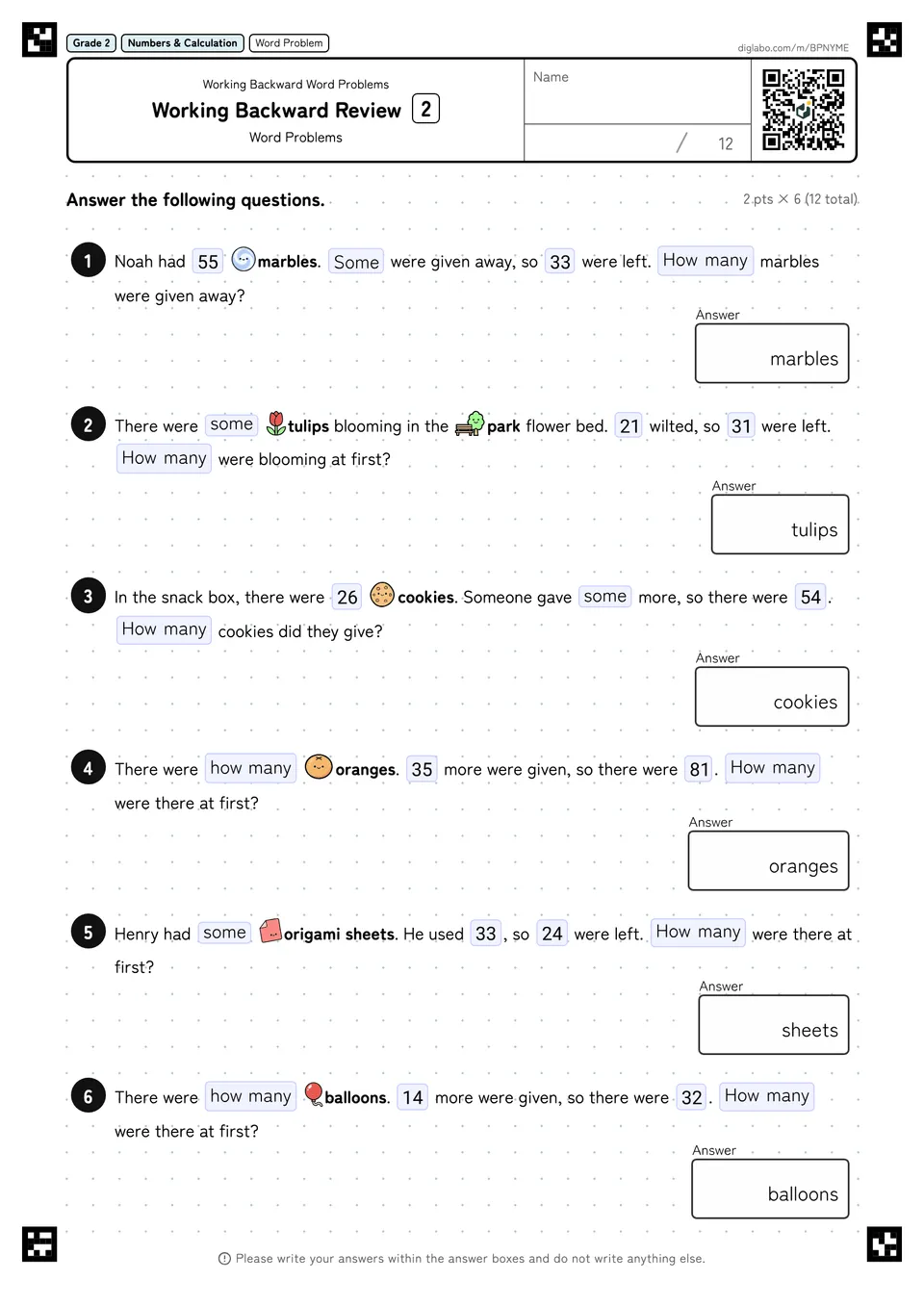
(1)Noah had 55 marbles. Some were given away, so 33 were left. How many marbles were given away? Answer □
Answer: 22marbles
(2)There were some tulips blooming in the park flower bed. 21 wilted, so 31 were left. How many were blooming at first? Answer □
Answer: 52tulips
(3)In the snack box, there were 26 cookies. Someone gave some more, so there were 54. How many cookies did they give? Answer □
Answer: 28cookies
(4)There were how many oranges. 35 more were given, so there were 81. How many were there at first? Answer □
Answer: 46oranges
(5)Henry had some origami sheets. He used 33, so 24 were left. How many were there at first? Answer □
Answer: 57sheets
(6)There were how many balloons. 14 more were given, so there were 32. How many were there at first? Answer □
Answer: 18balloons


