Math Drills
Patterns of Change
C-3Word Problems (Arrangement of Figures)

You can hand this out in class or share it on social media for free. Usage rules
What this worksheet covers
- Topic
- Patterns of Change
- Worksheet
- Patterns of Change
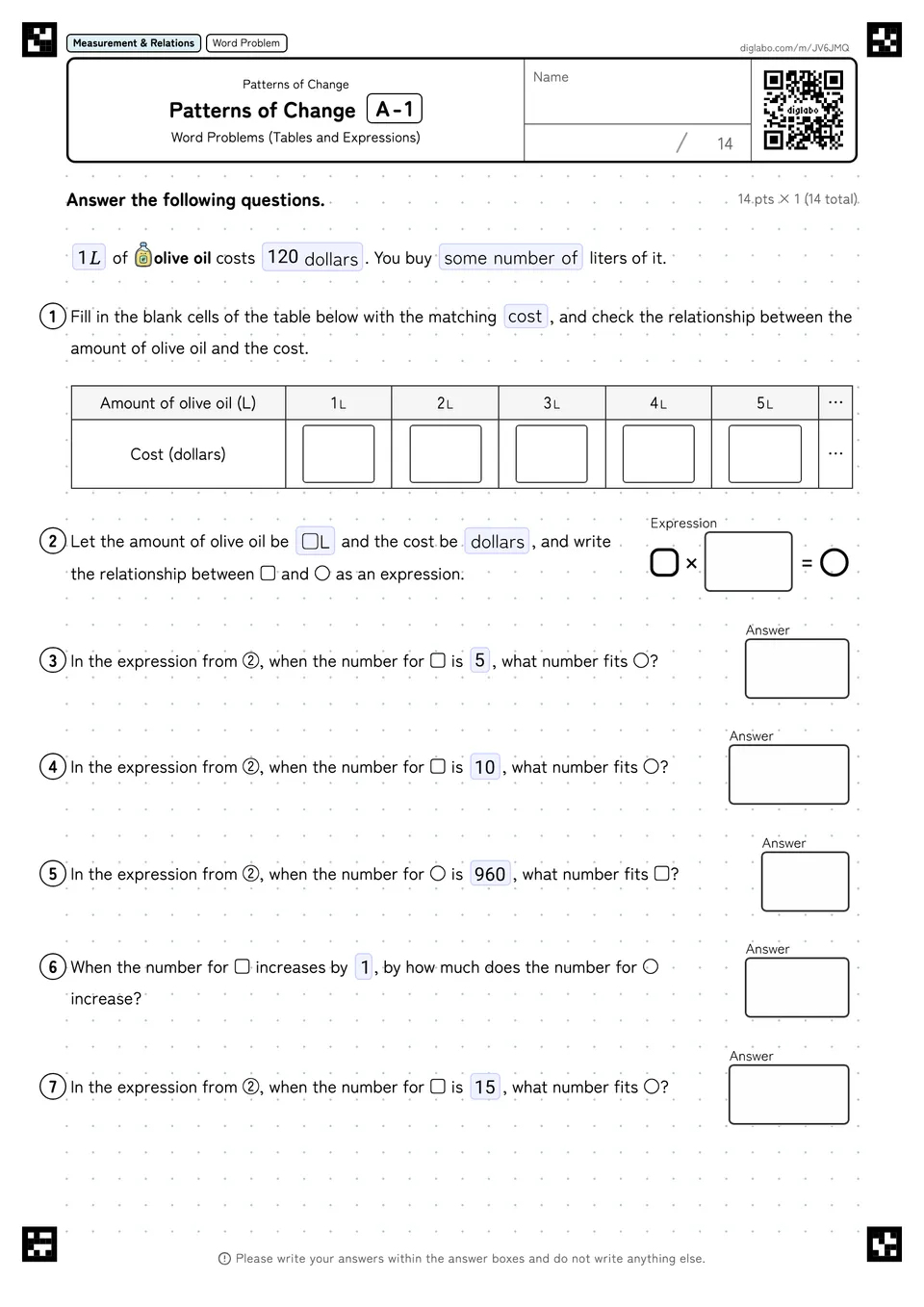
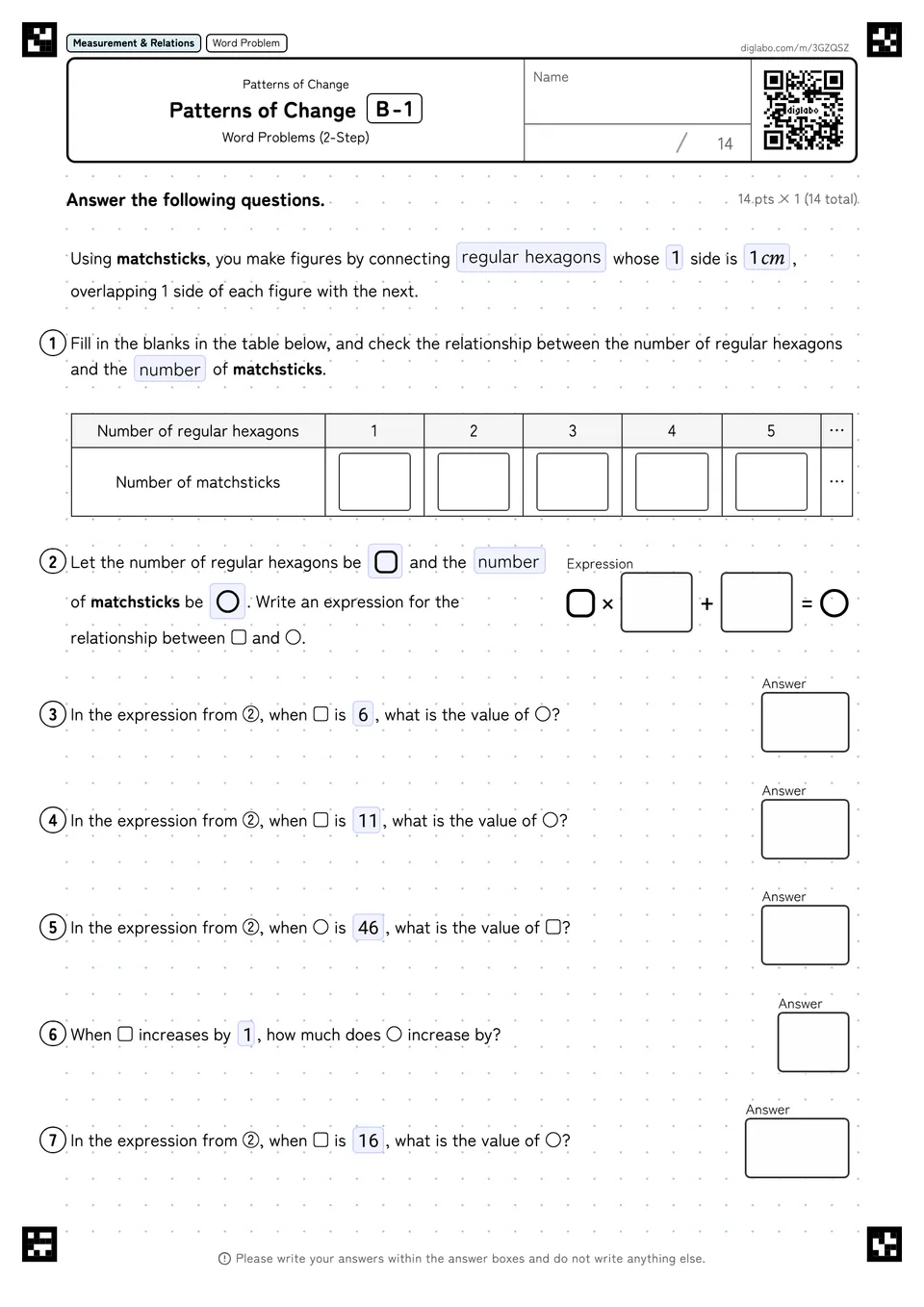
Beads laid out as a regular polygon, squares joined in Patterns of Shapes (Matchsticks), square tables pushed together so that people can be counted: these Word Problems organize the relation between two quantities into a table and then into a formula. Blank cells get filled, and the work reaches a two-step rule table where a number is added on after the multiplying.
Read more
The first figure met, four sticks to one square or four people to one table, gets used as the multiplier just as it stands. Count on the table how much the circle grows when the box goes up by 1, and if that figure matches the multiplier in the formula, the formula is right whatever the question.
A single lesson makes up the whole unit. From Multiplication of Decimals (Calculations) the numbers handled turn from whole numbers into decimals, and the expressions come ready-made.
- Patterns of Shapes (Beads)2 questions
- Patterns of Shapes (Matchsticks)1 question
- Patterns of Shapes (Tables and People)2 questions
Questions & answers
Problems and answers on this worksheet
These are the problems in “Patterns of Change”, shown with their answers.
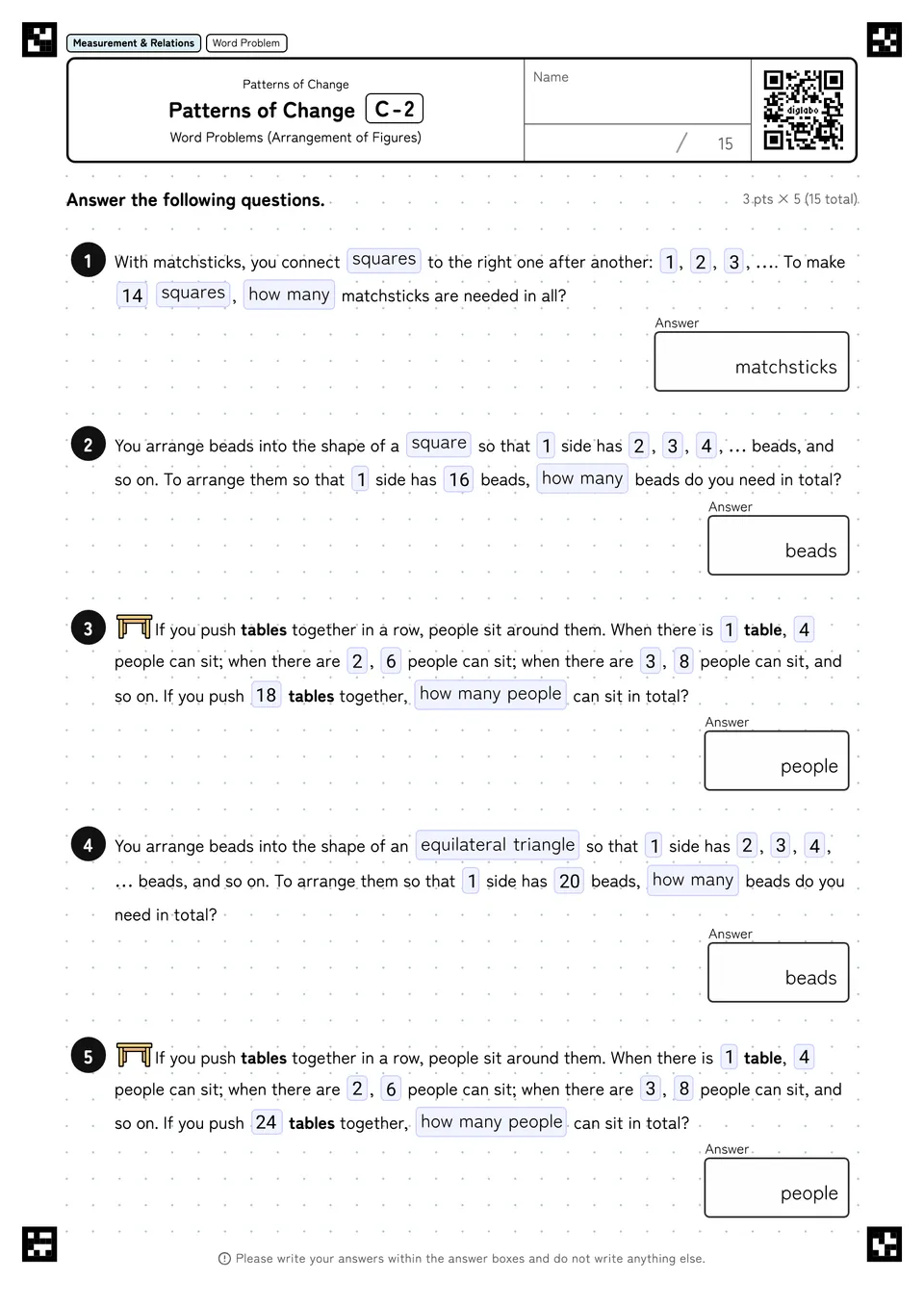
(1)If you push tables together in a row, people sit around them. When there is 1 table, 4 people can sit; when there are 2, 6 people can sit; when there are 3, 8 people can sit, and so on. If you push 10 tables together, how many people can sit in total? Answer □
Answer: 22people
(2)You arrange beads into the shape of an equilateral triangle so that 1 side has 2, 3, 4, ⋯ beads, and so on. To arrange them so that 1 side has 18 beads, how many beads do you need in total? Answer □
Answer: 51beads
(3)You arrange beads into the shape of an equilateral triangle so that 1 side has 2, 3, 4, ⋯ beads, and so on. To arrange them so that 1 side has 15 beads, how many beads do you need in total? Answer □
Answer: 42beads
(4)If you push tables together in a row, people sit around them. When there is 1 table, 4 people can sit; when there are 2, 6 people can sit; when there are 3, 8 people can sit, and so on. If you push 22 tables together, how many people can sit in total? Answer □
Answer: 46people
(5)With matchsticks, you connect squares to the right one after another: 1, 2, 3, ⋯. To make 15 squares, how many matchsticks are needed in all? Answer □
Answer: 46matchsticks