
Math Drills · Grade 2 (Elementary School)
Times Tables: 6 to 9 and 1
8 free maths worksheets for “Times Tables: 6 to 9 and 1” in Grade 2 (Elementary School). Download the question and answer PDFs and print them, no sign-up needed.
WorksheetsWhat this unit covers
The tables for 6 through 9, and then the one times table, complete the full set. Calculation for the product and Fill in the Blank for the multiplier or the number being multiplied come round again and again, until awkward rows such as the seven and eight times tables can be said aloud.
Mixing the six and eight times tables is frequent, as in answering 48 rather than 42 for 7 × 6. Similar-sounding facts pull the child off, and the answer lands just above or below the correct product. In the one times table, answers such as 1 for 1 × 7 show the multiplier being ignored.
The tables to memorize expand here to 6 through 9 and then the 1 times table, rounding out the full multiplication table. The way of memorizing built up in Times Tables: 5, 2, 3, and 4 carries over unchanged, and the completed table leads into The 10, 11, and 12 Times Tables, which reach past 10.
Learning steps
Worksheets
The 6 Times Table
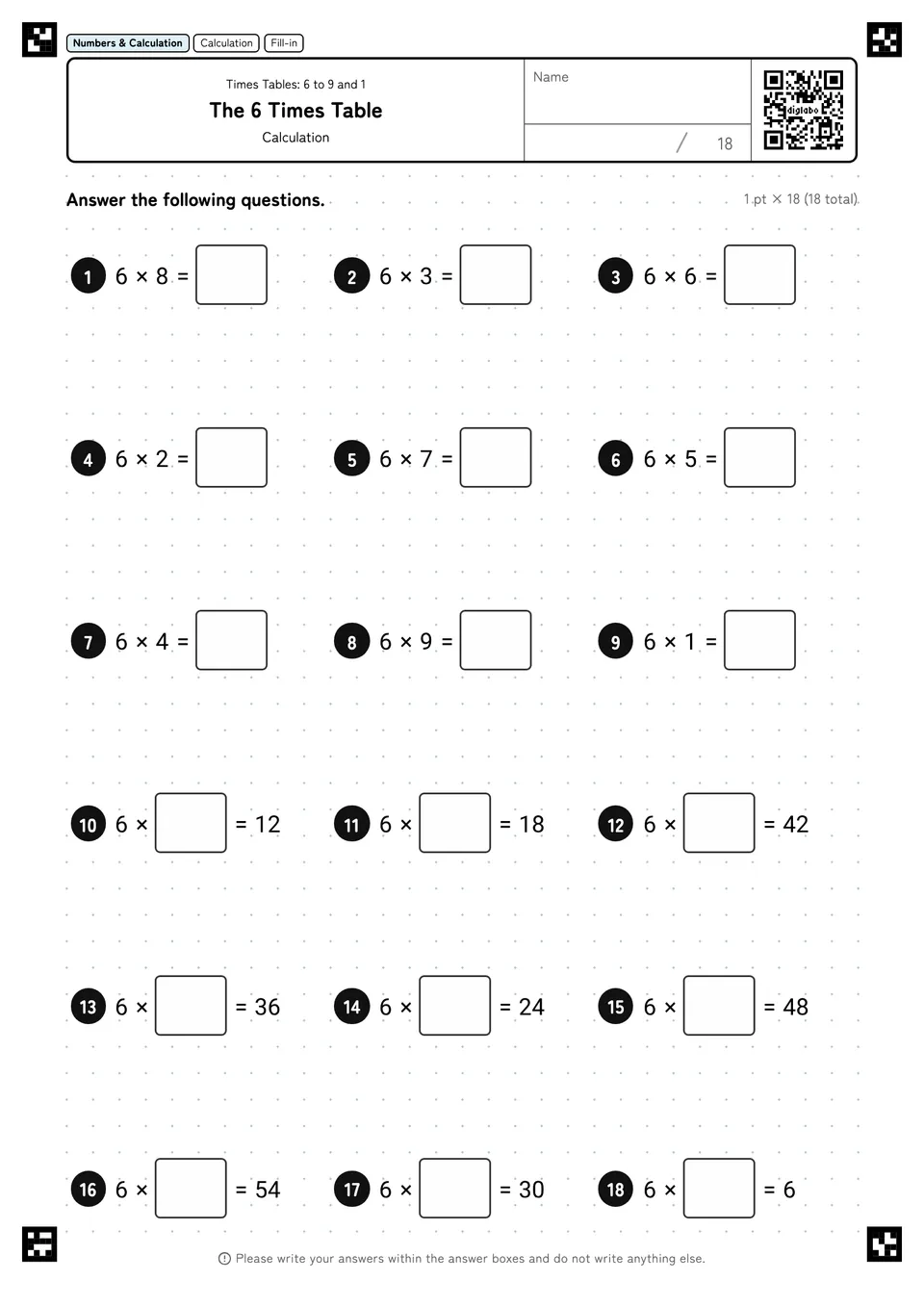
Calculation
- Calculation9 questions
- Fill in the Blank9 questions
The 7 Times Table
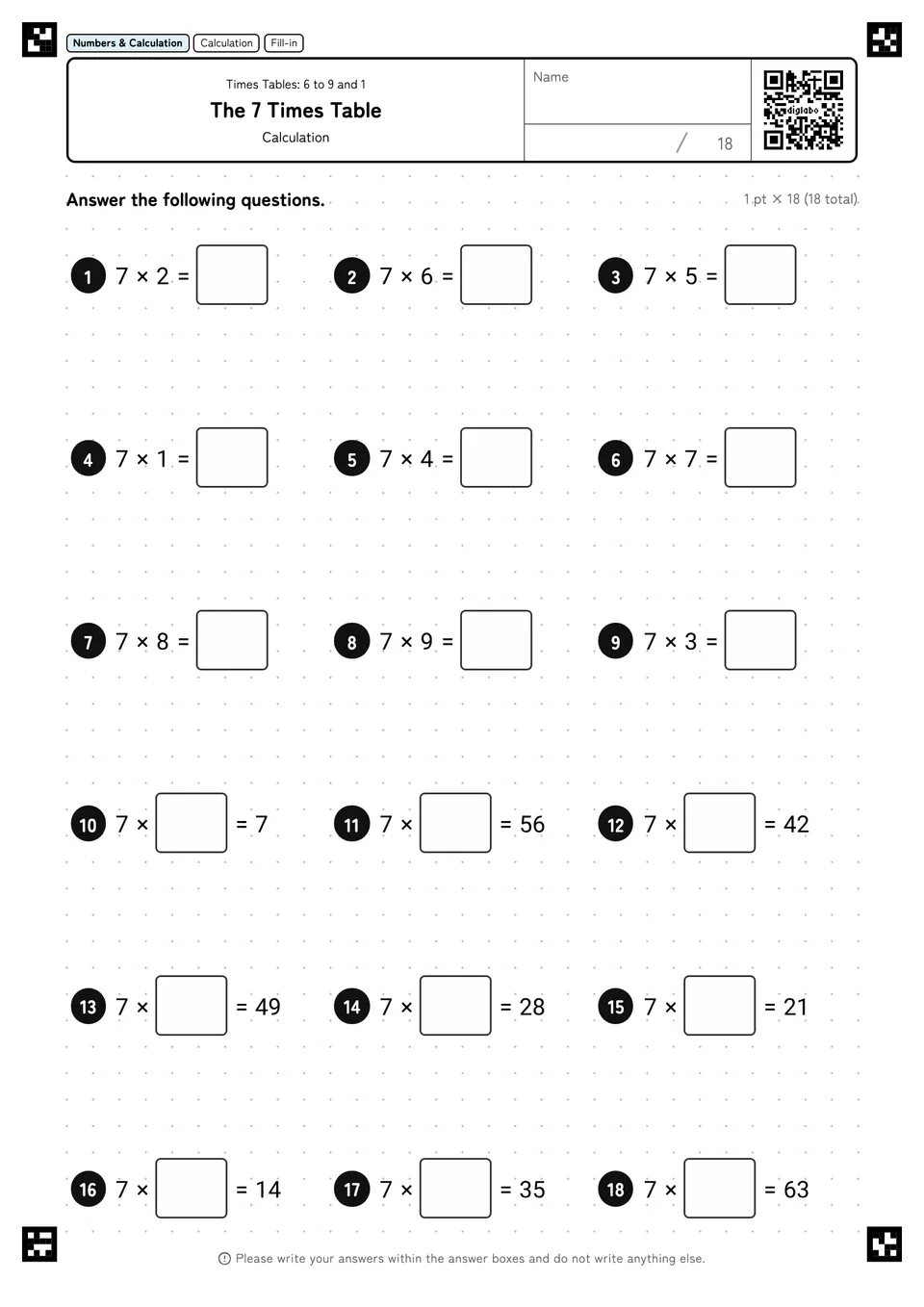
Calculation
- Calculation9 questions
- Fill in the Blank9 questions
The 8 Times Table
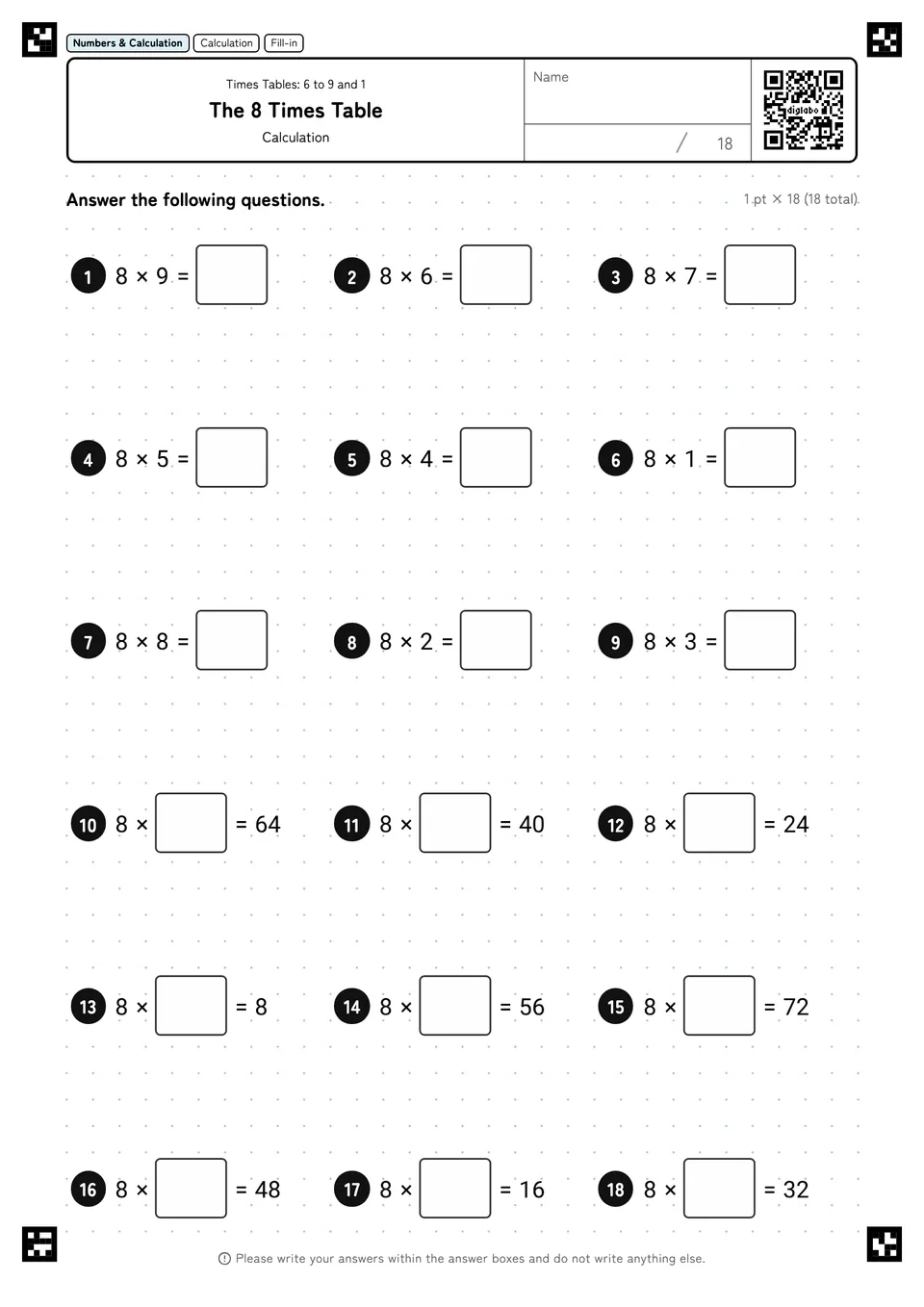
Calculation
- Calculation9 questions
- Fill in the Blank9 questions
The 9 Times Table
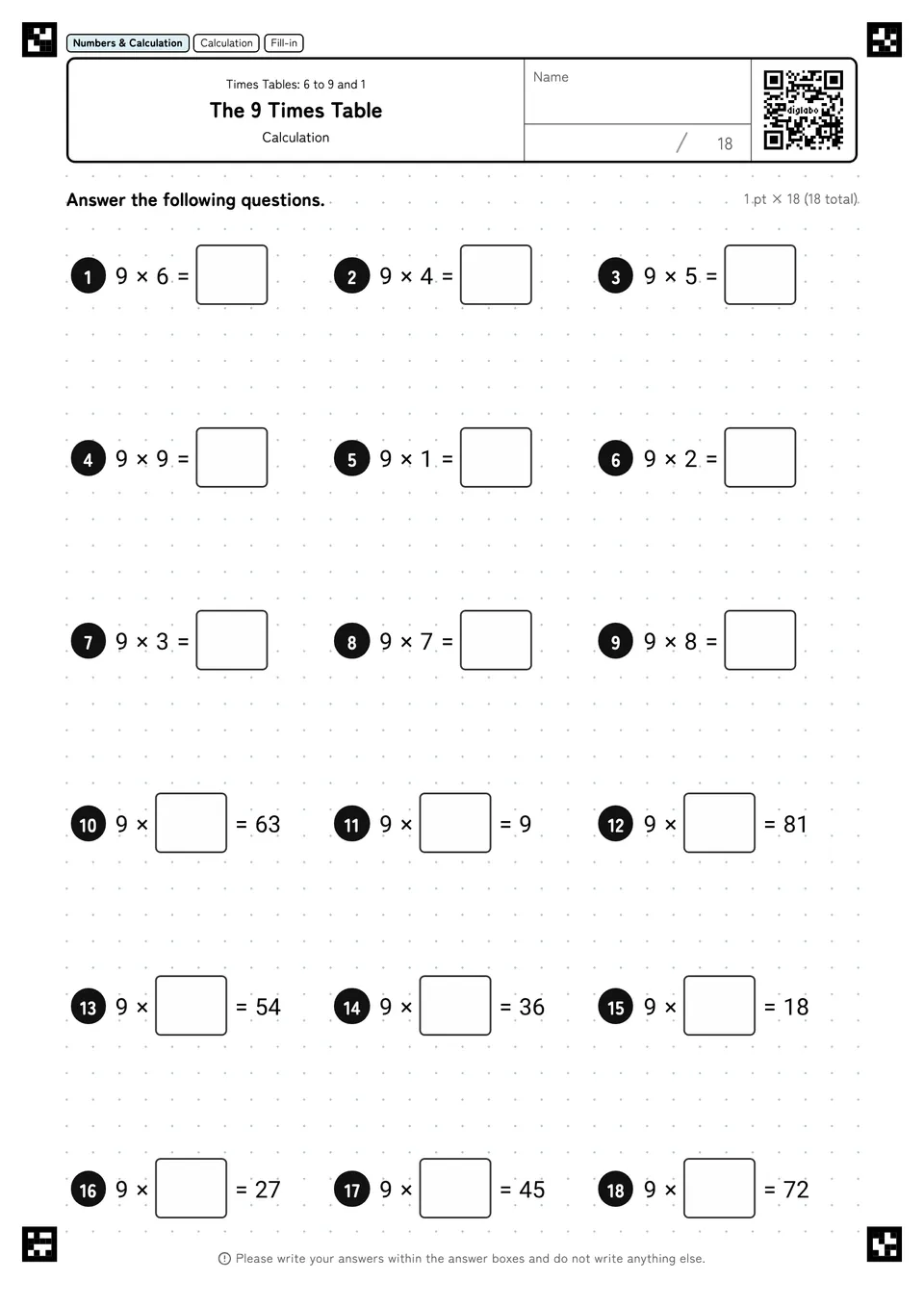
Calculation
- Calculation9 questions
- Fill in the Blank9 questions
The 1 Times Table
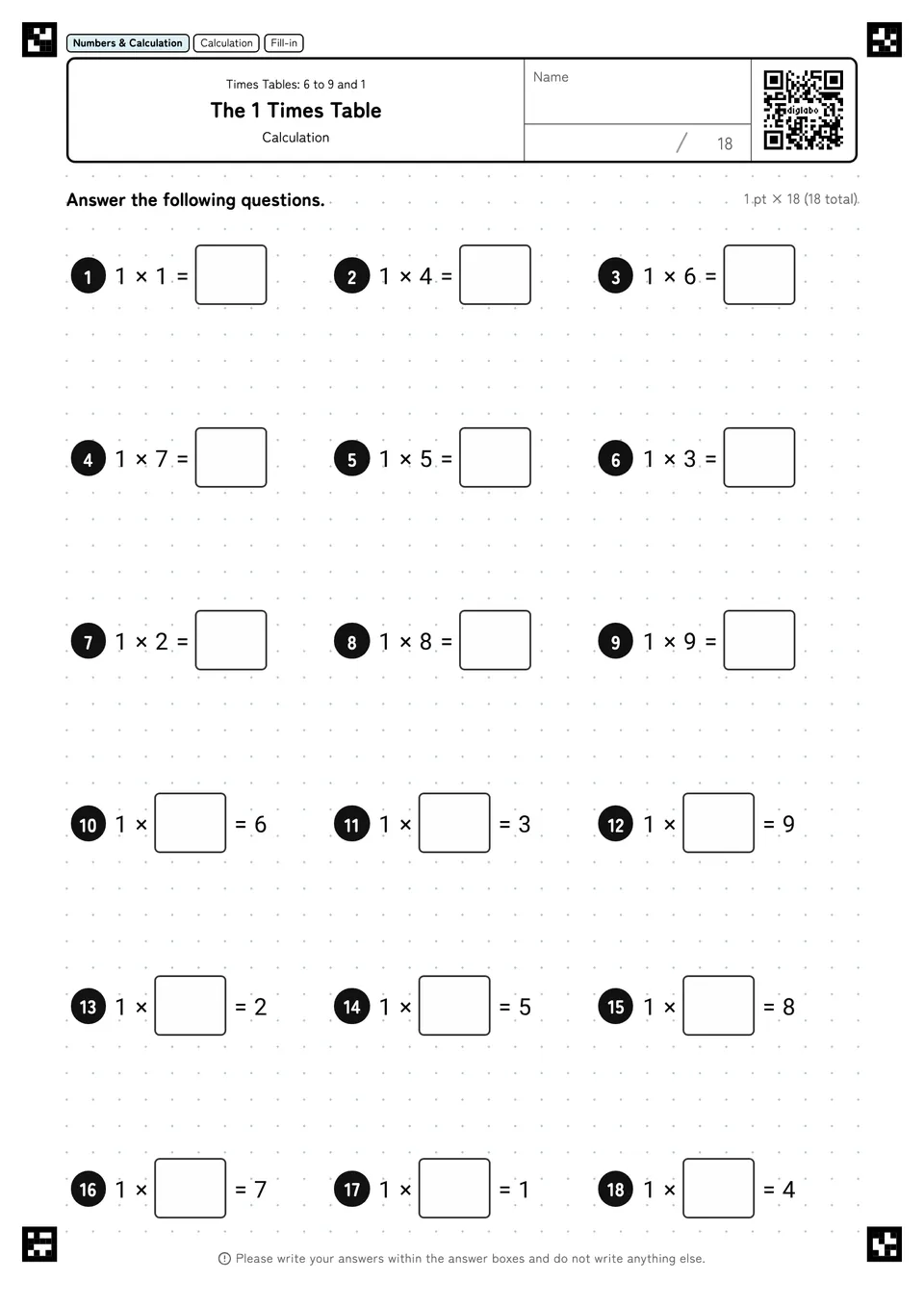
Calculation
- Calculation9 questions
- Fill in the Blank9 questions
Summary Prints
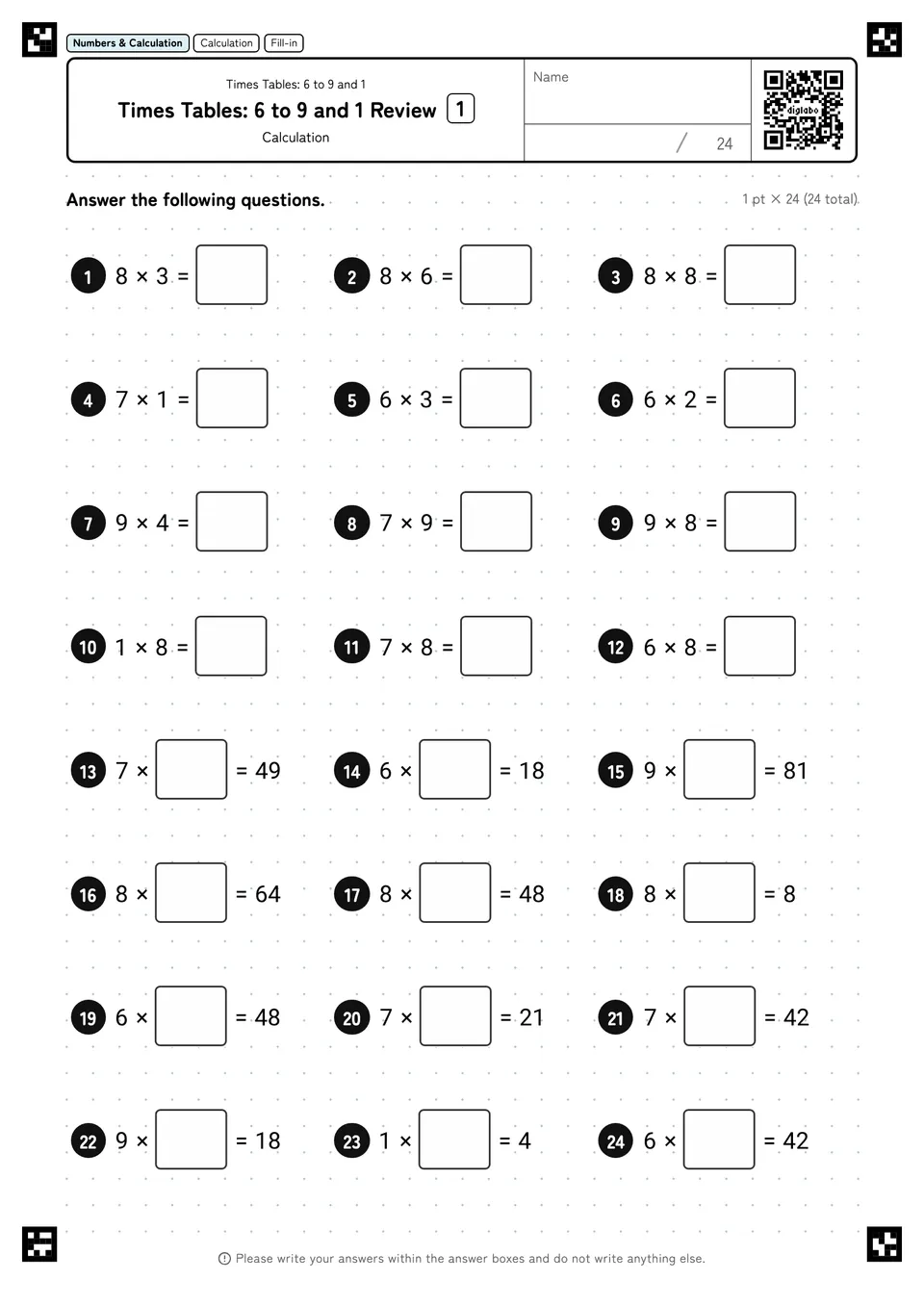 3
3Calculation
- The 6 Times Table · Calculation3 questions
- The 7 Times Table · Calculation3 questions
- The 8 Times Table · Calculation3 questions
- The 9 Times Table · Calculation2 questions
- The 1 Times Table · Calculation1 question
- The 6 Times Table · Fill in the Blank3 questions
- The 7 Times Table · Fill in the Blank3 questions
- The 8 Times Table · Fill in the Blank3 questions
- The 9 Times Table · Fill in the Blank2 questions
- The 1 Times Table · Fill in the Blank1 question
Related study guides
- Teaching Multiples and Divisors — Why 1 and 12 Go Missing From "The Divisors of 12"
Ask your child to list the divisors of 12, and they stop at 2, 3, 4, 6 — 1 and 12 never show up. The cause isn't calculation skill. It's that your child hasn't settled on how far to search for divisors. Here's how to teach them to see it as a set.
- Why Kids Who Know Their Times Tables Still Trip Up — The Steps of Column Multiplication
Just because a child can say their times tables doesn't mean column multiplication comes easily. Plenty of children get the times-table part right and still stumble on the steps of writing it in column form. A mistake in column multiplication tends to get blamed on the times tables. Usually, though, it's a different step that's the problem.
- Long Division — Fixing "Place, Multiply, Subtract, Bring Down"
Have you ever looked at a long division problem and wondered where to even start explaining "place, multiply, subtract, bring down"? Most children who stumble on long division aren't struggling with their times tables. There are four steps — place, multiply, subtract, bring down — and every time, they're just skipping one of them somewhere.
- Learning the Times Tables — Beyond Rote Chanting, and the Rows That Trip Children Up
Chanting alone tends to stall at the 6, 7 and 8 rows. Here's the order that works, what the hardest facts have in common, and how to run chanting and understanding in parallel at home.
- Where Division with Remainders Goes Wrong — Fixing "The Remainder Is Too Big"
Mistakes like "17 ÷ 5 = 2 remainder 7" follow a clear pattern. Here are the three causes, the link to the times tables, and how to handle remainders in word problems.
Frequently asked questions
- What do the “Times Tables: 6 to 9 and 1” worksheets for Grade 2 (Elementary School) practice?
- They cover problems such as Calculation, Fill in the Blank.
- How many “Times Tables: 6 to 9 and 1” worksheets are there for Grade 2 (Elementary School)?
- 8 worksheets are free to use. Every one is a printable PDF and comes with an answer key.