Math Drills
2-Digit ÷ 1-Digit
E-1Word Problems

You can hand this out in class or share it on social media for free. Usage rules
What this worksheet covers
- Worksheet
- 2-Digit ÷ 1-Digit
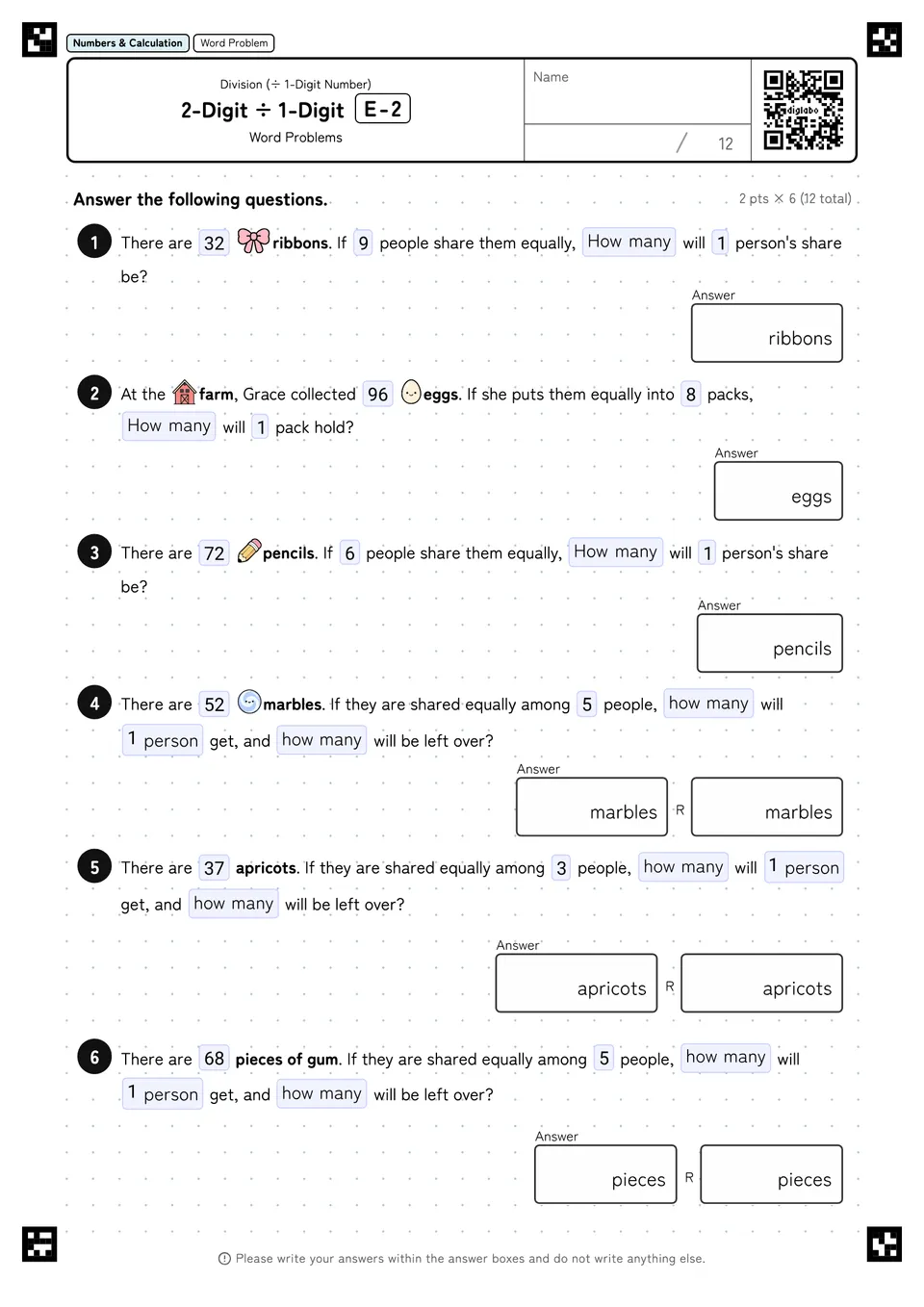
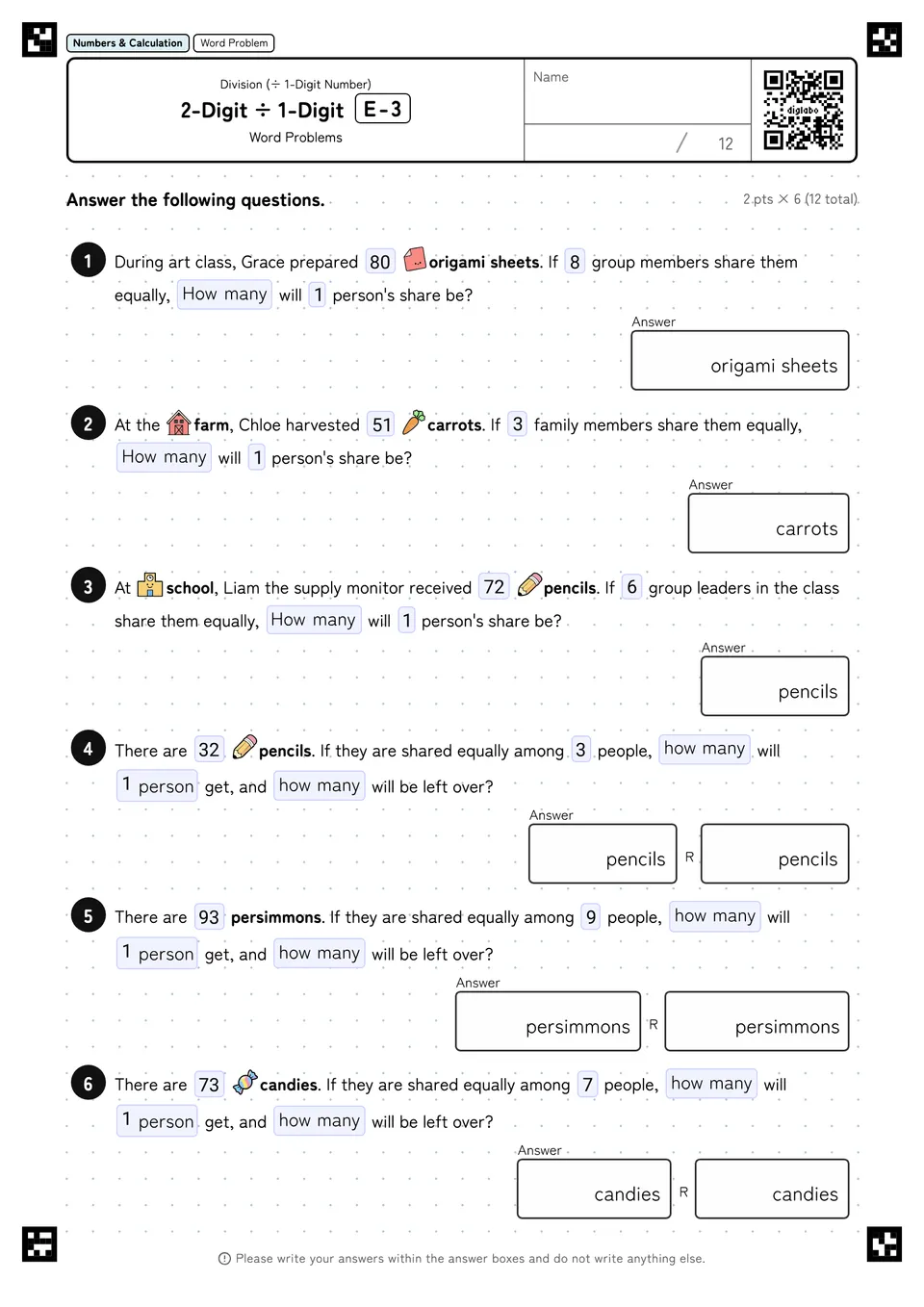
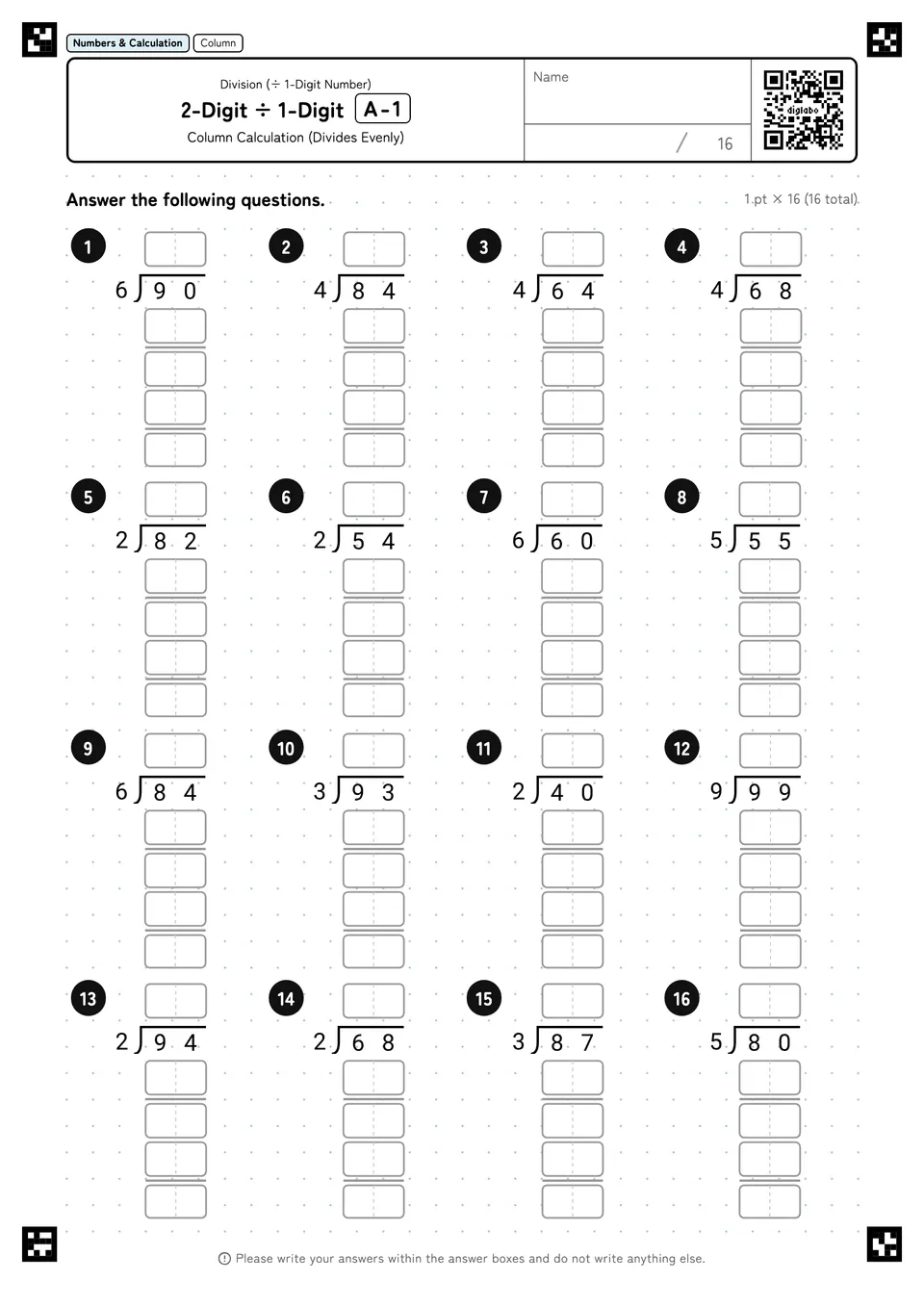
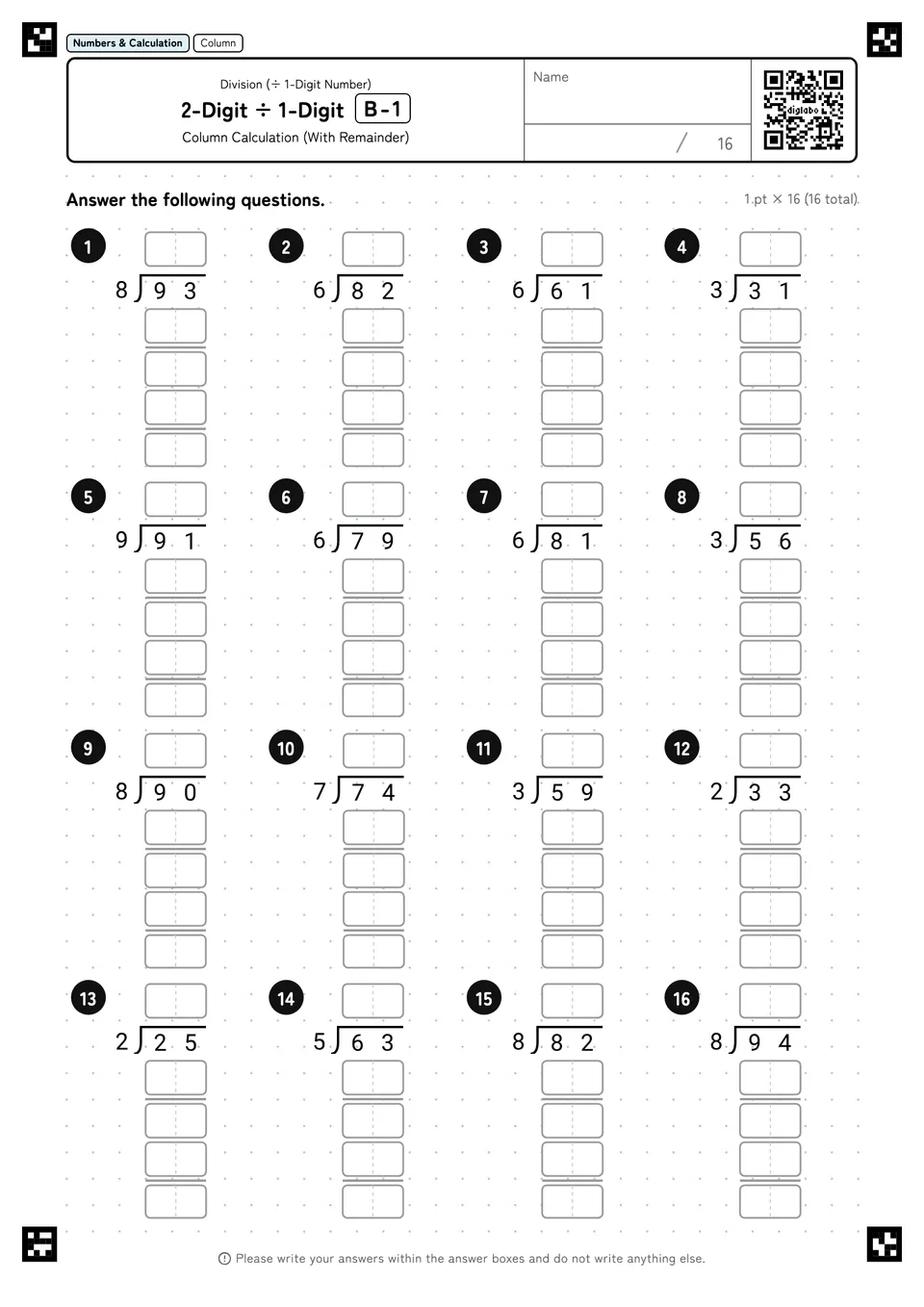
Only items with a two-digit dividend and a single-digit divisor are gathered. No Remainder (Column Calculation) and With a Remainder (Column Calculation) are stacked vertically, and the quotients in No Remainder (Calculation) run from ten into the forties. Fill in the Blank, hiding one of the figures, is mixed in, and Word Problems (No Remainder) and Word Problems (With a Remainder) raise expressions out of scenes of equal sharing.
Read more
In With a Remainder (Calculation) and Word Problems (With a Remainder) the quotient and the remainder are written as two separate things. Reckoning that what is left over can be handed out too, children raise the quotient by one and leave the remainder box empty. The quotient multiplied by the divisor must never exceed the dividend, and exceeding it means one quotient too many was set.
This is the entrance to Division (÷ 1-Digit Number). In 3-Digit ÷ 1-Digit the dividend gains another digit. What grows is only the number of rows brought down, and turning the same hand each time a quotient is set stays as it is.
- Word Problems (No Remainder)3 questions
- Word Problems (With a Remainder)3 questions
Questions & answers
Problems and answers on this worksheet
These are the problems in “Division (÷ 1-Digit Number)”, shown with their answers.
(1)There are 84 buttons. If 6 people share them equally, How many will 1 person's share be? Answer □
Answer: 14buttons
(2)There are 36 eggs. If 3 people share them equally, How many will 1 person's share be? Answer □
Answer: 12eggs
(3)There are 98 bottles of juice. If 7 people share them equally, How many will 1 person's share be? Answer □
Answer: 14bottles of juice
(4)There are 73 beads. If they are shared equally among 5 people, how many will 1 person get, and how many will be left over? Answer □R□
Answer: 14beads, 3beads
(5)There are 53 apples. If they are shared equally among 4 people, how many will 1 person get, and how many will be left over? Answer □R□
Answer: 13apples, 1apples
(6)There are 98 oranges. If they are shared equally among 9 people, how many will 1 person get, and how many will be left over? Answer □R□
Answer: 10oranges, 8oranges
What to do next
More worksheets in this unit
 2-Digit ÷ 1-Digit2-Digit ÷ 1-Digit Column Calculation (With Remainder)
 2-Digit ÷ 1-Digit2-Digit ÷ 1-Digit Calculation
 2-Digit ÷ 1-Digit2-Digit ÷ 1-Digit Fill in the Blank
 3-Digit ÷ 1-Digit3-Digit ÷ 1-Digit Column Calculation (Divides Evenly)
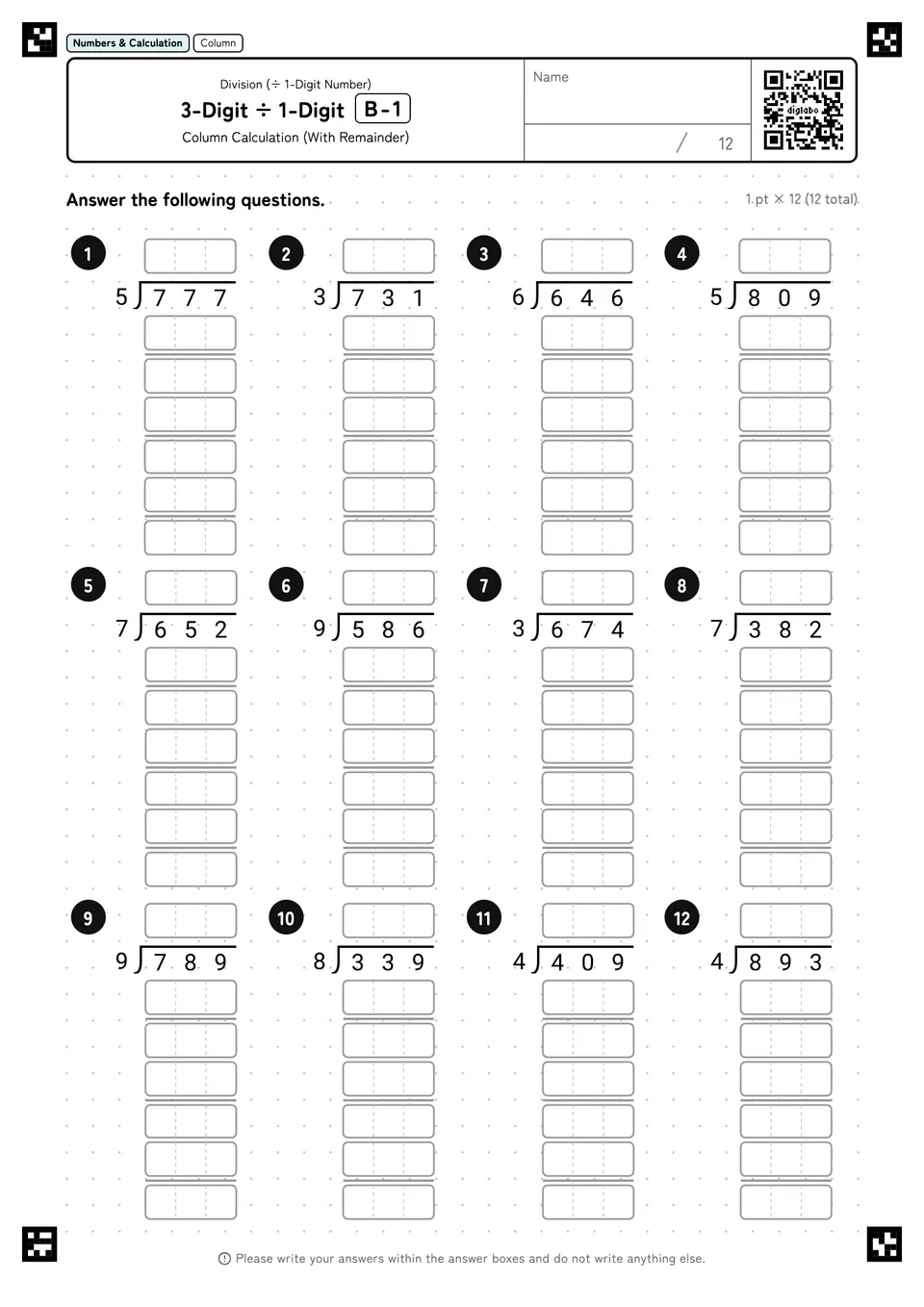 3-Digit ÷ 1-Digit3-Digit ÷ 1-Digit Column Calculation (With Remainder)
 3-Digit ÷ 1-Digit3-Digit ÷ 1-Digit Calculation
 3-Digit ÷ 1-Digit3-Digit ÷ 1-Digit Fill in the Blank
 3-Digit ÷ 1-Digit3-Digit ÷ 1-Digit Word Problems
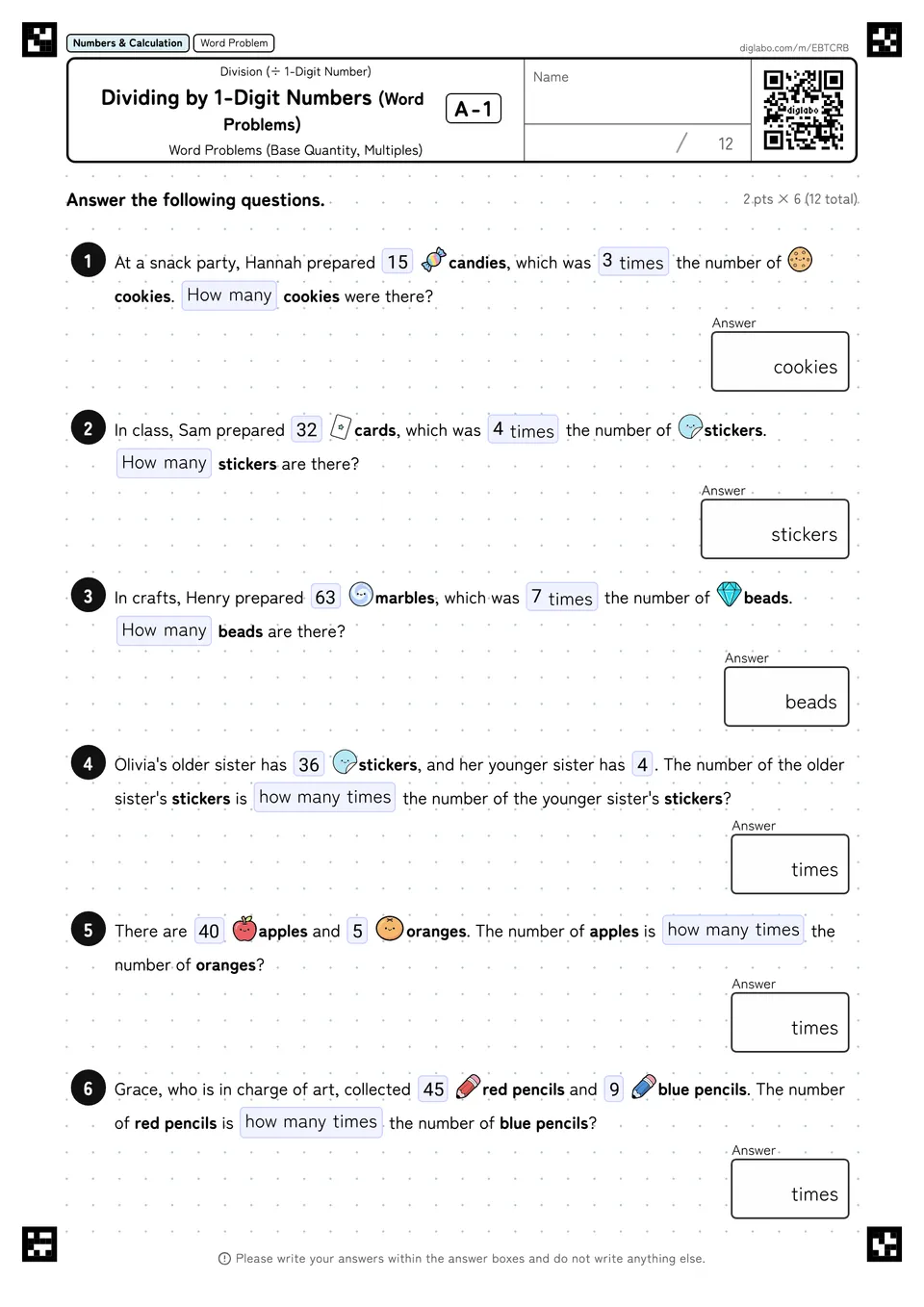 Dividing by 1-Digit Numbers (Word Problems)Dividing by 1-Digit Numbers (Word Problems) Word Problems (Base Quantity, Multiples)
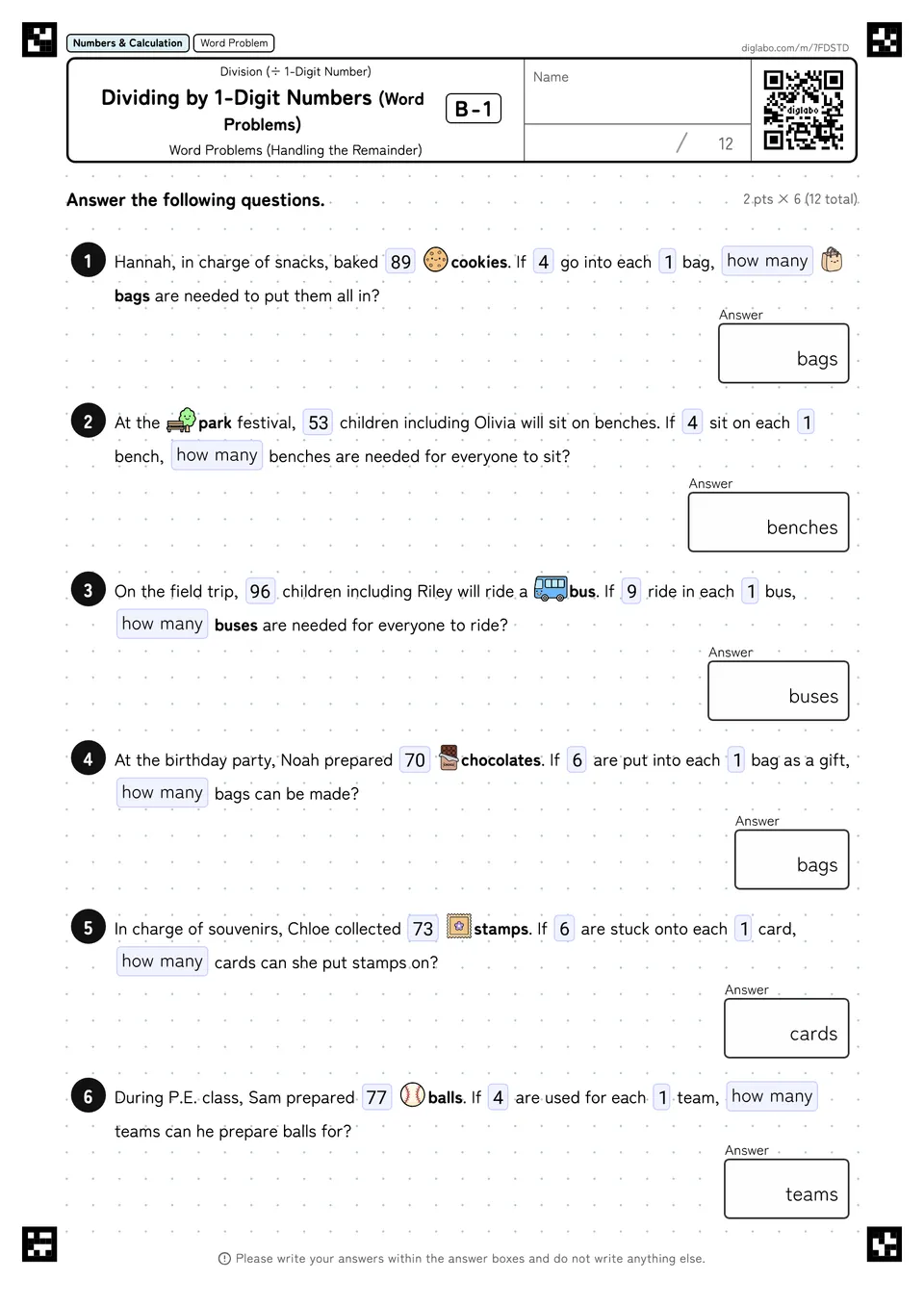 Dividing by 1-Digit Numbers (Word Problems)Dividing by 1-Digit Numbers (Word Problems) Word Problems (Handling the Remainder)
 Dividing by 1-Digit Numbers (Word Problems)Dividing by 1-Digit Numbers (Word Problems) Word Problems (Large Numbers)
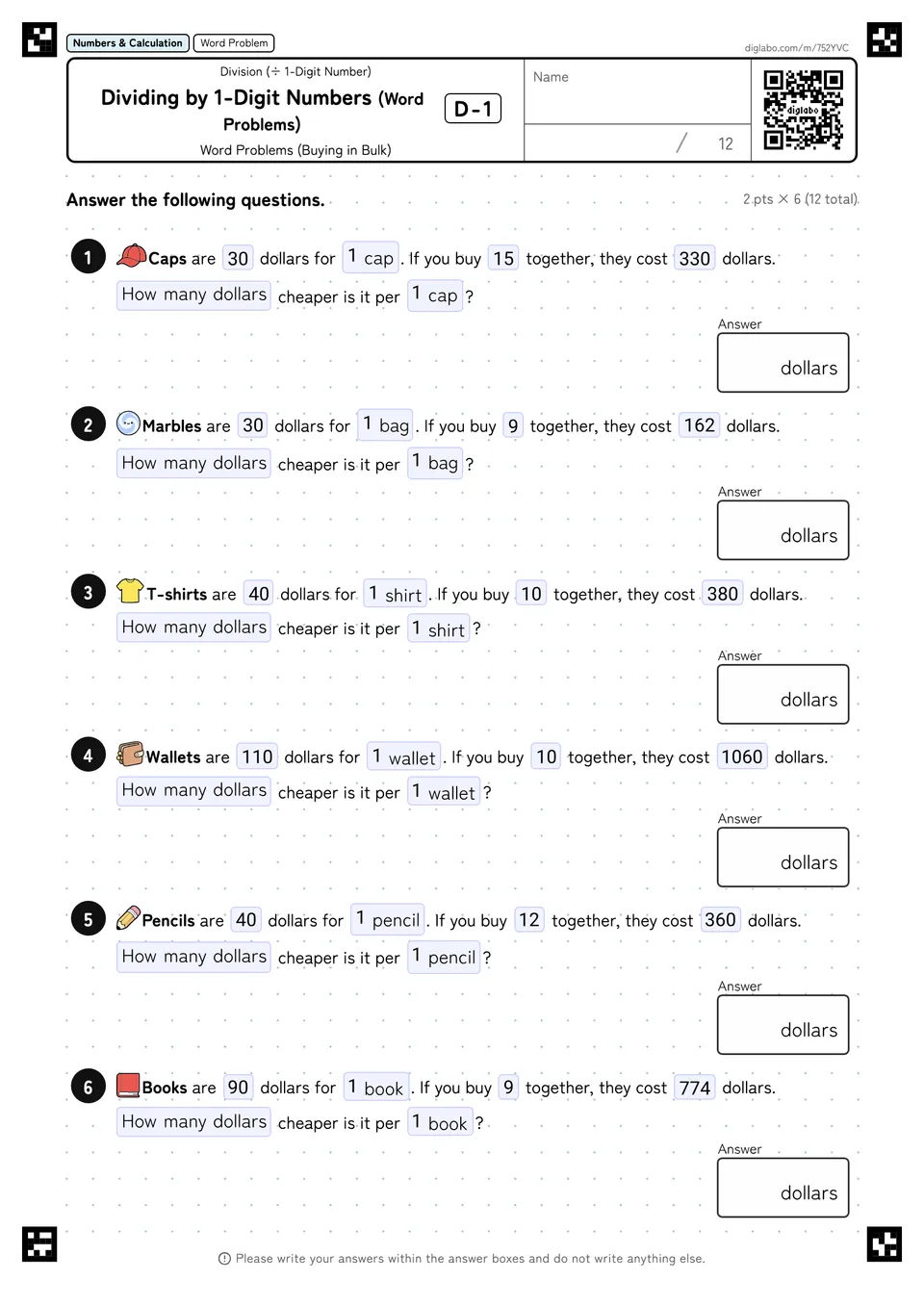 Dividing by 1-Digit Numbers (Word Problems)Dividing by 1-Digit Numbers (Word Problems) Word Problems (Buying in Bulk)
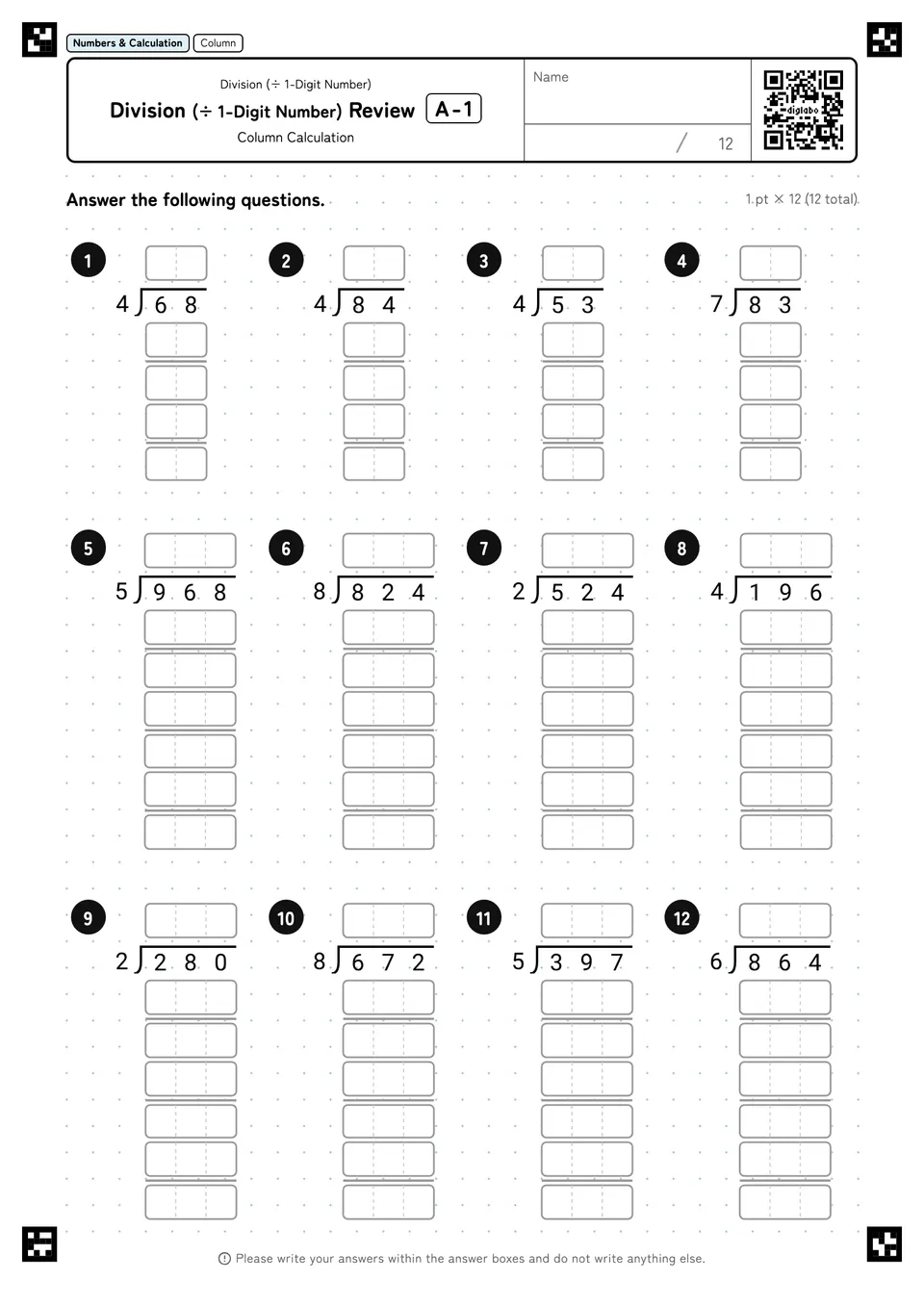 Division (÷ 1-Digit Number) ReviewDivision (÷ 1-Digit Number) Review Column Calculation
 Division (÷ 1-Digit Number) ReviewDivision (÷ 1-Digit Number) Review Calculation
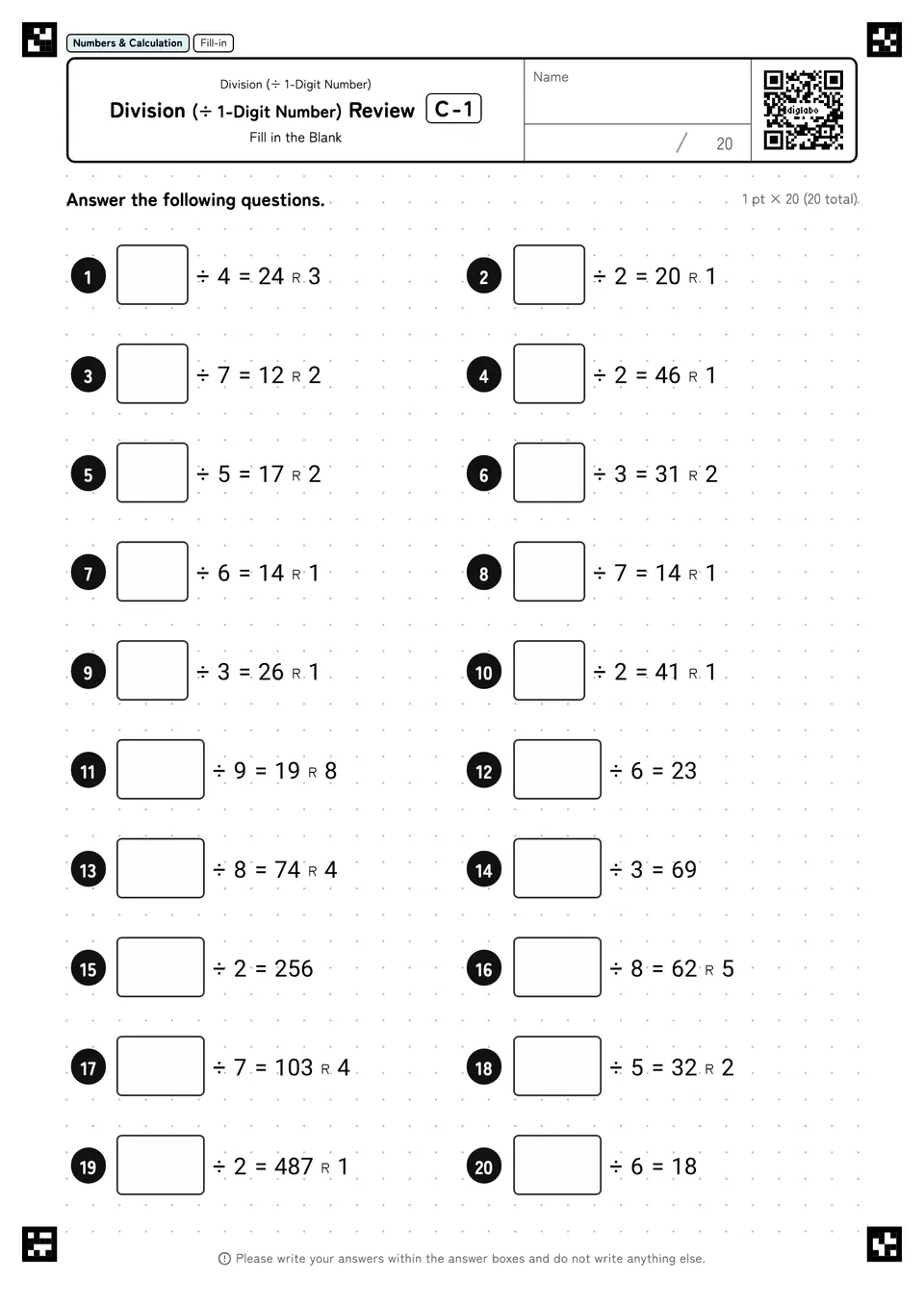 Division (÷ 1-Digit Number) ReviewDivision (÷ 1-Digit Number) Review Fill in the Blank
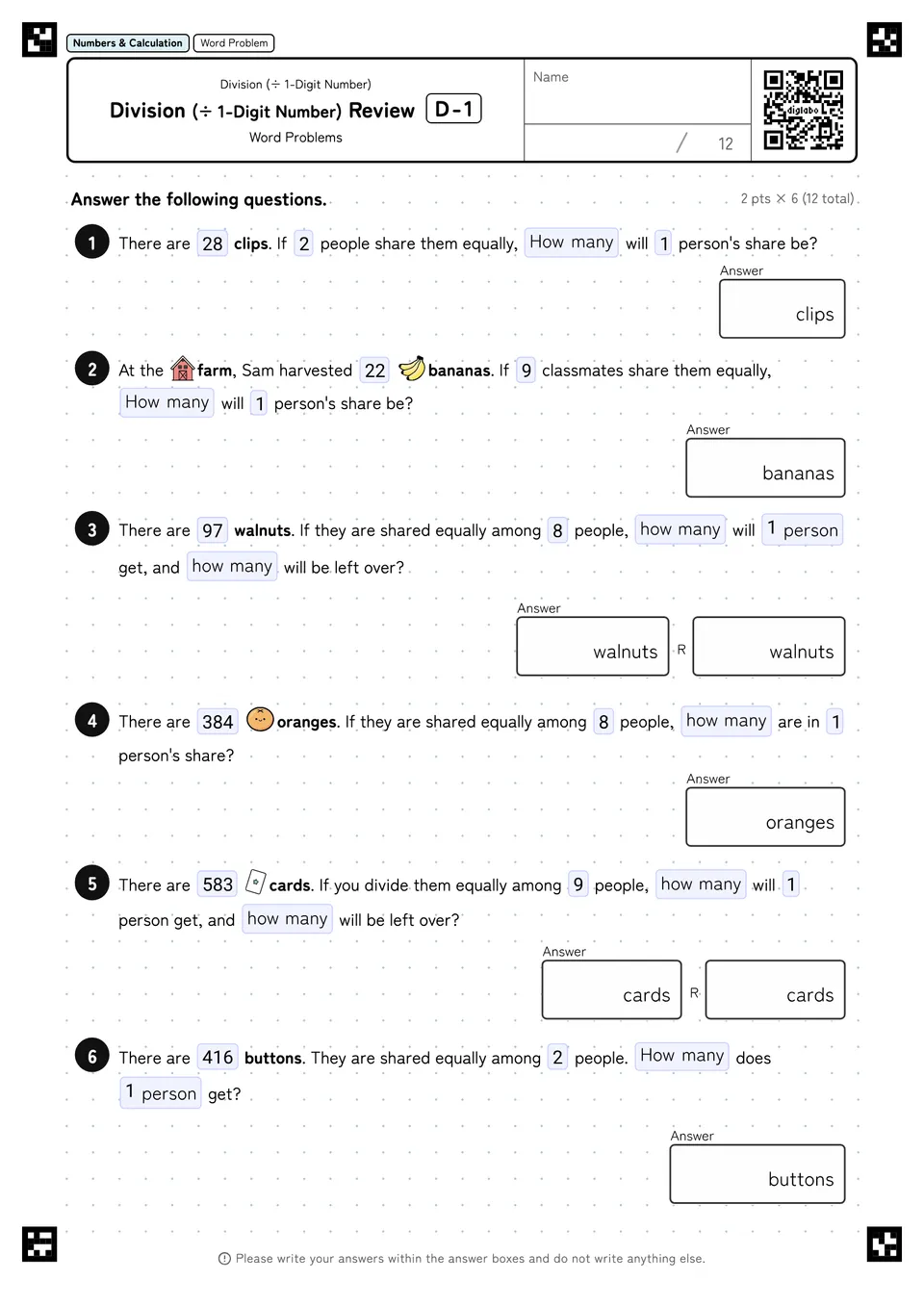 Division (÷ 1-Digit Number) ReviewDivision (÷ 1-Digit Number) Review Word Problems
 Division (÷ 1-Digit Number) ReviewDivision (÷ 1-Digit Number) Review Word Problems (Base Quantity, etc.)
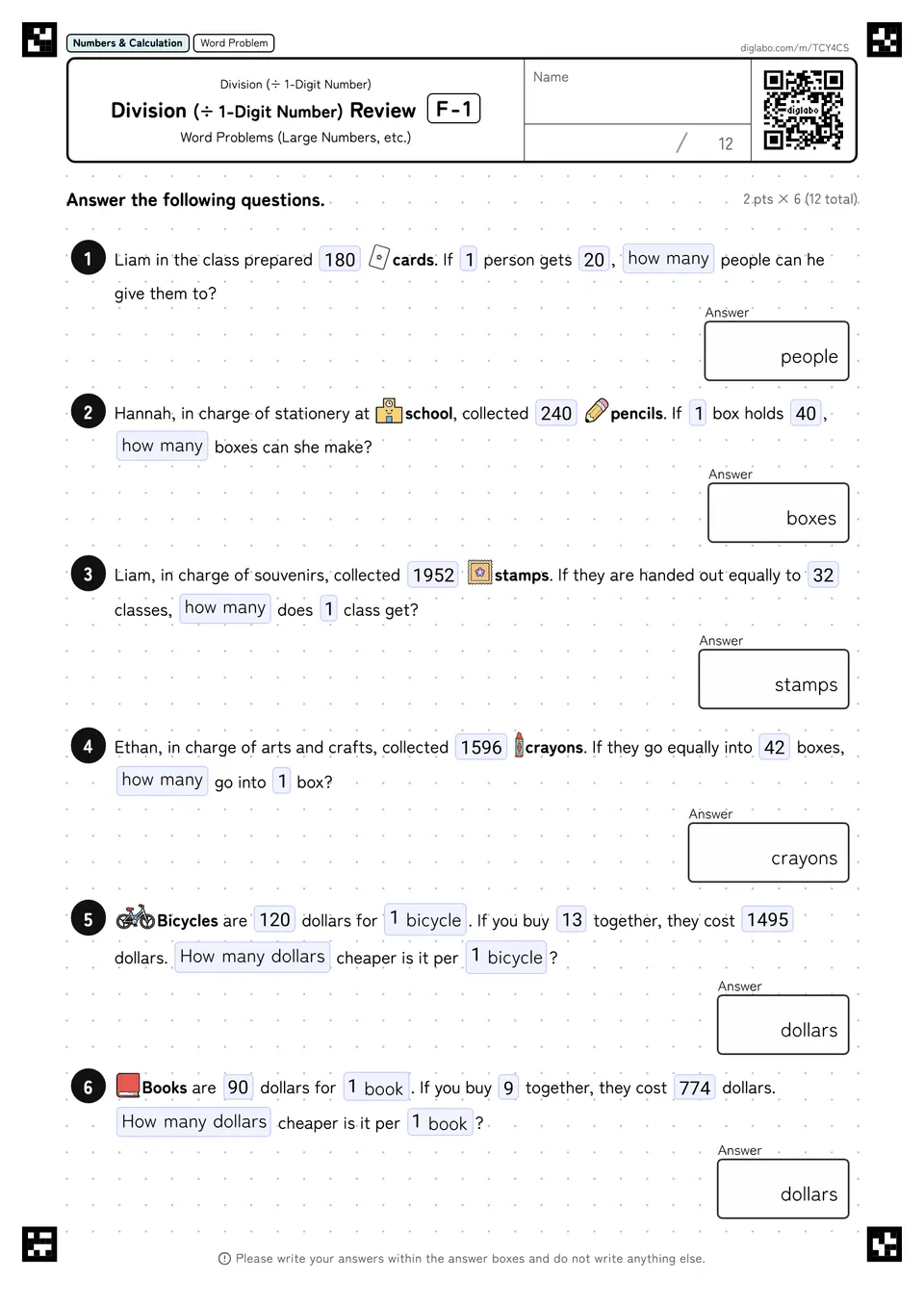 Division (÷ 1-Digit Number) ReviewDivision (÷ 1-Digit Number) Review Word Problems (Large Numbers, etc.)