
Math Drills · Grade 4 (Elementary School)
Perpendicular and Parallel Lines, Quadrilaterals
15 free maths worksheets for “Perpendicular and Parallel Lines, Quadrilaterals” in Grade 4 (Elementary School). Download the question and answer PDFs and print them, no sign-up needed.
WorksheetsWhat this unit covers
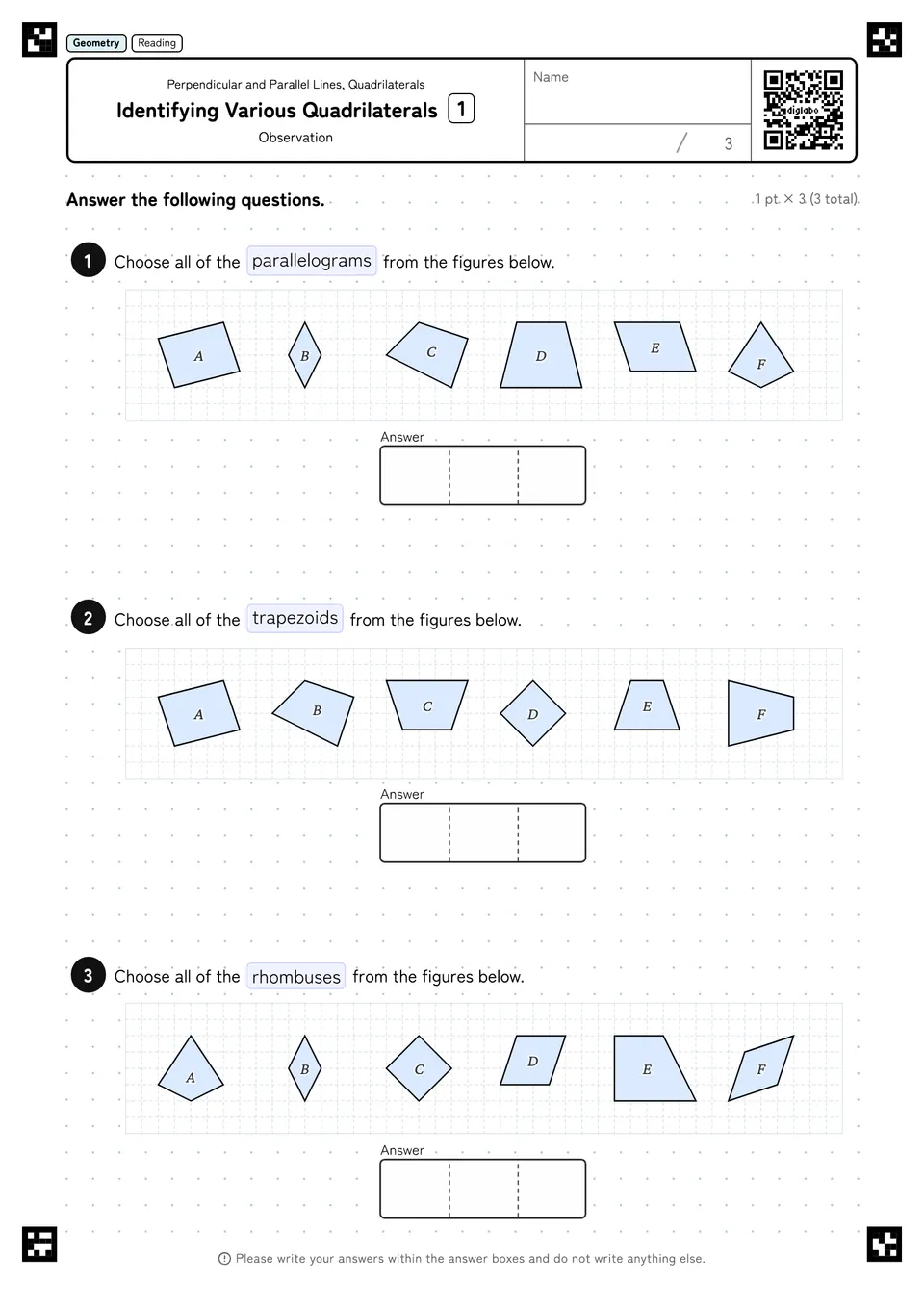
Attention turns to the relationship between two straight lines, beginning with Finding Perpendicular Lines and Finding Parallel Lines. After parallel lines and angles and The Width Between Parallel Lines, trapezoids, parallelograms and rhombuses are picked out by label, and the properties of diagonals follow in one continuous thread.
Trying to tell a parallelogram from a rhombus by equal side lengths alone leads to mixing the two up, and this is also where answers that refuse to count a square as a rhombus come from. With diagonals the two properties get swapped: a rectangle has diagonals of equal length, while a rhombus has diagonals that cross at right angles.
The skill for calculating vertical angles built in Angles is put to work on the angles formed by a pair of parallel lines, and from there this unit teaches how to tell a rhombus, a parallelogram and a trapezoid apart. This grasp of a shape's defining traits leads straight into Area in grade 5, which asks for the area of a parallelogram or a rhombus to be calculated directly.
Learning steps
- Perpendicular and Parallel LinesFinding Perpendicular LinesFinding Parallel LinesParallel Lines and Angles (Finding the Angle)Parallel Lines and Angles (Identifying Equal Angles)The Width Between Parallel Lines
- Identifying Various QuadrilateralsChoosing Trapezoids by LabelChoosing Parallelograms by LabelChoosing Rhombuses by Label
- Features of Parallelograms and RhombusesFeatures of ParallelogramsFeatures of Rhombuses
- DiagonalsDiagonals of a RectangleDiagonals of a Rhombus
Worksheets
Perpendicular and Parallel Lines


Identifying Various Quadrilaterals
Features of Parallelograms and Rhombuses


Related study guides
- "That's Not a Triangle If It's Facing the Wrong Way" — How to Tell Shapes Apart by Their Properties
A pointed corner facing sideways is enough for a child to say, "that's not a triangle." It's a sign they've learned shape names by overall look rather than by their properties. Here's how to teach children to tell shapes apart by the number and length of their sides, in order from grade 2 through grade 4.
Frequently asked questions
- What do the “Perpendicular and Parallel Lines, Quadrilaterals” worksheets for Grade 4 (Elementary School) practice?
- They cover problems such as Finding Perpendicular Lines, Finding Parallel Lines, Parallel Lines and Angles (Finding the Angle), Parallel Lines and Angles (Identifying Equal Angles), The Width Between Parallel Lines, Choosing Trapezoids by Label, Choosing Parallelograms by Label, Choosing Rhombuses by Label.
- How many “Perpendicular and Parallel Lines, Quadrilaterals” worksheets are there for Grade 4 (Elementary School)?
- 15 worksheets are free to use. Every one is a printable PDF and comes with an answer key.