
Math Drills · Grade 4 (Elementary School)
Rectangular Prisms and Cubes
15 free maths worksheets for “Rectangular Prisms and Cubes” in Grade 4 (Elementary School). Download the question and answer PDFs and print them, no sign-up needed.
WorksheetsWhat this unit covers
Box shapes are organized by the number of faces, edges and vertices and by which edges share a length. Perpendicular and parallel relationships between edges, between faces, and between edges and faces are examined, nets are used to match up Overlapping Edges and Overlapping Vertices, and positions on a plane and in space are described.
Many answers treat edge relationships as a choice between parallel and perpendicular, overlooking edges that neither meet nor run parallel. On a net, overlapping edges get chosen by how close they look, giving pairings that do not match once the box is folded. With Position in Space, the third number goes unwritten.
Counting edges and faces, and putting the relationship between edge and edge, or face and face, into words, is finished off here. Joining faces together into a solid is exactly the foundation Shapes of Boxes in grade 2 laid down. Deepened on rectangular prisms and cubes, this way of looking becomes the starting point for grade 5, when Prisms and Cylinders takes up other solids.
Learning steps
- Features of Rectangular Prisms and CubesFeaturesFeatures (Word Problems)Number of Vertices, Edges, and FacesEdges of the Same Length
- Perpendicular and Parallel Edges and FacesRelationship Between EdgesRelationship Between FacesRelationship Between Edges and FacesRelationship Between Faces and Edges
- Nets of SolidsOverlapping EdgesOverlapping VerticesChoosing the Sketch from the DimensionsEdge Length
- Describing PositionPosition on a PlanePosition in Space
Worksheets
Features of Rectangular Prisms and Cubes
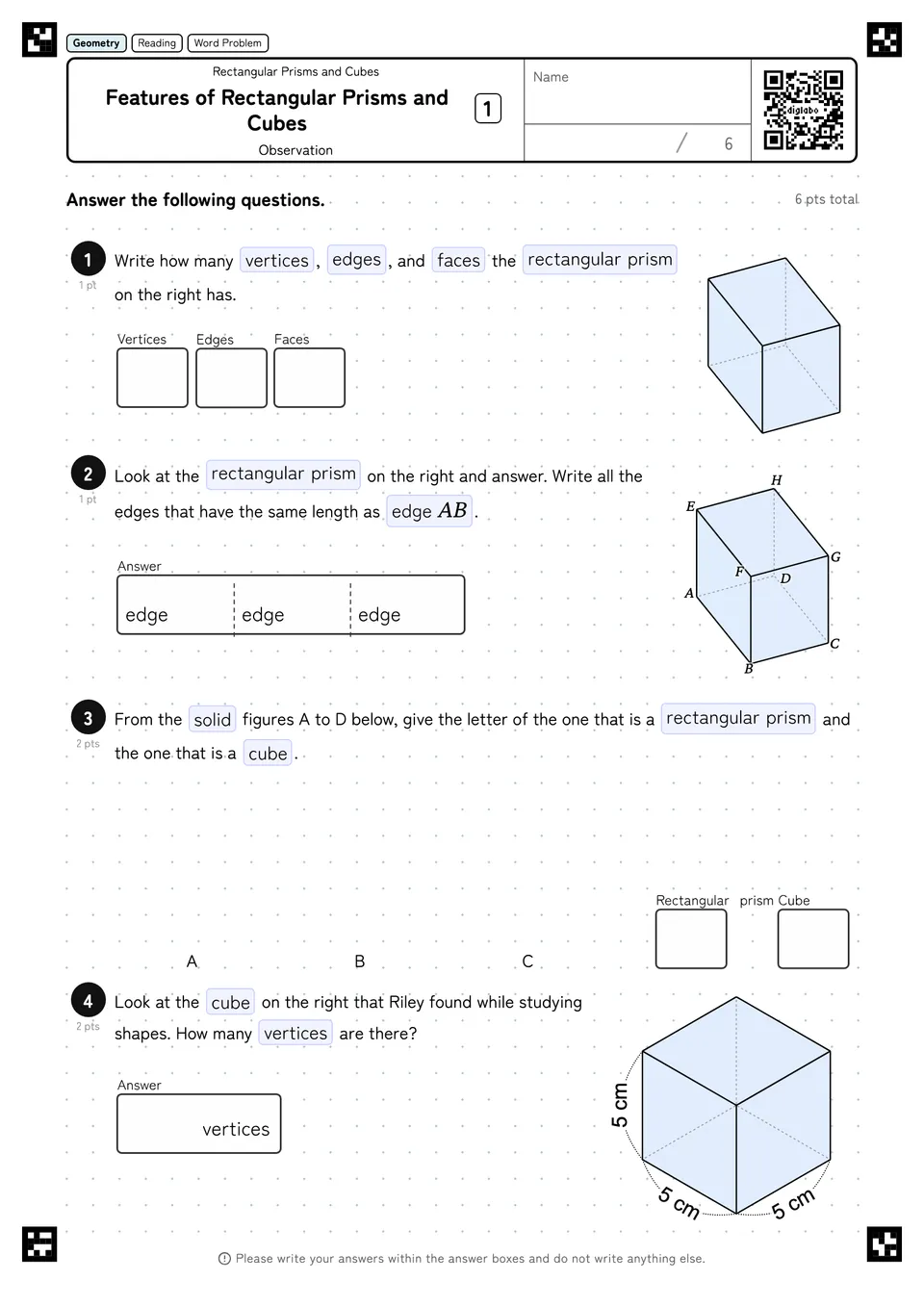
Perpendicular and Parallel Edges and Faces

Nets of Solids

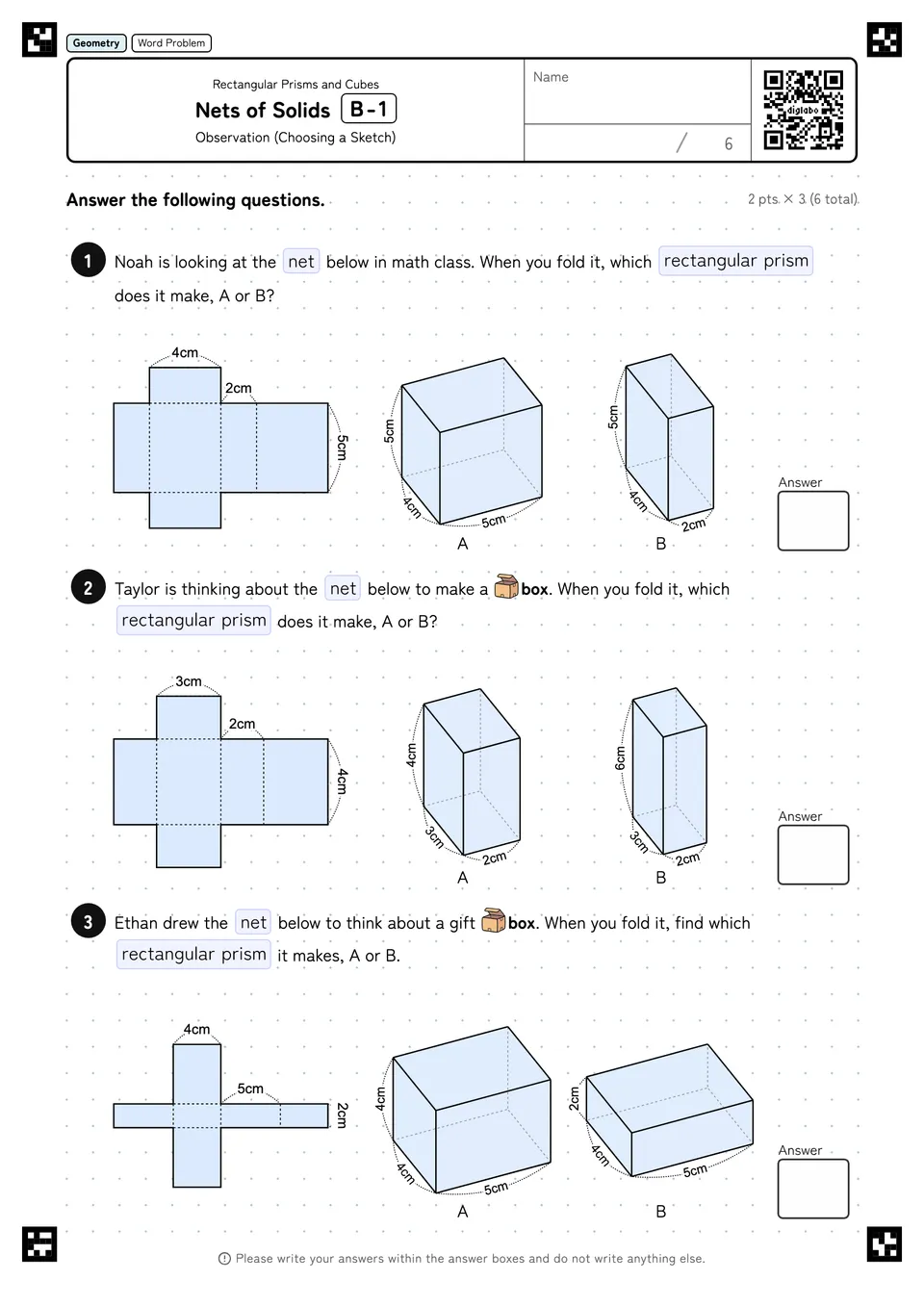

Frequently asked questions
- What do the “Rectangular Prisms and Cubes” worksheets for Grade 4 (Elementary School) practice?
- They cover problems such as Features, Features (Word Problems), Number of Vertices, Edges, and Faces, Edges of the Same Length, Relationship Between Edges, Relationship Between Faces, Relationship Between Edges and Faces, Relationship Between Faces and Edges.
- How many “Rectangular Prisms and Cubes” worksheets are there for Grade 4 (Elementary School)?
- 15 worksheets are free to use. Every one is a printable PDF and comes with an answer key.