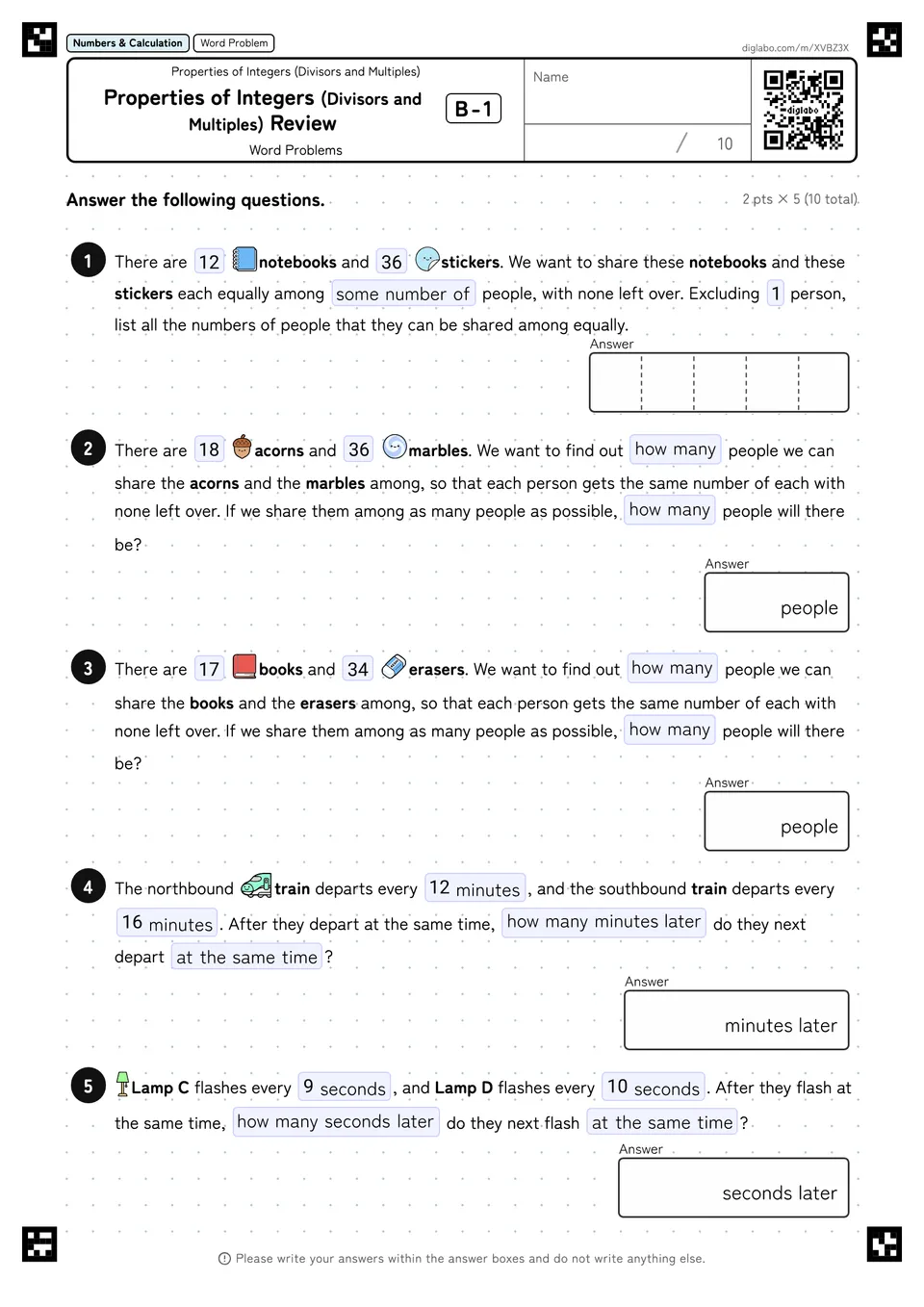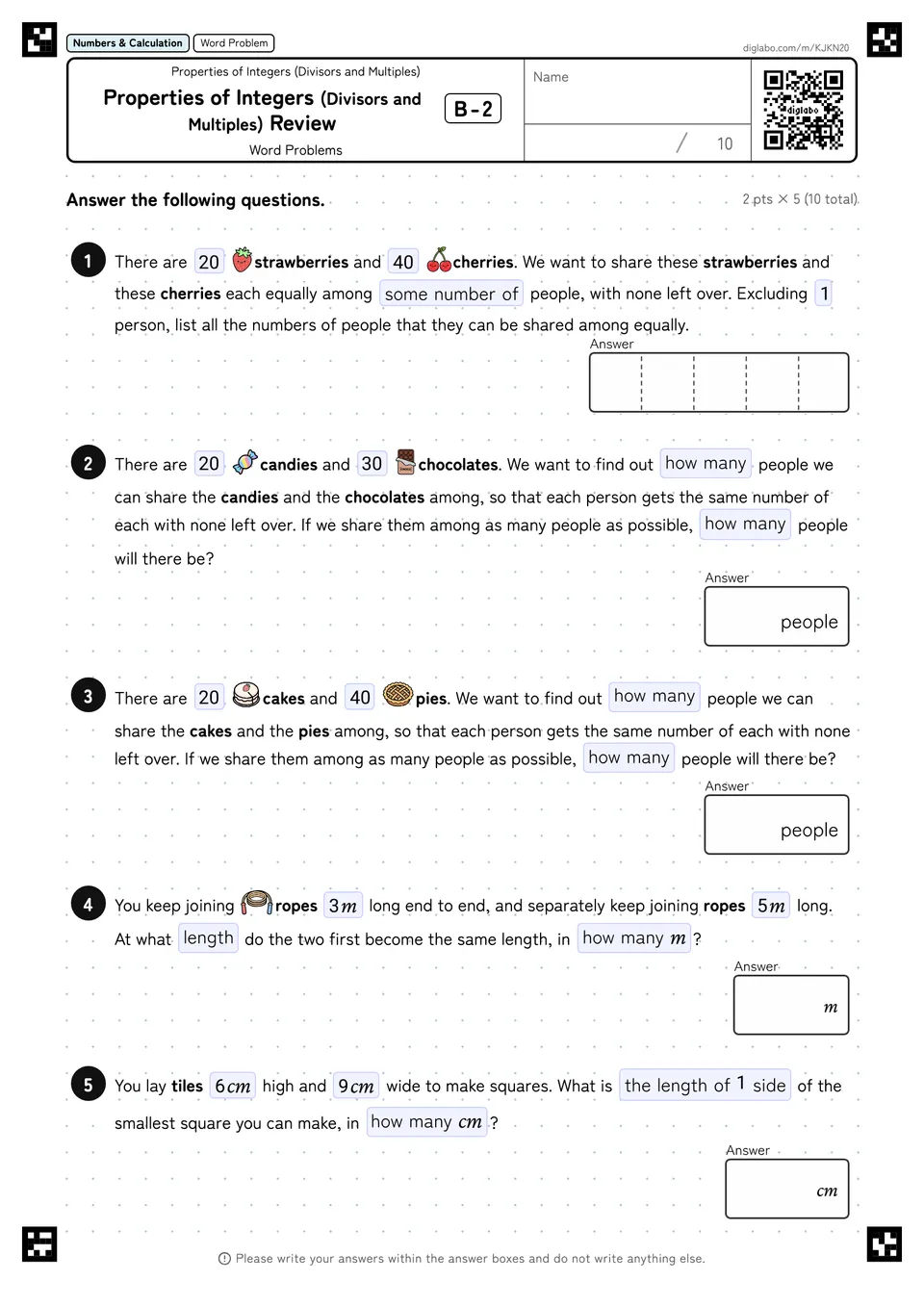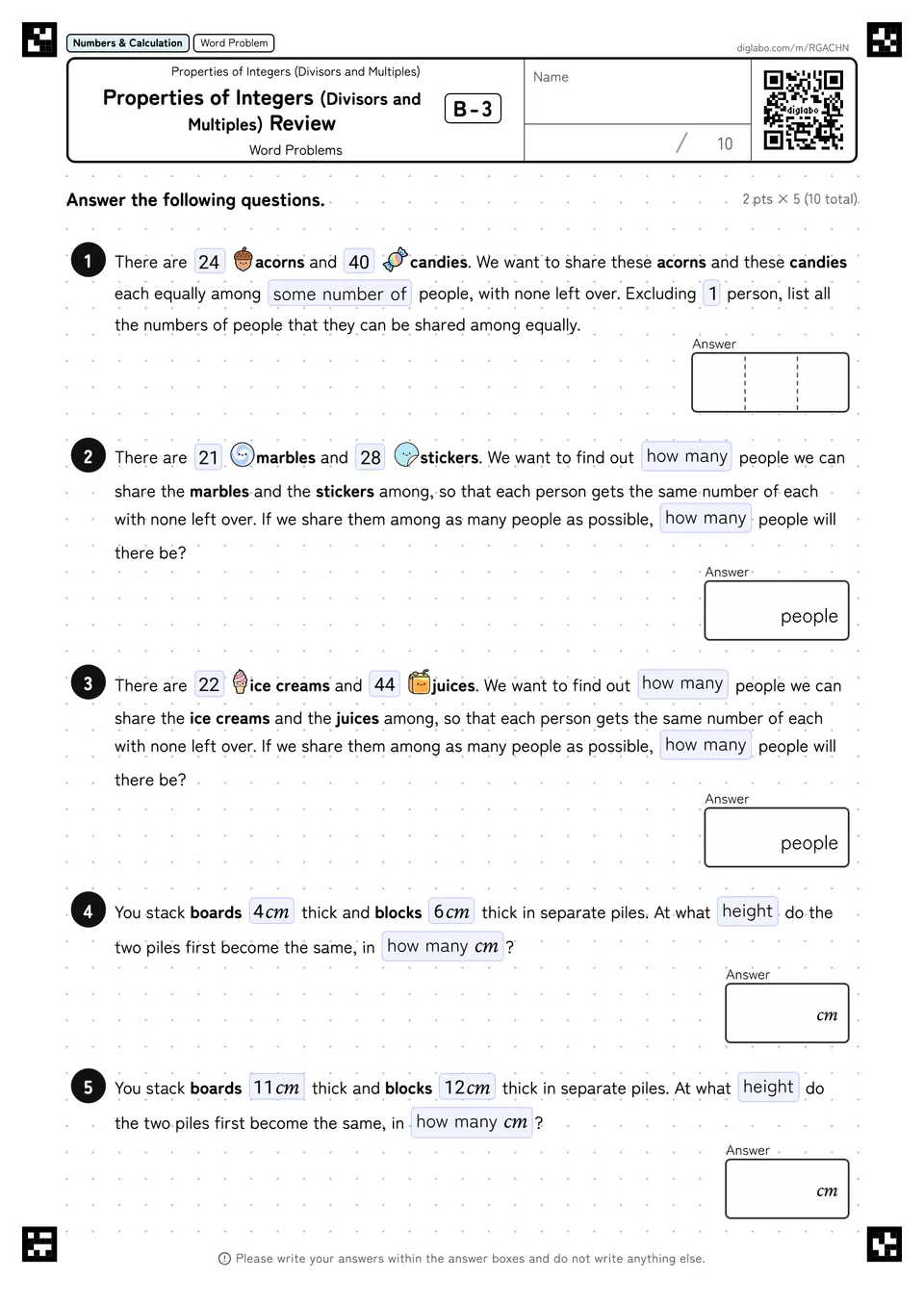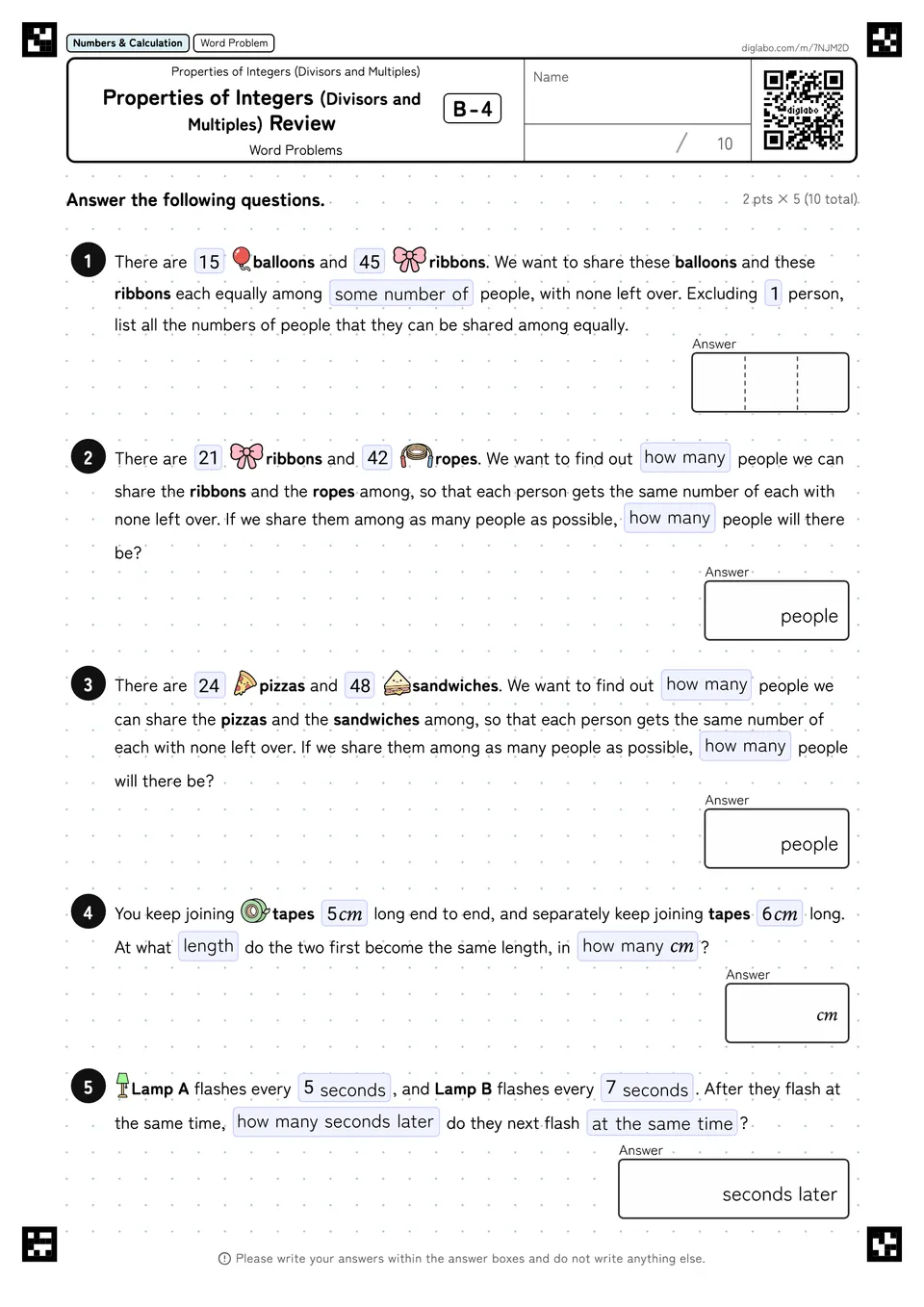
Math Drills
Properties of Integers (Divisors and Multiples) Review
B-5Word Problems
You can hand this out in class or share it on social media for free. Usage rules
What this worksheet covers
Listing divisors and multiples comes first, and pulling out what two numbers share leads on to common divisors, the greatest common divisor, common multiples and the least common multiple. Both listing and calculation are covered, along with word problems that ask when a quantity divides evenly and when two cycles line up again.
Read more
The most frequent error is choosing the wrong tool for the situation, a greatest common divisor where a least common multiple was needed or the reverse. An answer smaller than the original numbers means a common divisor situation, and a larger one means common multiples. When listing divisors, 1 and the number itself also go missing.
The rows of the times table become a clue for studying number properties from an angle not tried before. What this rests on is the sequence of the 4s and 3s tables memorized in Times Tables: 5, 2, 3, and 4 in grade 2. The numbers found here are used exactly as they are in the unit that follows, Properties of Fractions, for reducing and finding common denominators.
- Common Divisors and Greatest Common Divisor · Listing Common Divisors (Word Problems)1 question
- Common Divisors and Greatest Common Divisor · Using the Greatest Common Divisor2 questions
- Common Multiples and Least Common Multiple · Using the Least Common Multiple2 questions
Questions & answers
Problems and answers on this worksheet
These are the problems in “Properties of Integers (Divisors and Multiples)”, shown with their answers.
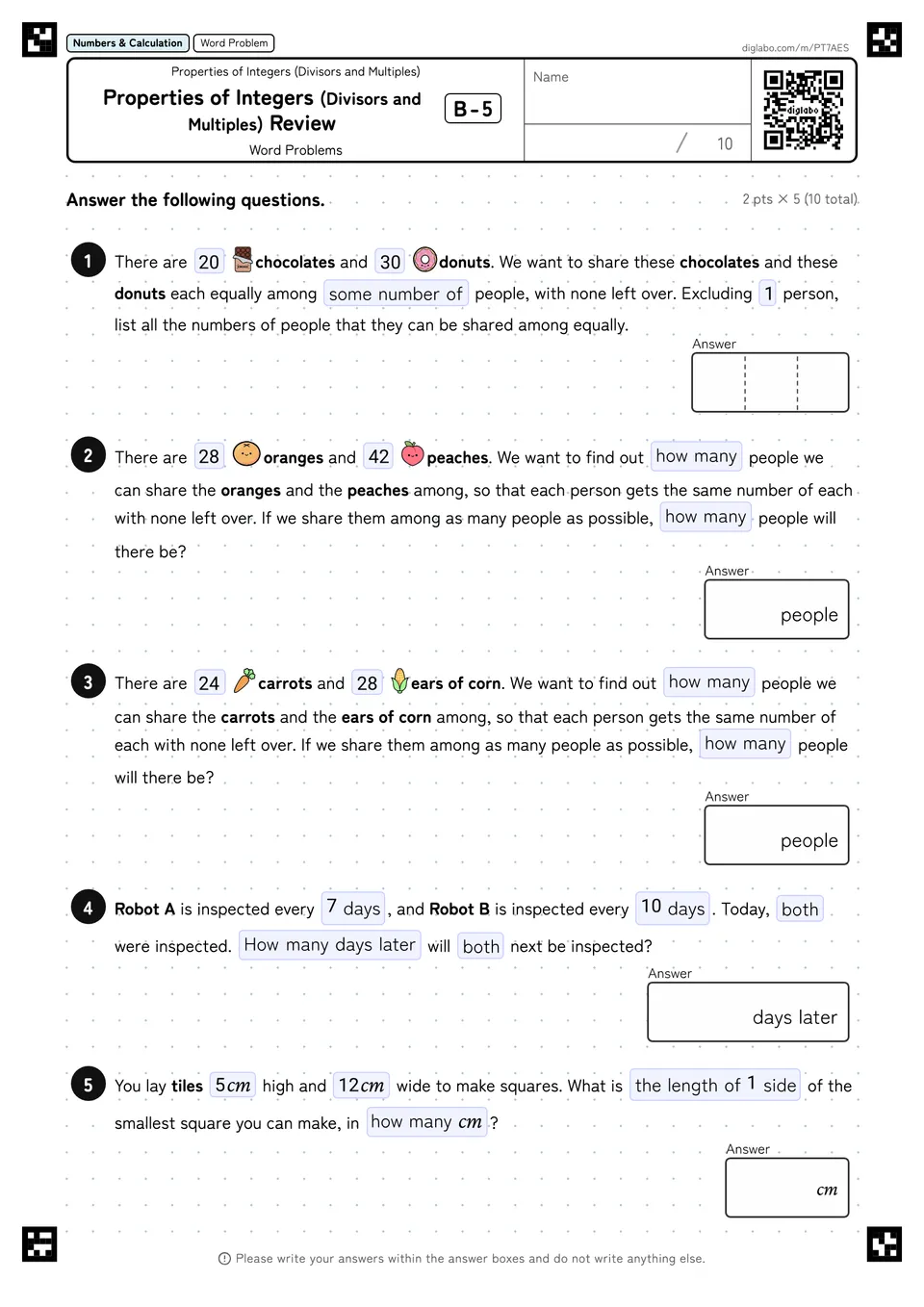
(1)There are 20 chocolates and 30 donuts. We want to share these chocolates and these donuts each equally among some number of people, with none left over. Excluding 1 person, list all the numbers of people that they can be shared among equally. Answer □
Answer: 2, 5, 10
(2)There are 28 oranges and 42 peaches. We want to find out how many people we can share the oranges and the peaches among, so that each person gets the same number of each with none left over. If we share them among as many people as possible, how many people will there be? Answer □
Answer: 14people
(3)There are 24 carrots and 28 ears of corn. We want to find out how many people we can share the carrots and the ears of corn among, so that each person gets the same number of each with none left over. If we share them among as many people as possible, how many people will there be? Answer □
Answer: 4people
(4)Robot A is inspected every 7 days, and Robot B is inspected every 10 days. Today, both were inspected. How many days later will both next be inspected? Answer □
Answer: 70days later
(5)You lay tiles 5cm high and 12cm wide to make squares. What is the length of 1 side of the smallest square you can make, in how many cm? Answer □
Answer: 60cm
What to do next
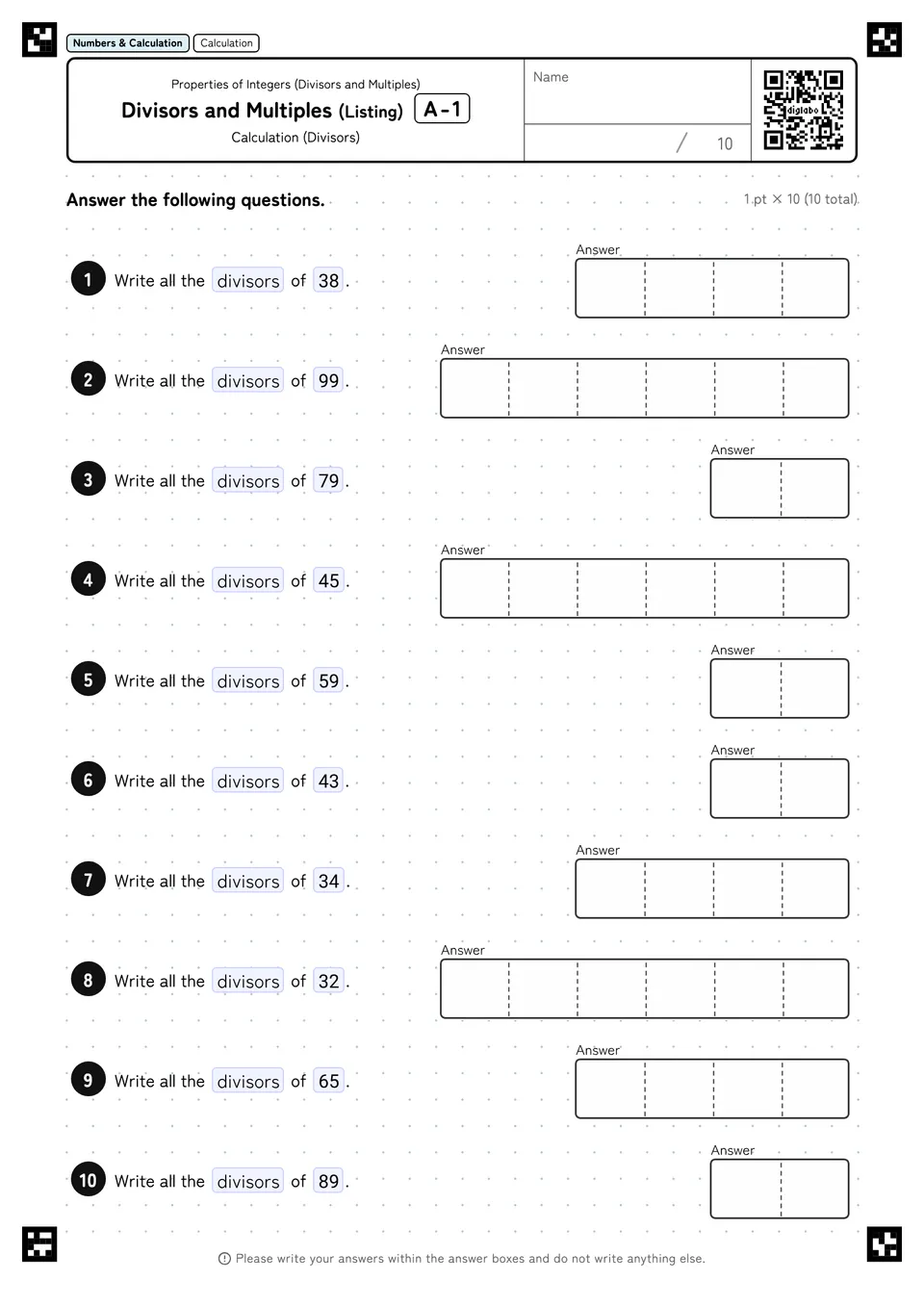
More worksheets in this unit
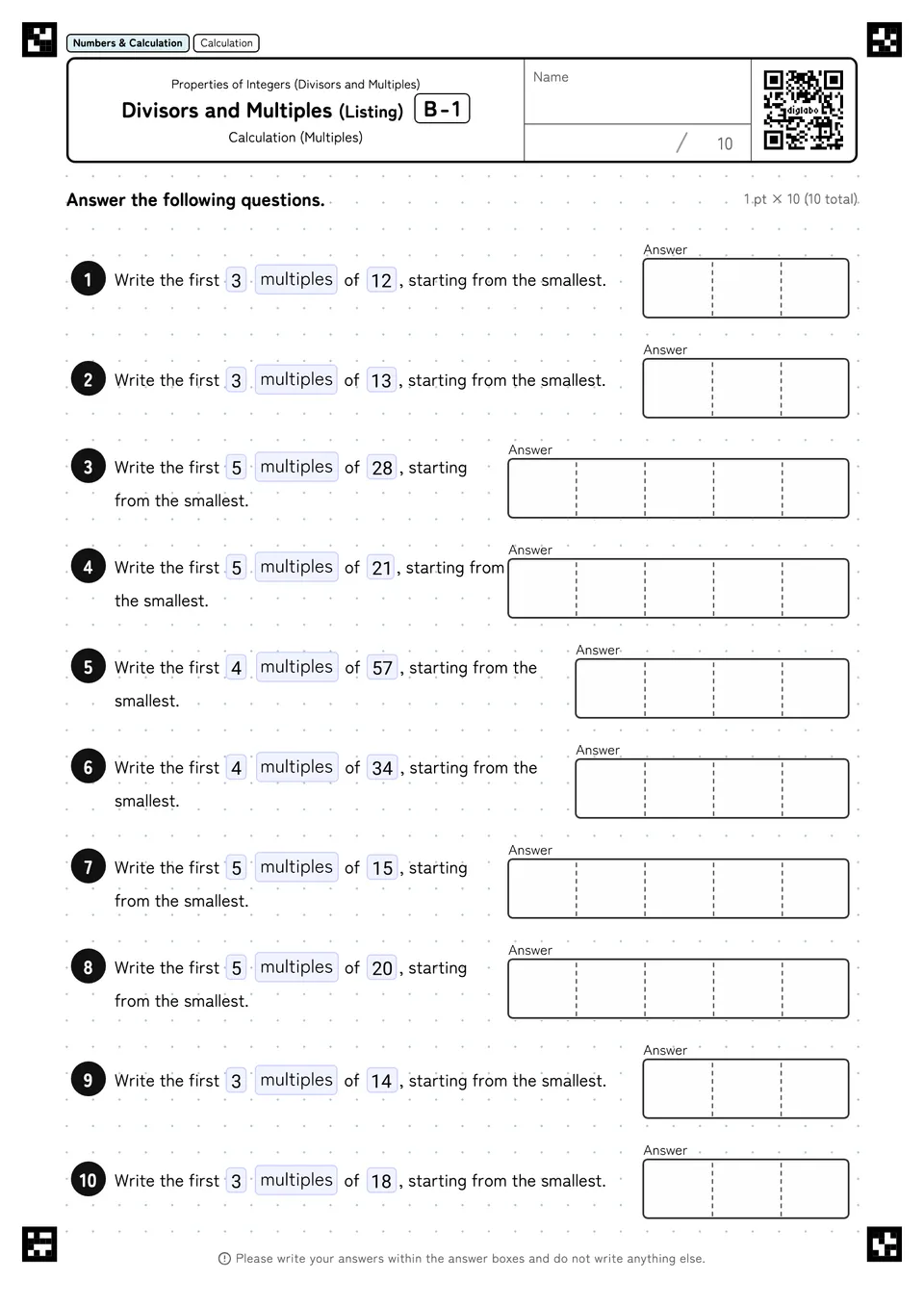 Divisors and Multiples (Listing)Divisors and Multiples (Listing) Calculation (Multiples)
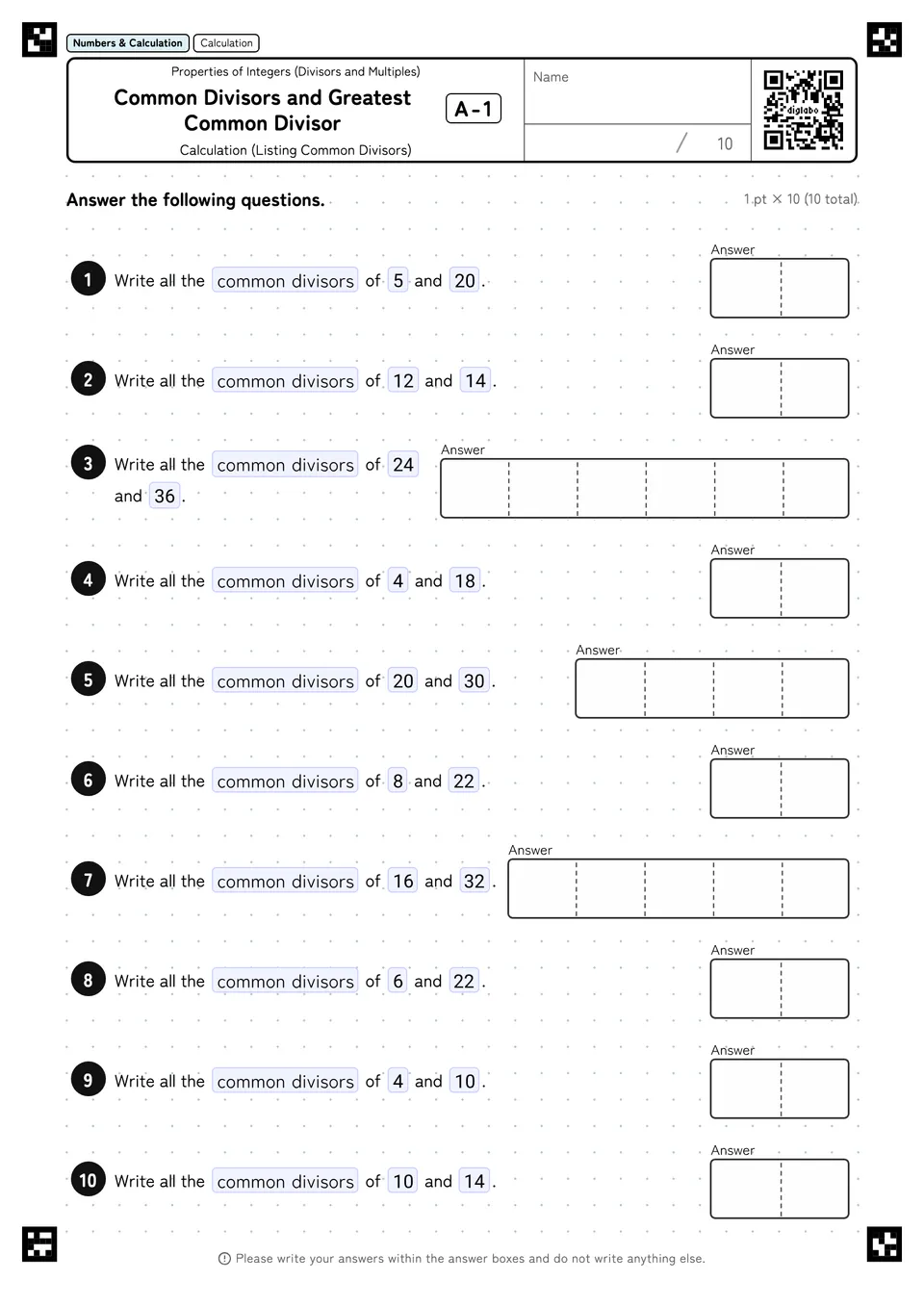 Common Divisors and Greatest Common DivisorCommon Divisors and Greatest Common Divisor Calculation (Listing Common Divisors)
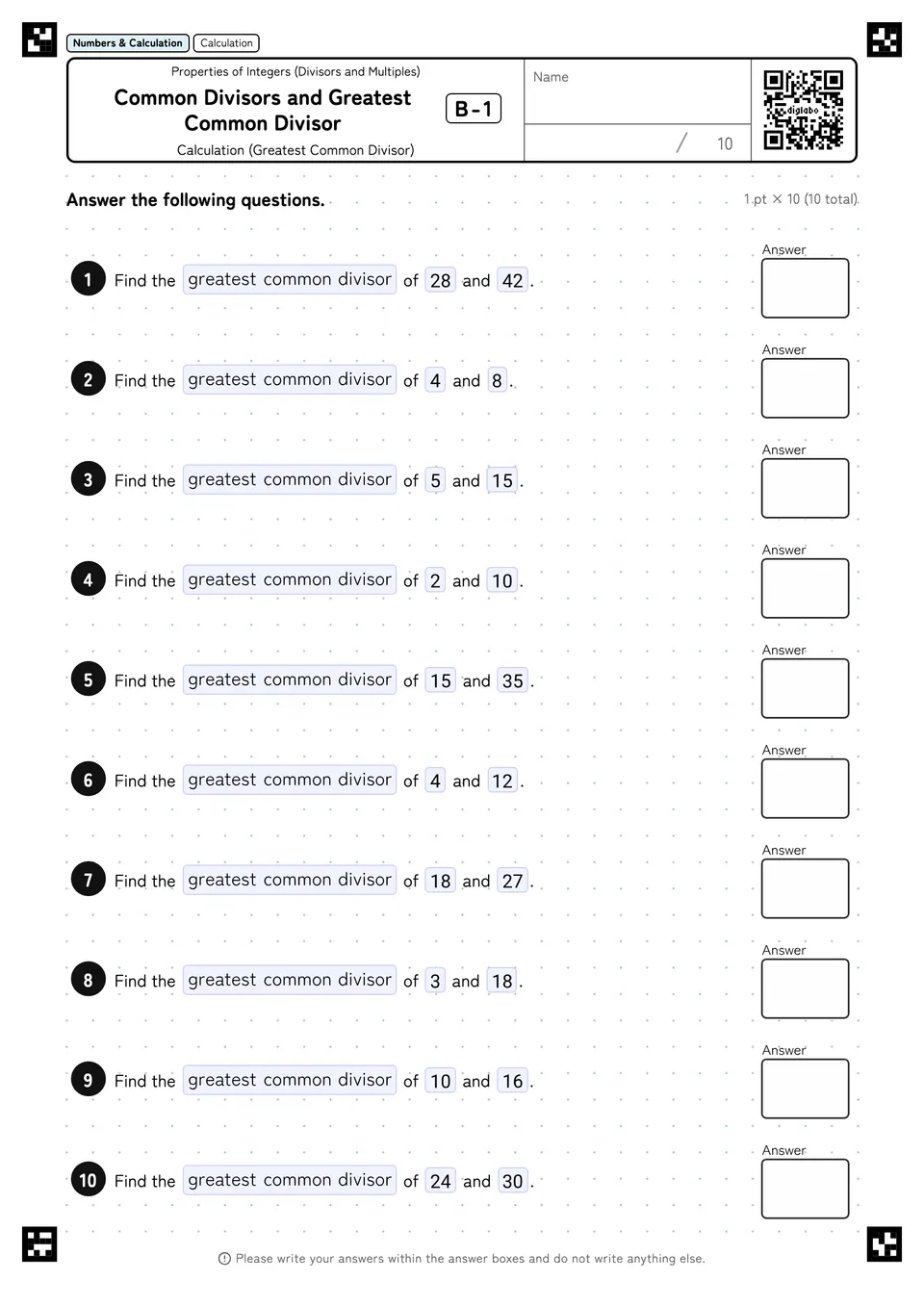 Common Divisors and Greatest Common DivisorCommon Divisors and Greatest Common Divisor Calculation (Greatest Common Divisor)
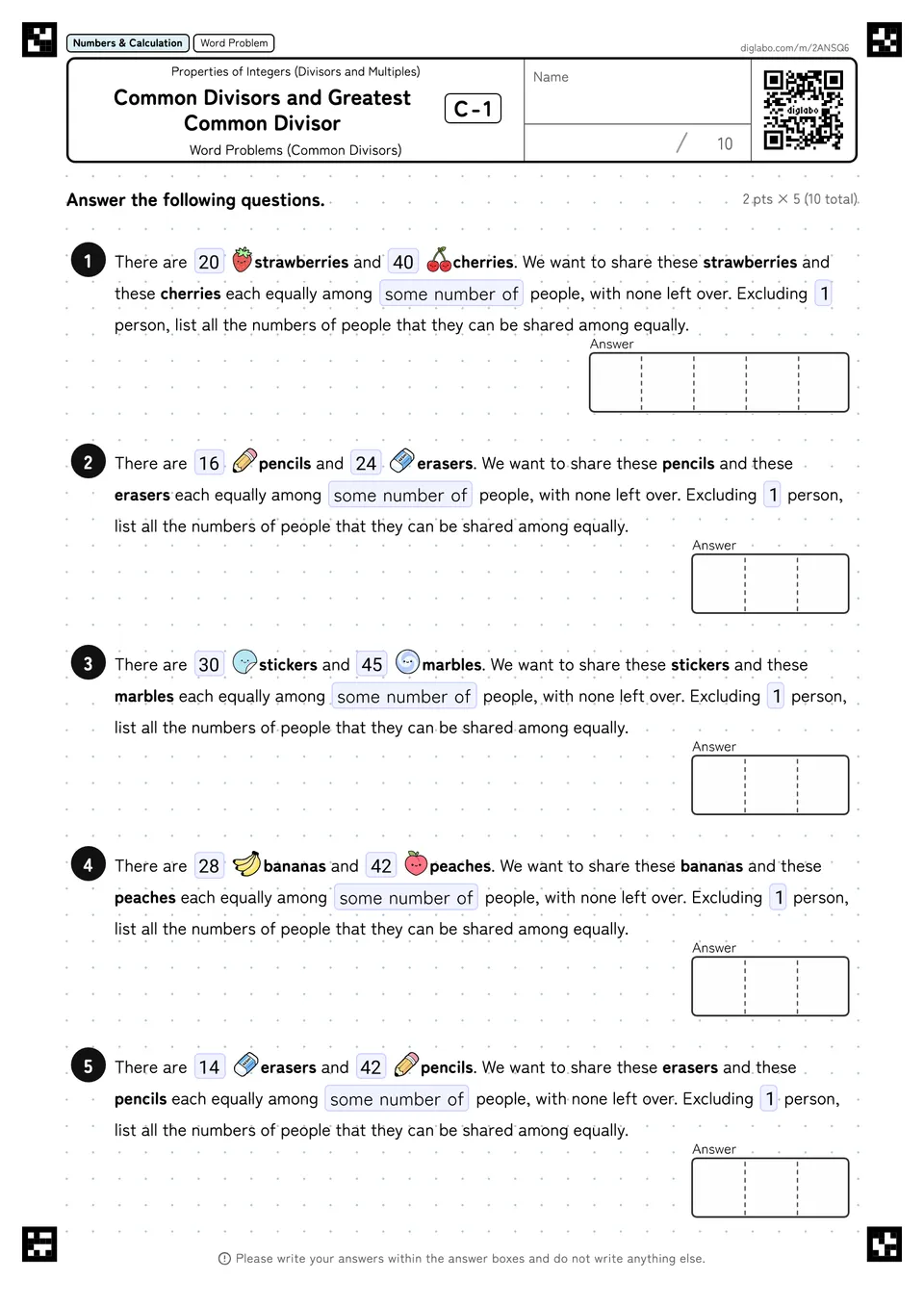 Common Divisors and Greatest Common DivisorCommon Divisors and Greatest Common Divisor Word Problems (Common Divisors)
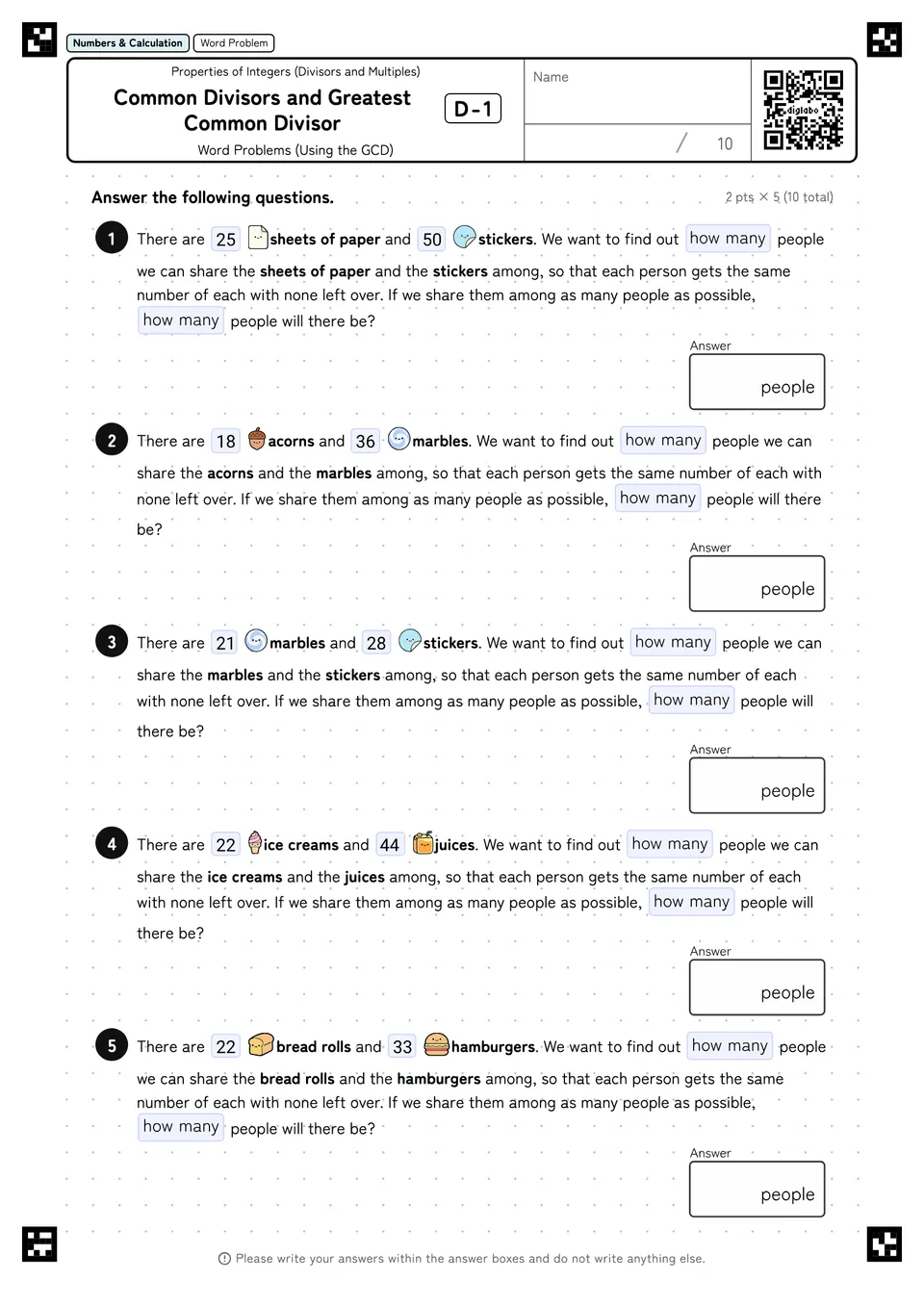 Common Divisors and Greatest Common DivisorCommon Divisors and Greatest Common Divisor Word Problems (Using the GCD)
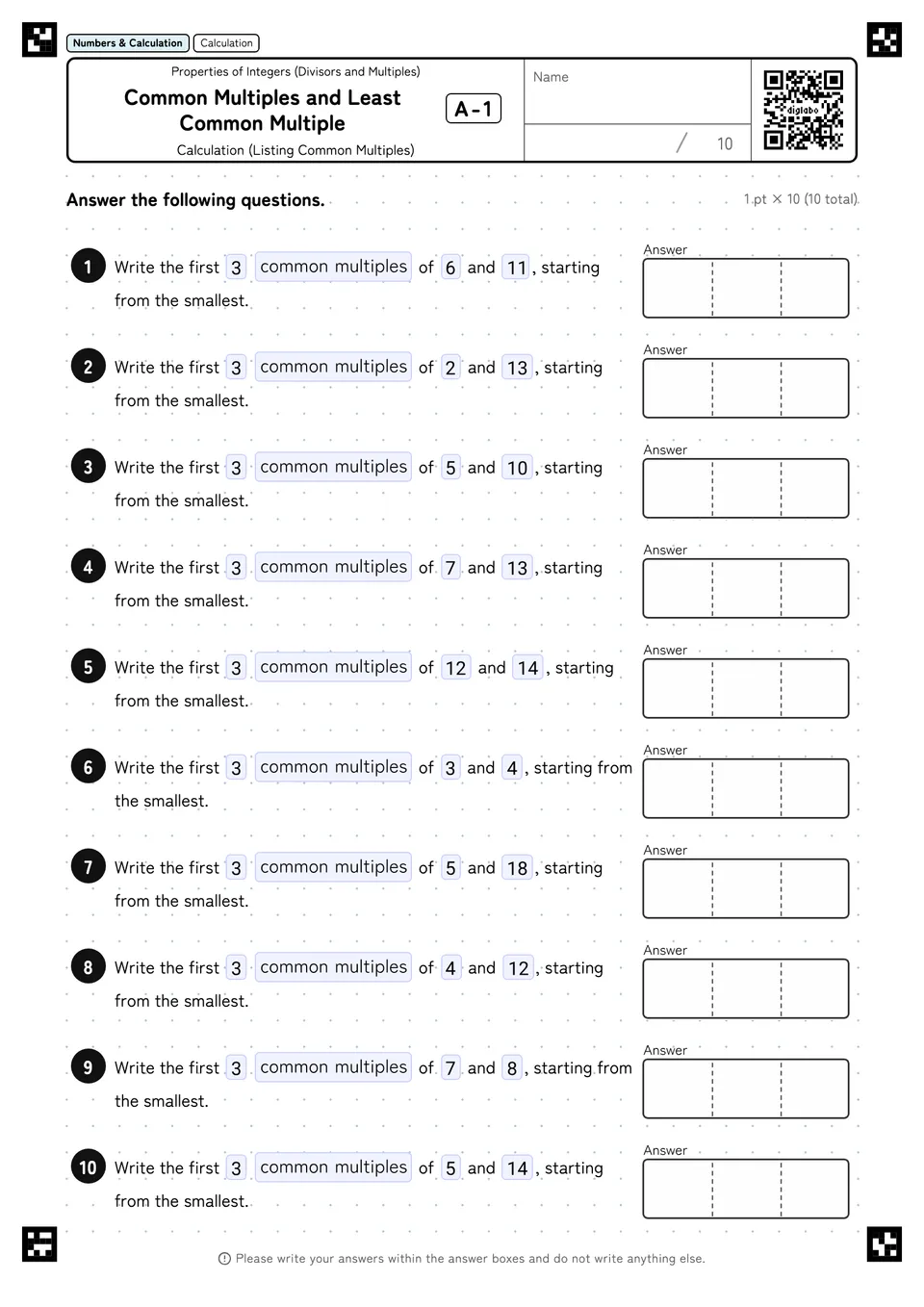 Common Multiples and Least Common MultipleCommon Multiples and Least Common Multiple Calculation (Listing Common Multiples)
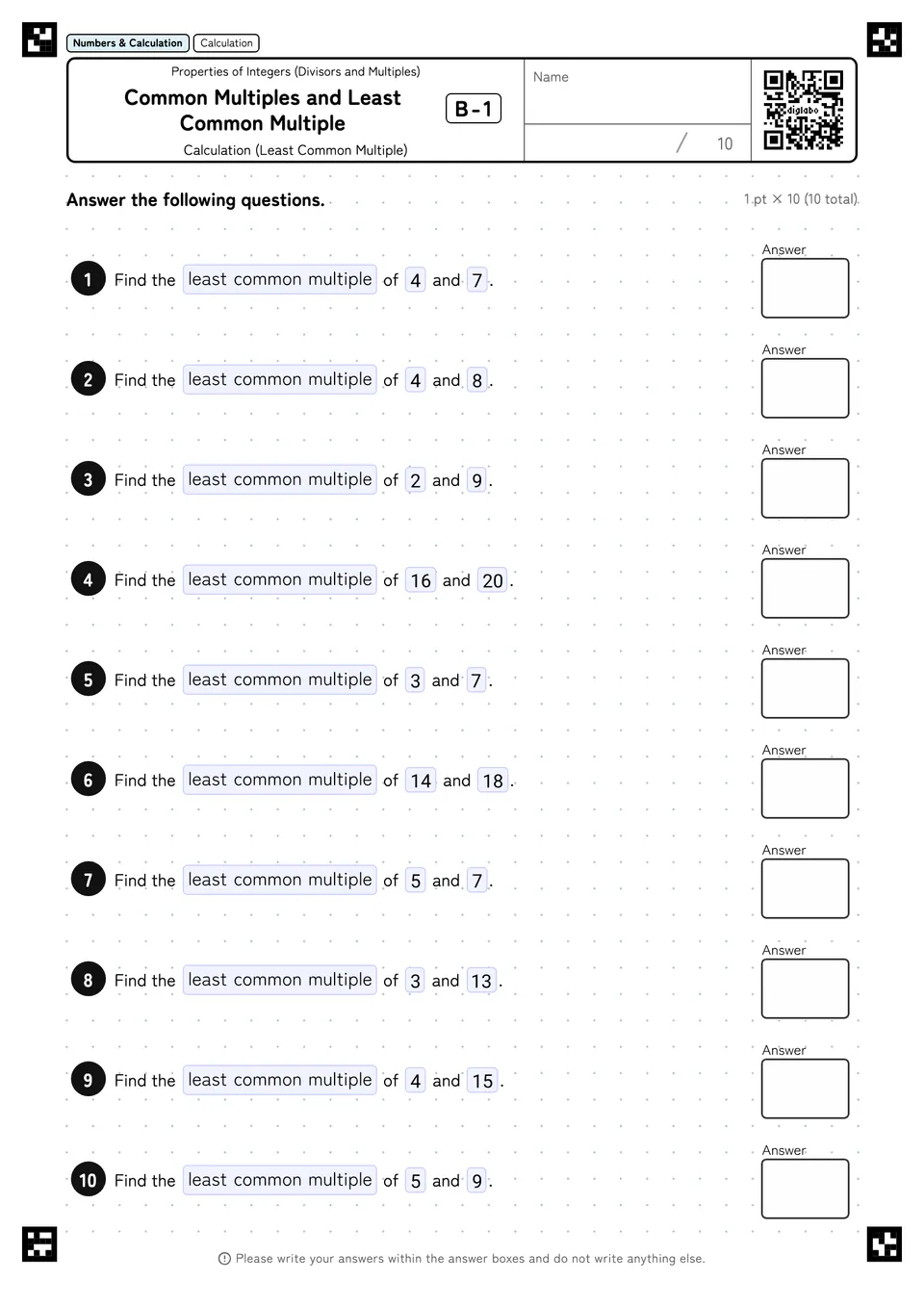 Common Multiples and Least Common MultipleCommon Multiples and Least Common Multiple Calculation (Least Common Multiple)
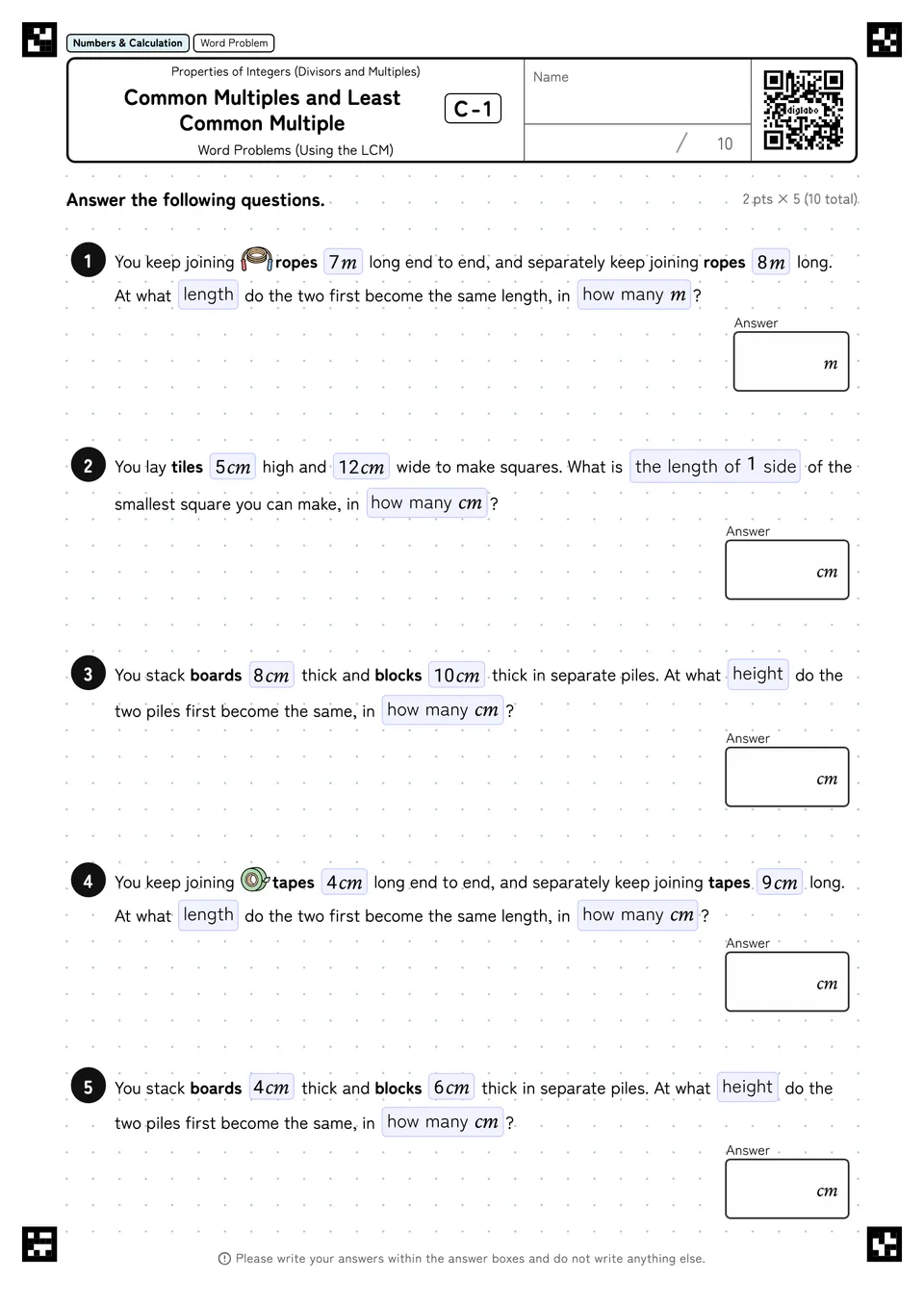 Common Multiples and Least Common MultipleCommon Multiples and Least Common Multiple Word Problems (Using the LCM)
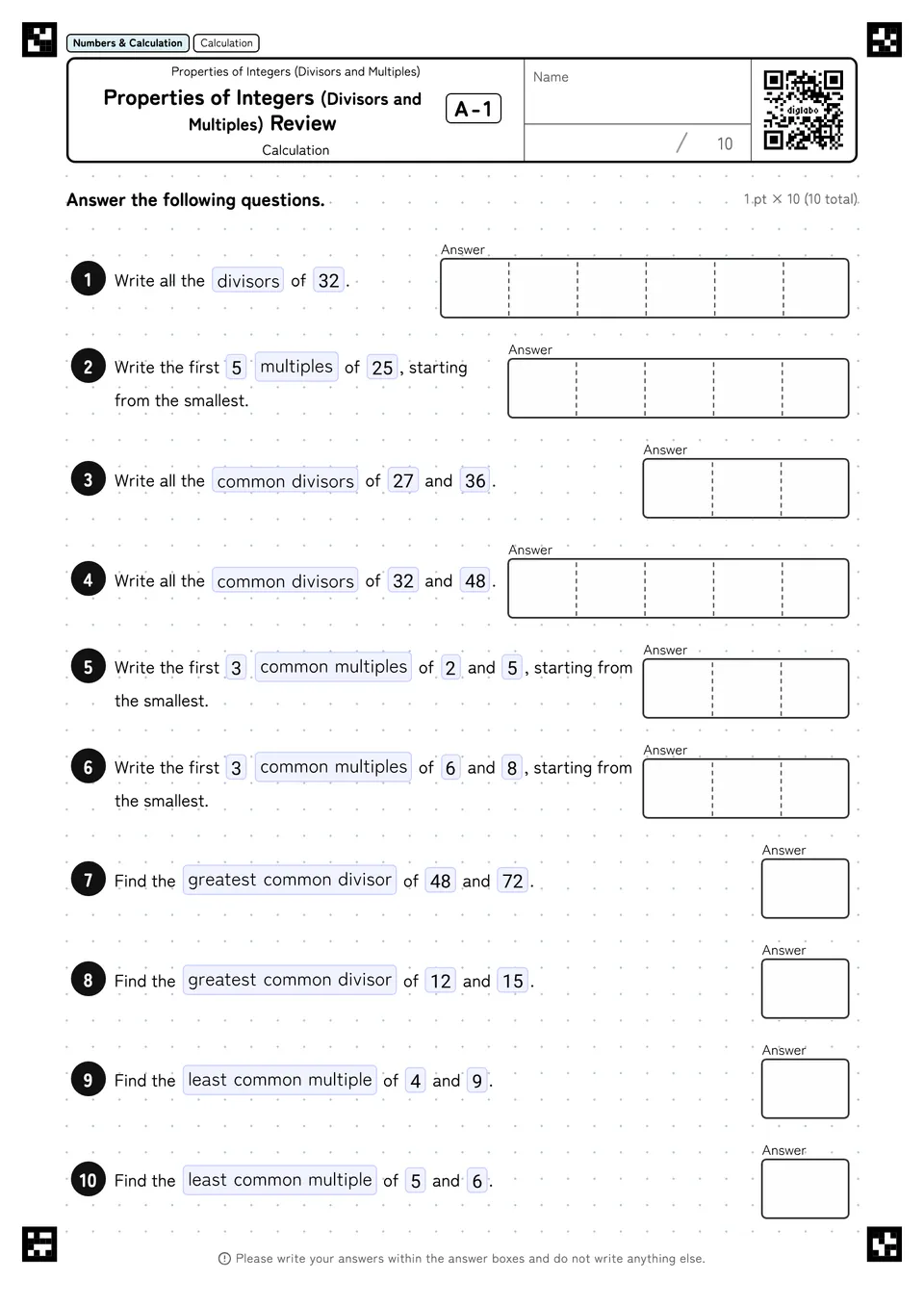 Properties of Integers (Divisors and Multiples) ReviewProperties of Integers (Divisors and Multiples) Review Calculation