Math Drills
Subtraction (No Borrowing)
C-3Word Problems
You can hand this out in class or share it on social media for free. Usage rules
What this worksheet covers
- Topic
- 2-Digit ± 1-Digit
- Worksheet
- Subtraction (No Borrowing)
Every equation takes a one-digit number away from a two-digit one, and all are arranged so that the ones digits alone will do the job. The tens place stays put right to the end. Calculation traces the procedure, Fill in the Blank supplies the missing number, and Word Problems turn a shrinking situation into an equation.
Read more
Taking the number to be subtracted out of the tens instead produces 26 for 46 - 2. When the ones digit of the answer has not budged from the original number, this is the shape at work. Word Problems also bring cases where a growing situation and a shrinking one are not told apart and the answer is reached by adding.
Swap the direction and the routine of dealing with one place at a time is the same as in Addition (No Carrying). Two lessons complete the unit, and in Calculations with 3 Numbers it is the count of numbers, not of places, that grows.
- Word Problems6 questions
Questions & answers
Problems and answers on this worksheet
These are the problems in “2-Digit ± 1-Digit”, shown with their answers.
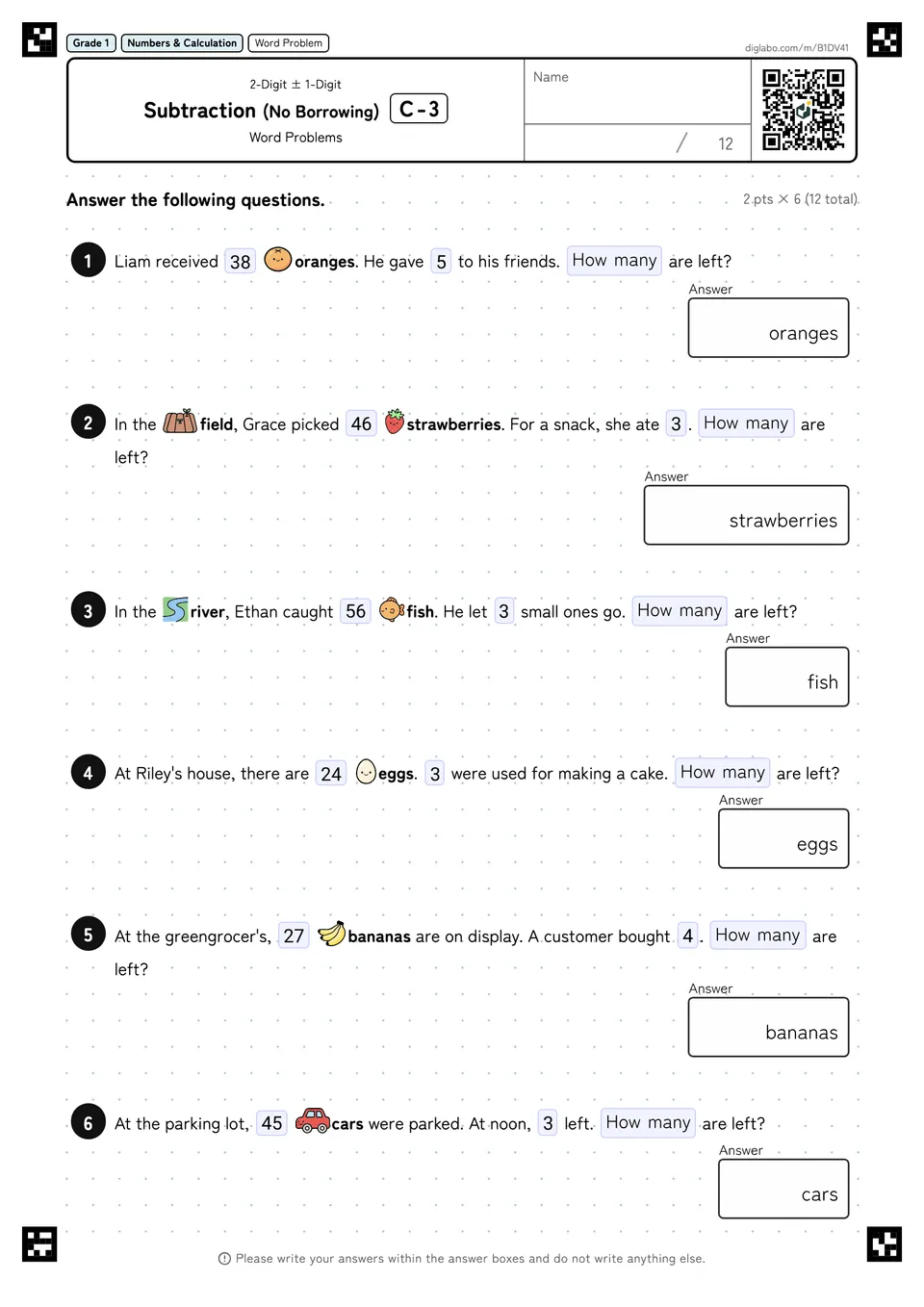
(1)Liam received 38 oranges. He gave 5 to his friends. How many are left? Answer □
Answer: 33oranges
(2)In the field, Grace picked 46 strawberries. For a snack, she ate 3. How many are left? Answer □
Answer: 43strawberries
(3)In the river, Ethan caught 56 fish. He let 3 small ones go. How many are left? Answer □
Answer: 53fish
(4)At Riley's house, there are 24 eggs. 3 were used for making a cake. How many are left? Answer □
Answer: 21eggs
(5)At the greengrocer's, 27 bananas are on display. A customer bought 4. How many are left? Answer □
Answer: 23bananas
(6)At the parking lot, 45 cars were parked. At noon, 3 left. How many are left? Answer □
Answer: 42cars
What to do next
More worksheets in this unit
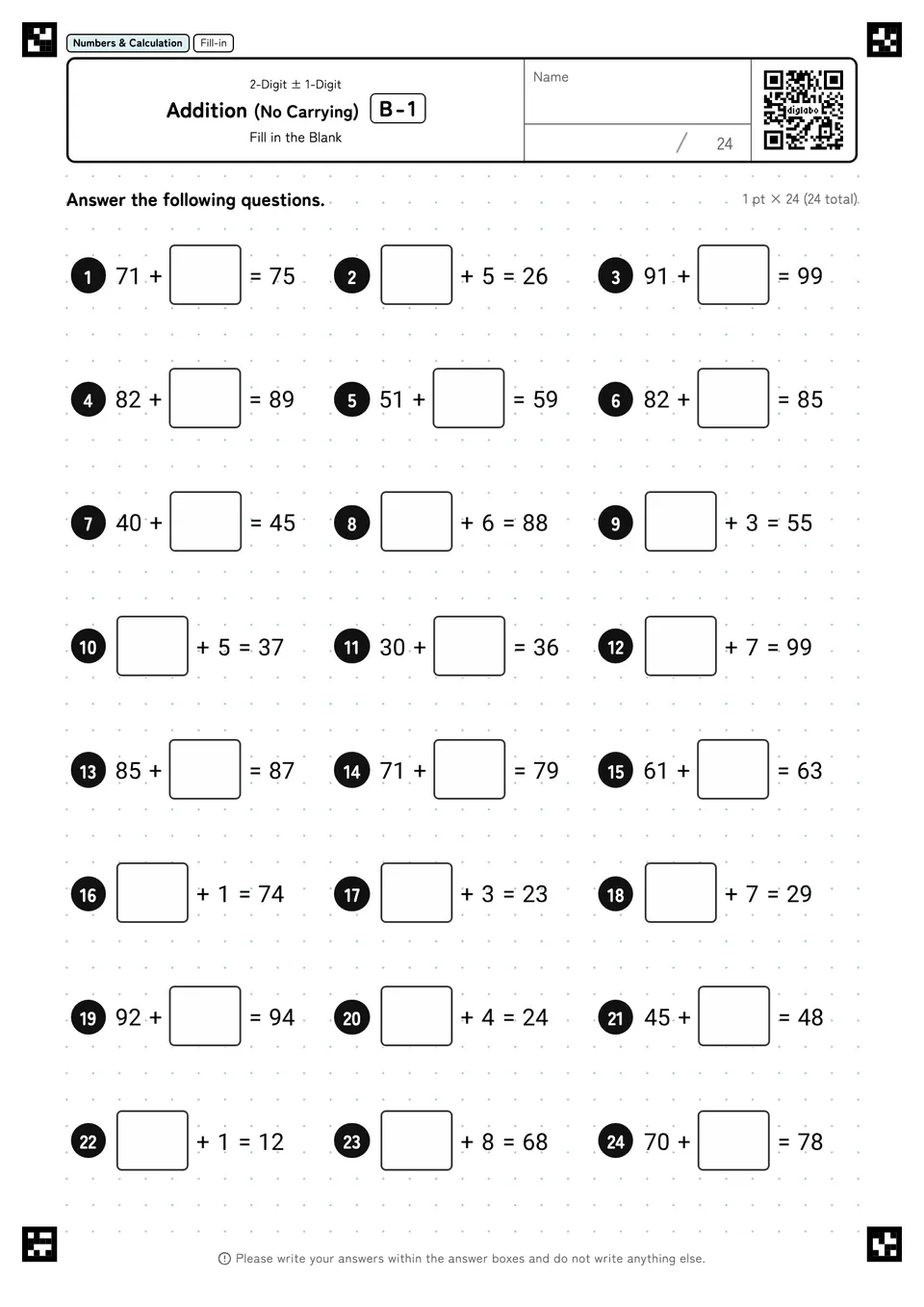 Addition (No Carrying)Addition (No Carrying) Fill in the Blank
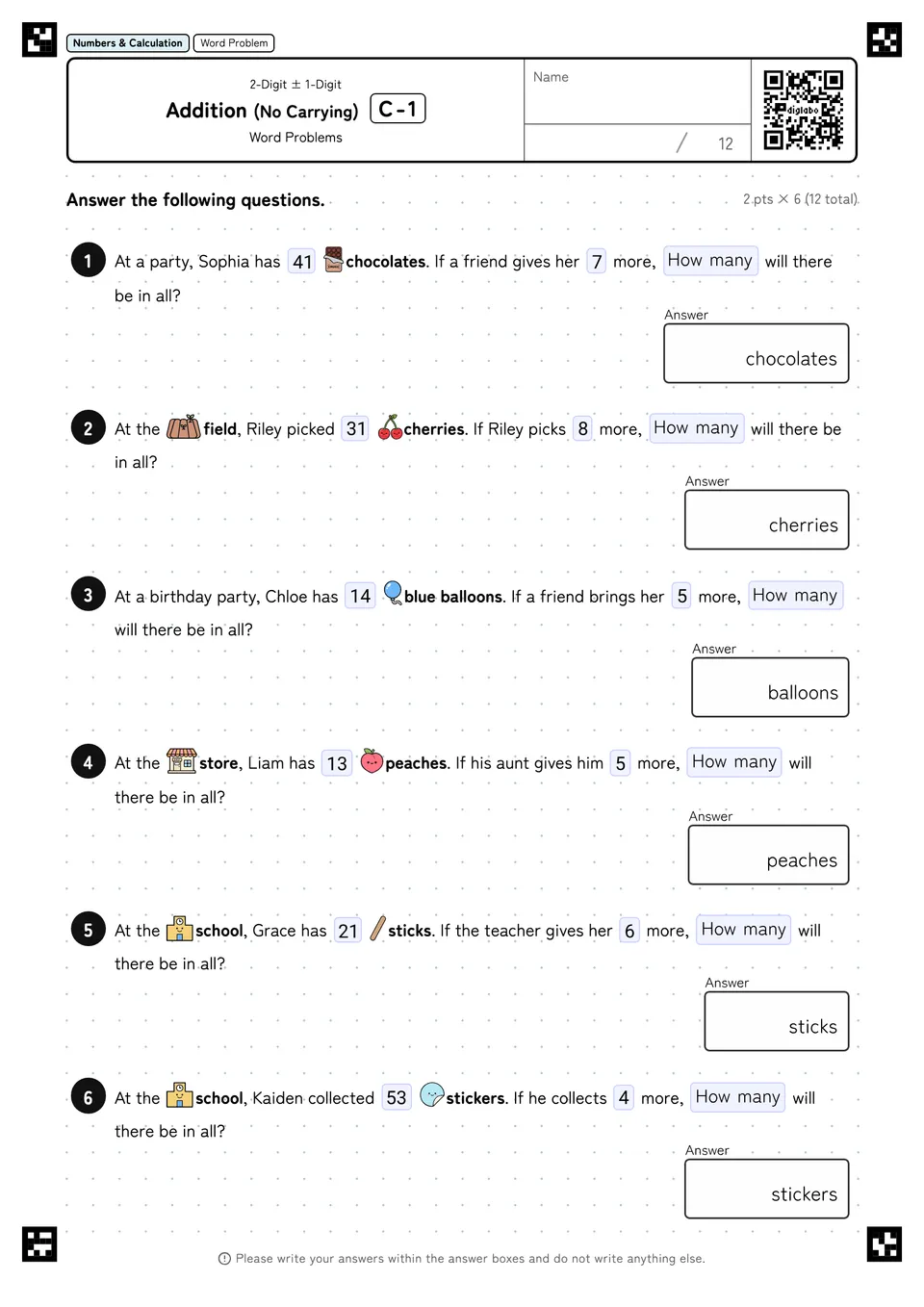 Addition (No Carrying)Addition (No Carrying) Word Problems
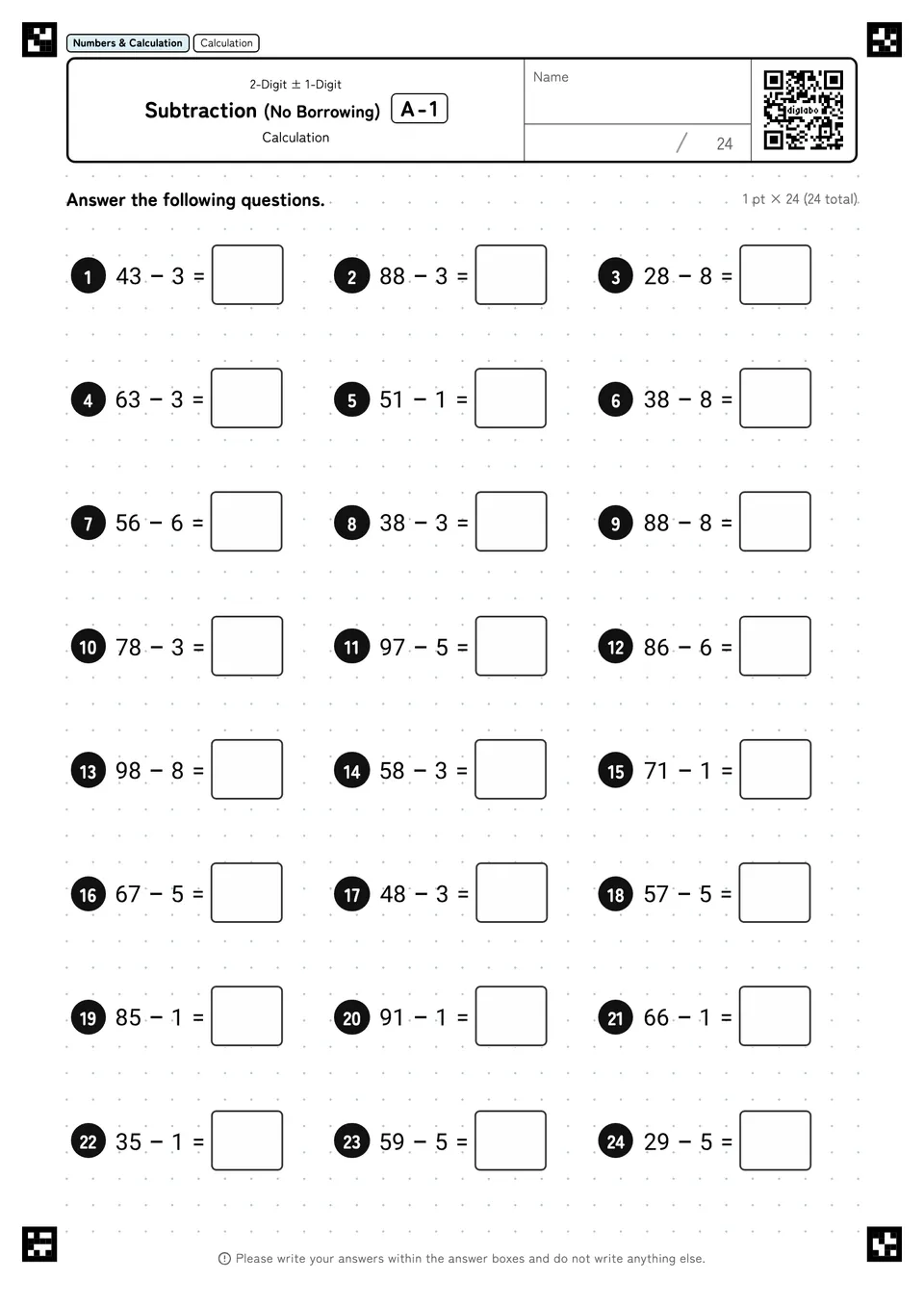 Subtraction (No Borrowing)Subtraction (No Borrowing) Calculation
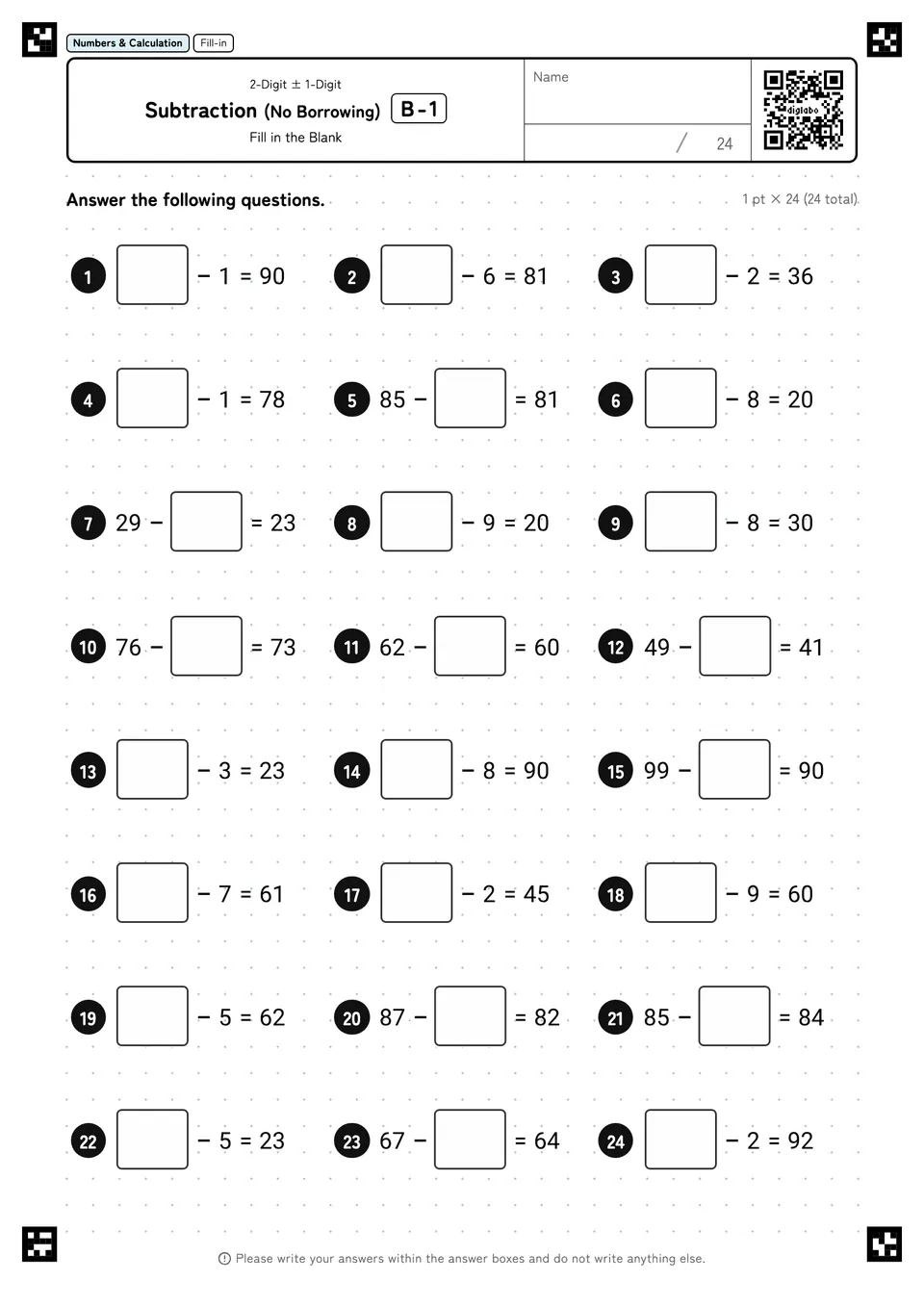 Subtraction (No Borrowing)Subtraction (No Borrowing) Fill in the Blank
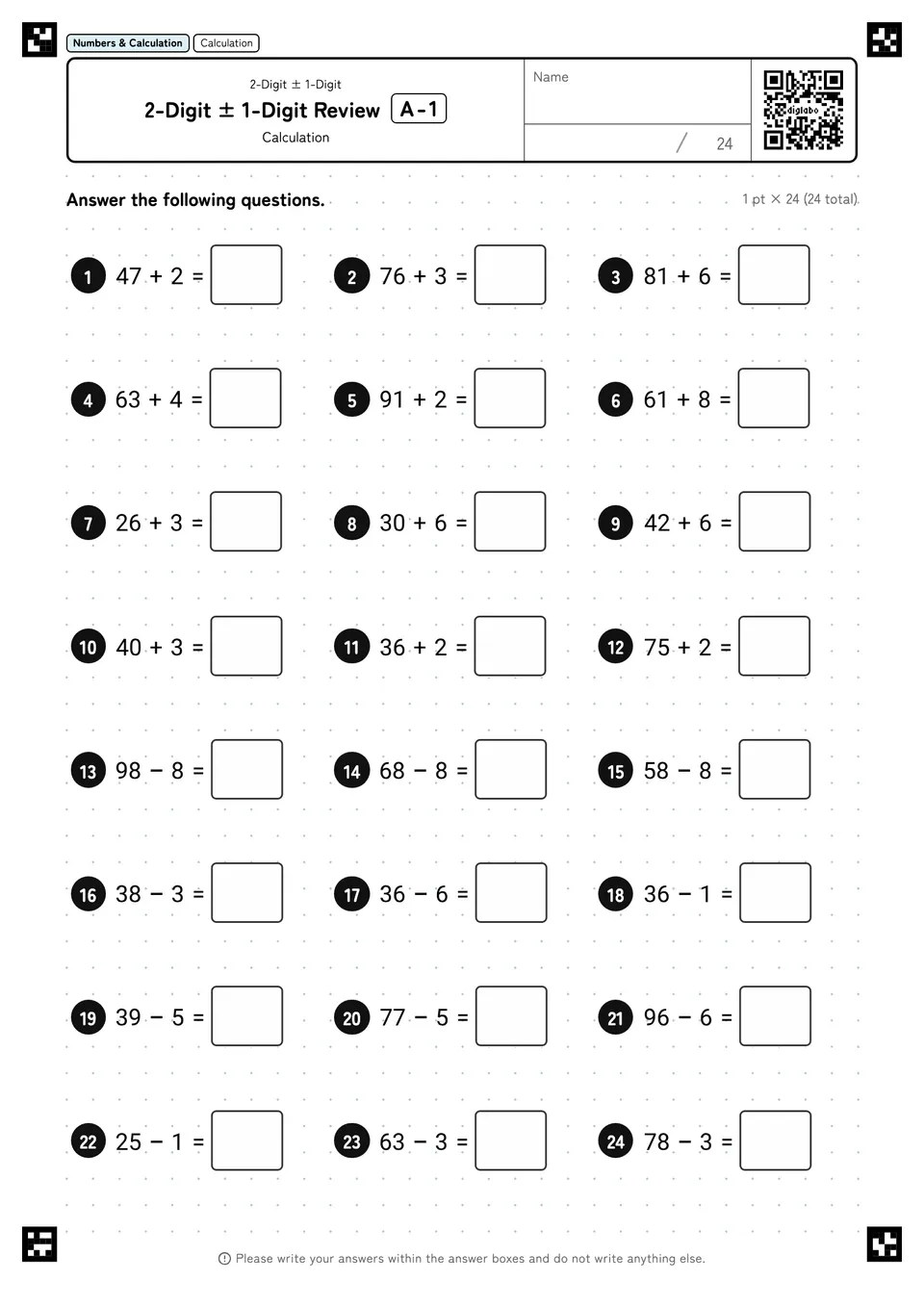 2-Digit ± 1-Digit Review2-Digit ± 1-Digit Review Calculation
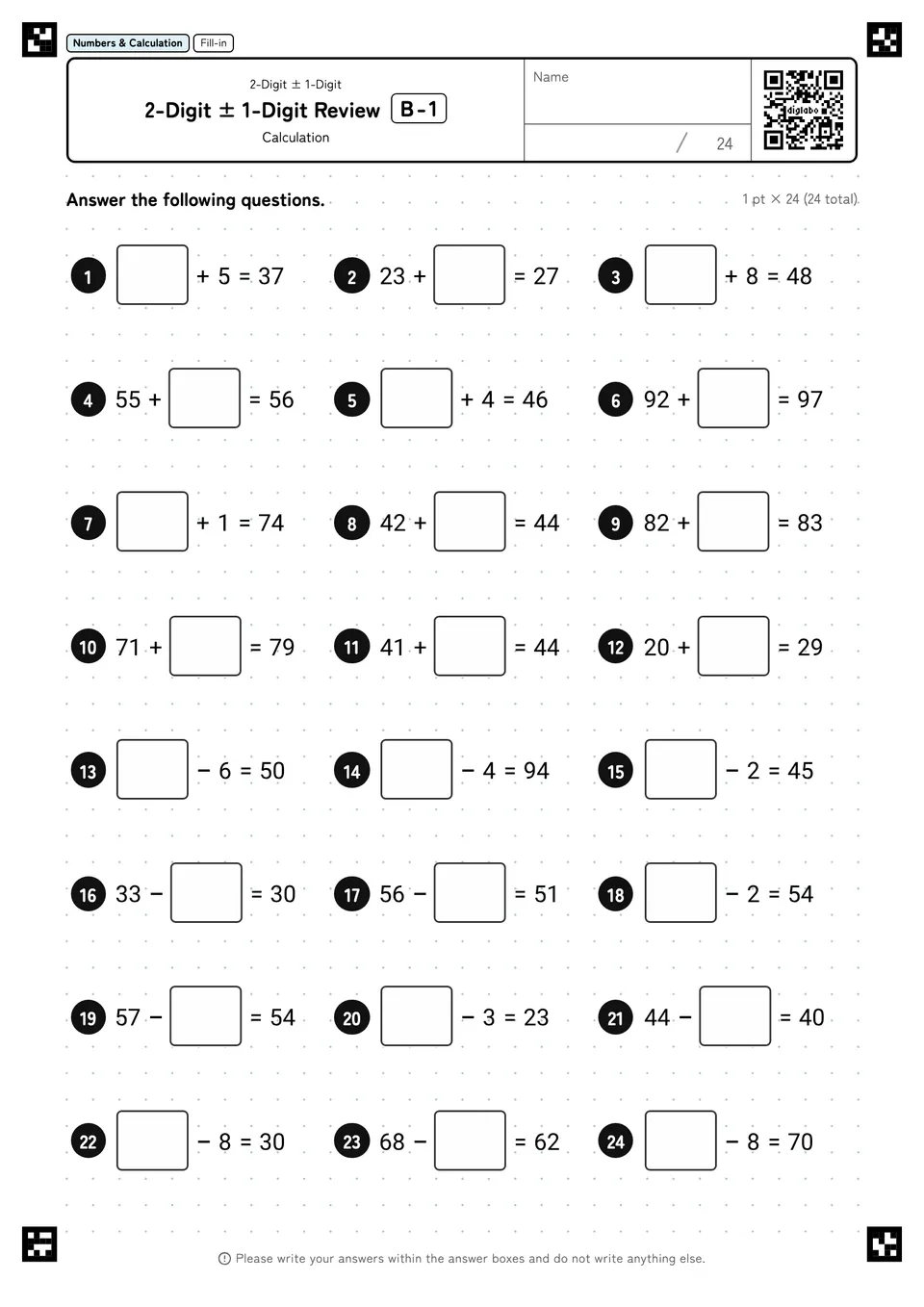 2-Digit ± 1-Digit Review2-Digit ± 1-Digit Review Calculation
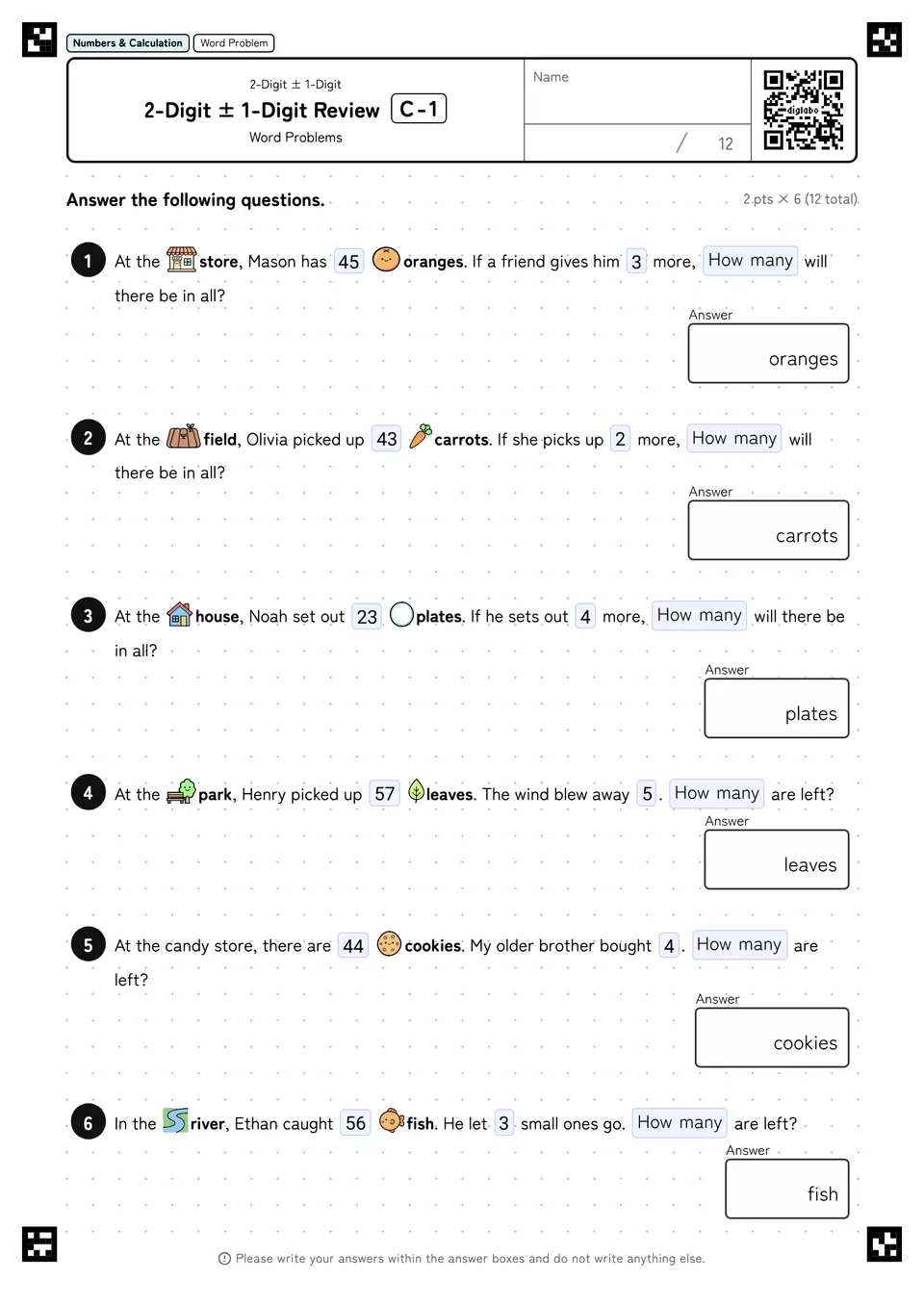 2-Digit ± 1-Digit Review2-Digit ± 1-Digit Review Word Problems