Math Drills
Subtraction (No Borrowing)
D-2Word Problems
You can hand this out in class or share it on social media for free. Usage rules
What this worksheet covers
- Worksheet
- Subtraction (No Borrowing)
Work opens by lining the places up in the column layout, moves on to answering from the bare equation, then to putting a number in the box, and finishes with word problems where the equation is set up from a sentence. A two-digit or three-digit number is taken from a three-digit one, with the upper figure larger or equal at every place, so nothing has to be broken apart.
Read more
Where the box stands for the number being subtracted from, children go on subtracting because the sign says so and write a number smaller than the answer. Taking the two-digit number away from what they wrote and seeing whether the answer in the equation comes back catches it while the pencil is still there.
Fourth lesson of the unit, and the turn toward taking away. Handling one place at a time is the touch of 2-Digit Subtraction, and from Subtraction (1 Borrow) places that will not go begin to appear.
- Word Problems (3-Digit − 3-Digit)6 questions
Questions & answers
Problems and answers on this worksheet
These are the problems in “3-Digit Addition and Subtraction”, shown with their answers.
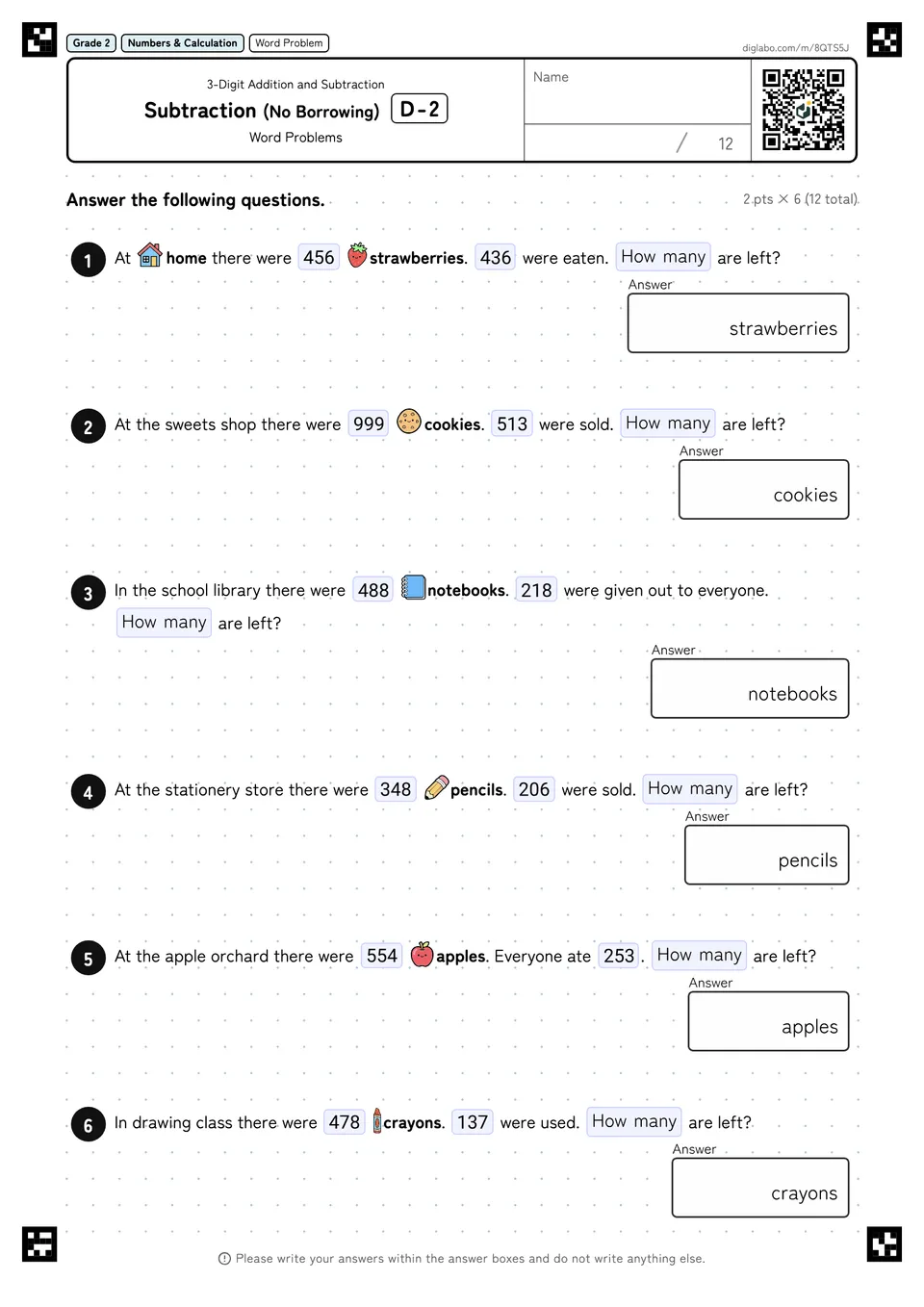
(1)At home there were 456 strawberries. 436 were eaten. How many are left? Answer □
Answer: 20strawberries
(2)At the sweets shop there were 999 cookies. 513 were sold. How many are left? Answer □
Answer: 486cookies
(3)In the school library there were 488 notebooks. 218 were given out to everyone. How many are left? Answer □
Answer: 270notebooks
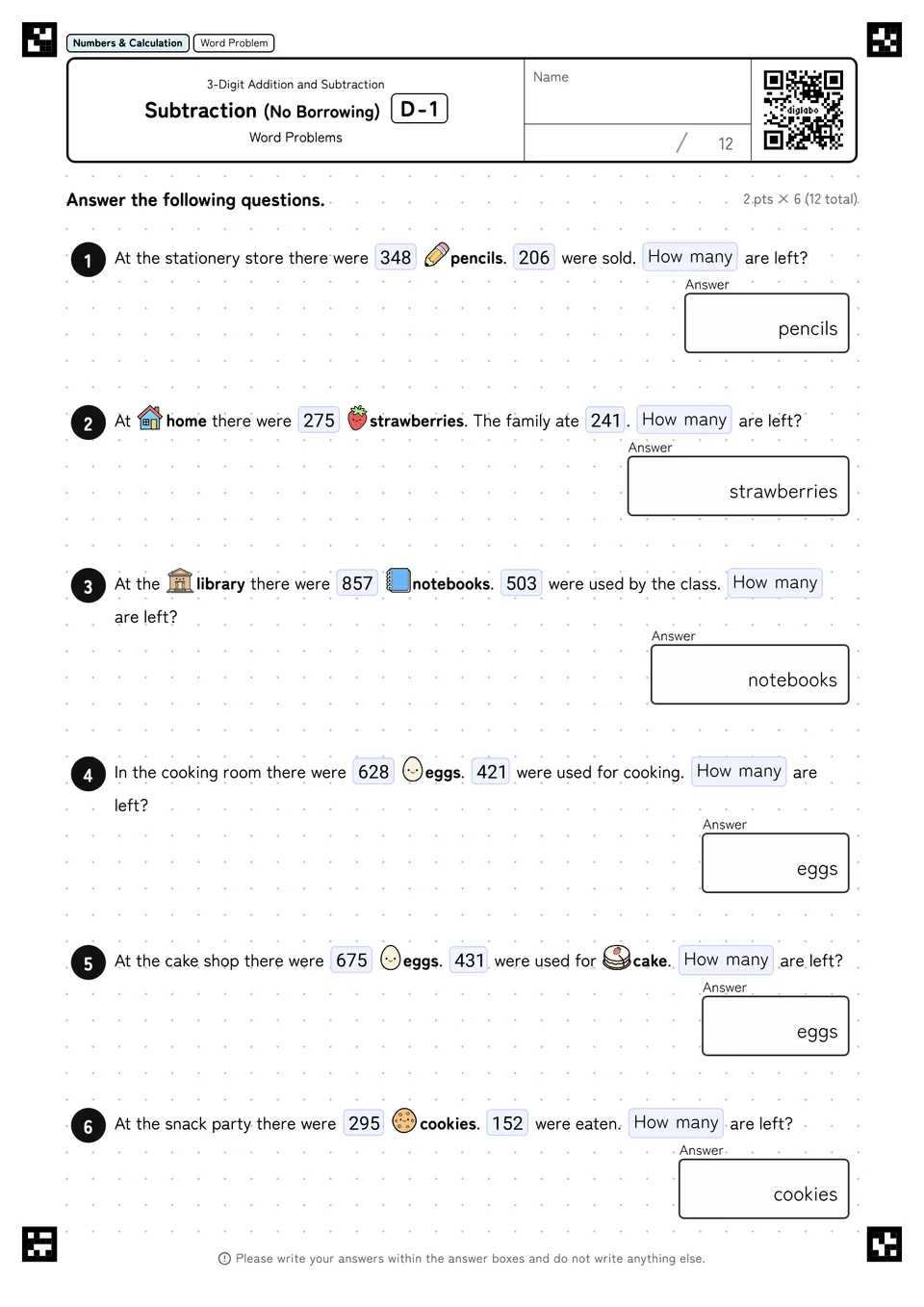
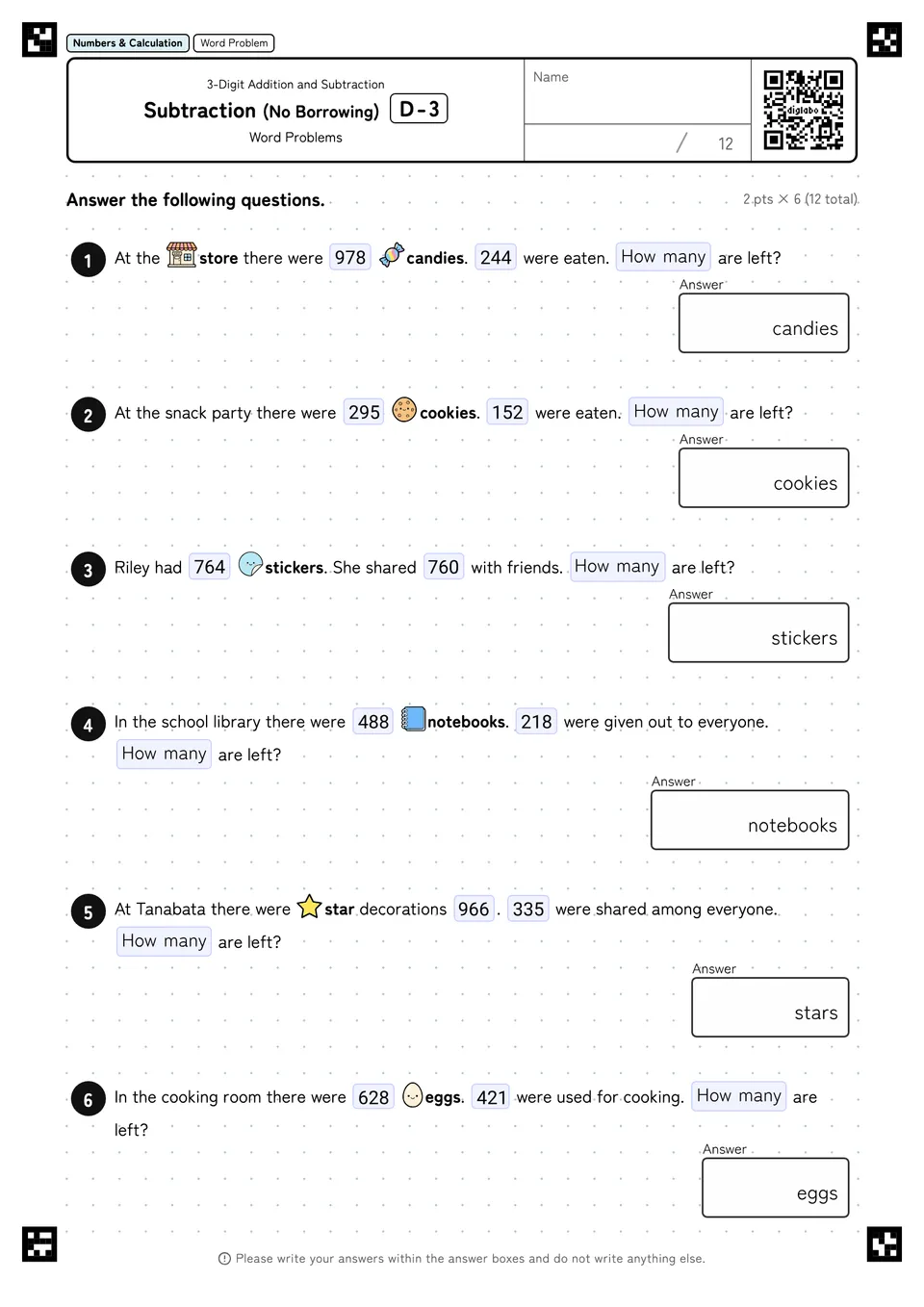
(4)At the stationery store there were 348 pencils. 206 were sold. How many are left? Answer □
Answer: 142pencils
(5)At the apple orchard there were 554 apples. Everyone ate 253. How many are left? Answer □
Answer: 301apples
(6)In drawing class there were 478 crayons. 137 were used. How many are left? Answer □
Answer: 341crayons
What to do next

More worksheets in this unit
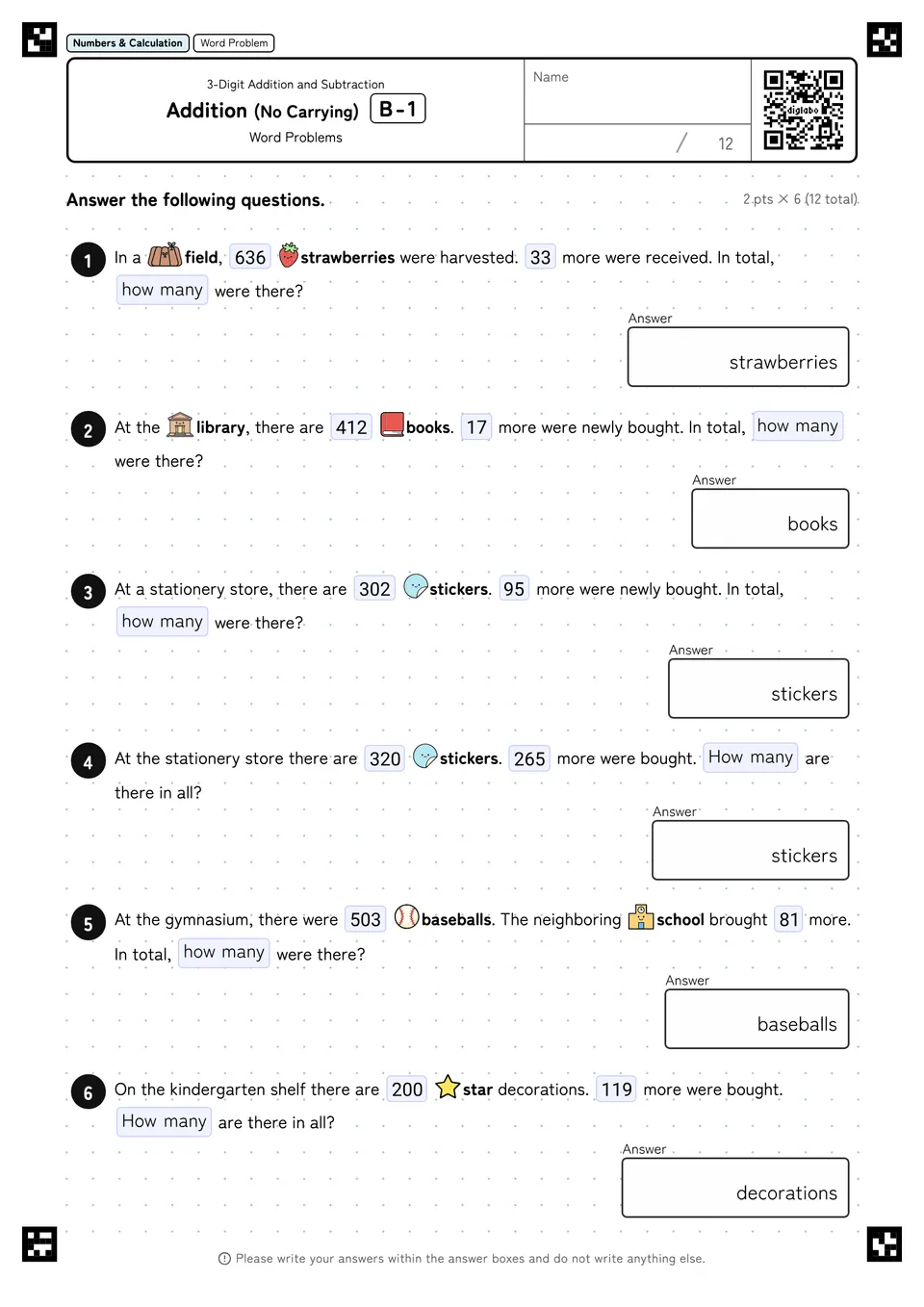 Addition (No Carrying)Addition (No Carrying) Word Problems
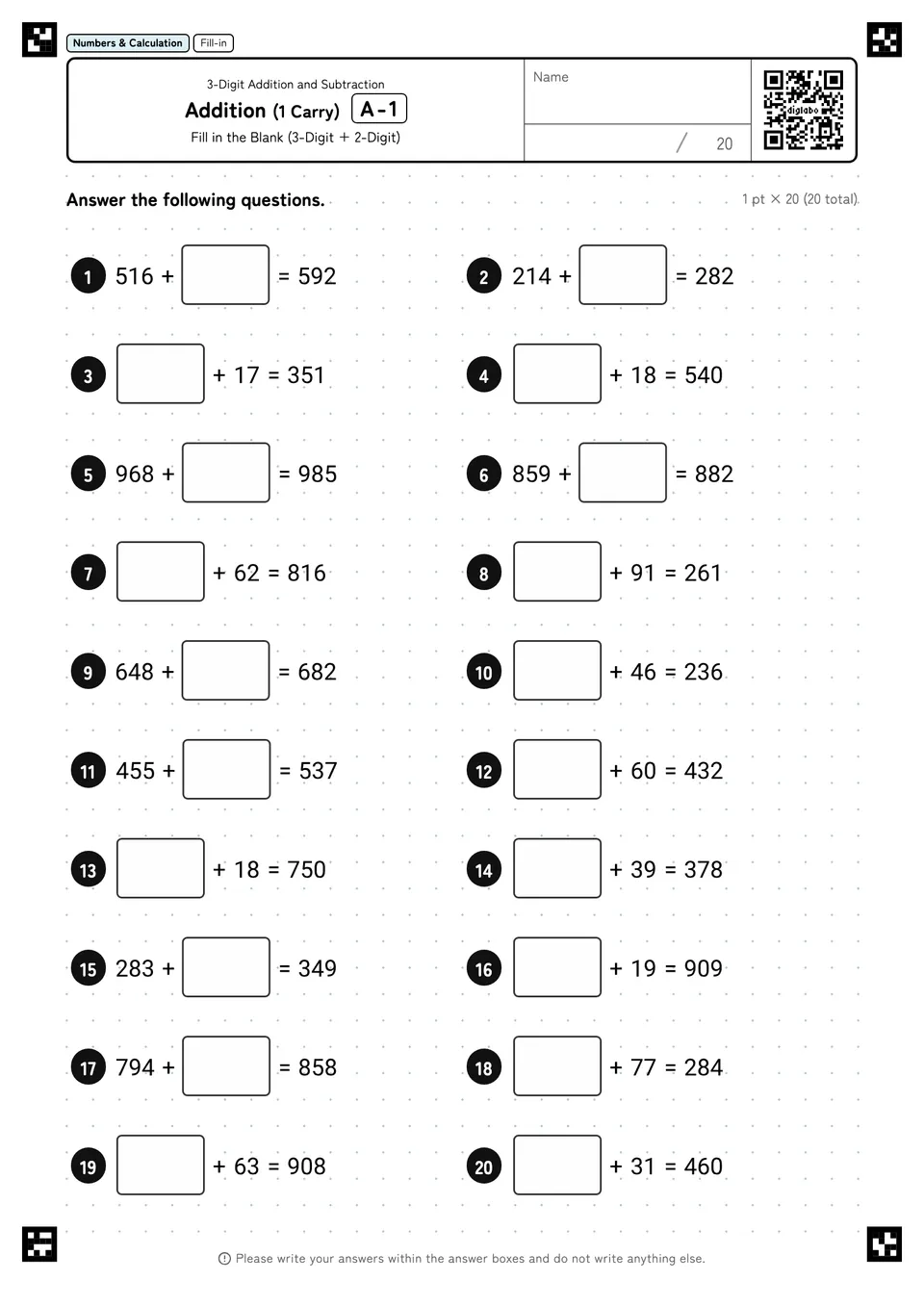 Addition (1 Carry)Addition (1 Carry) Fill in the Blank (3-Digit + 2-Digit)
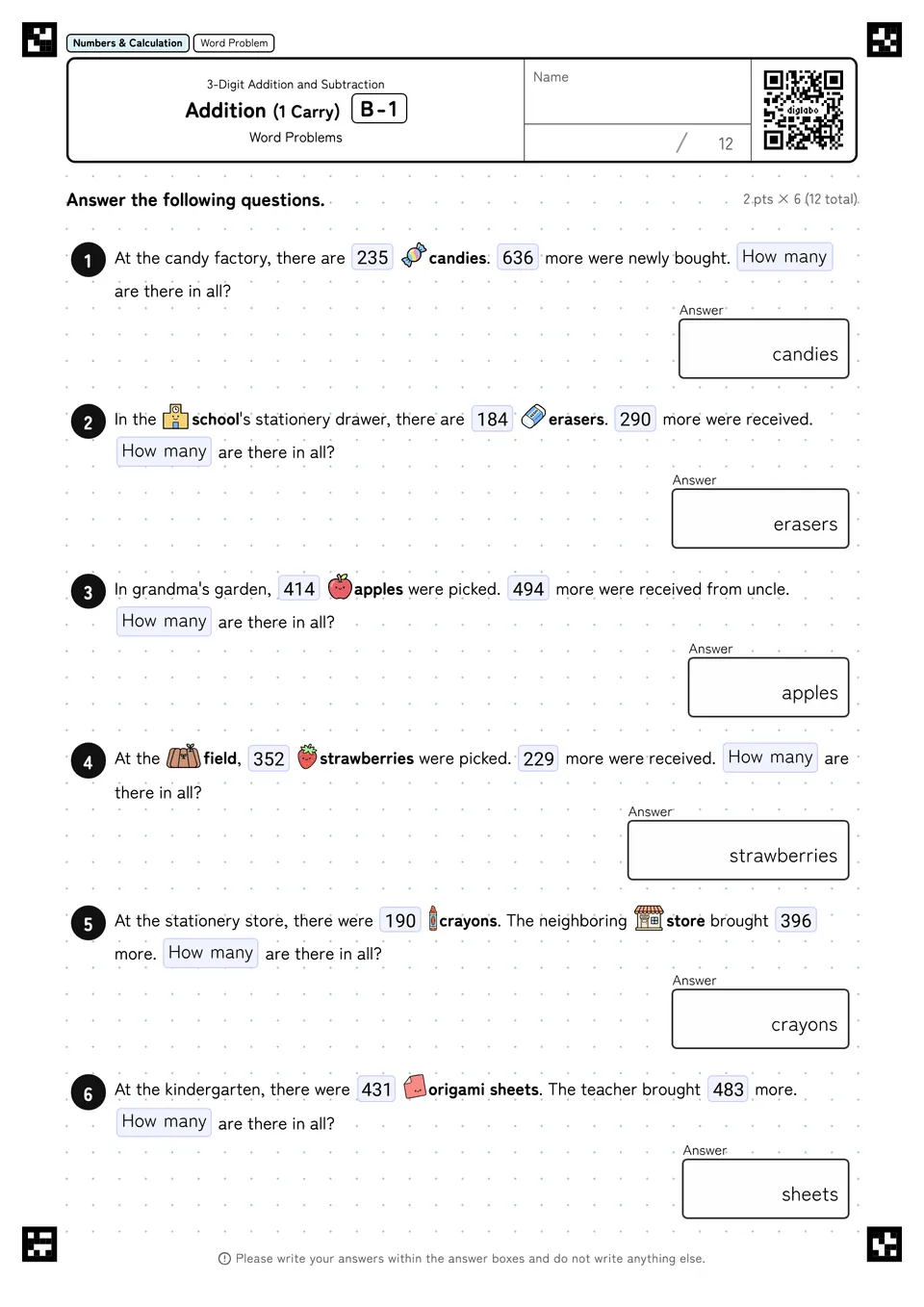 Addition (1 Carry)Addition (1 Carry) Word Problems
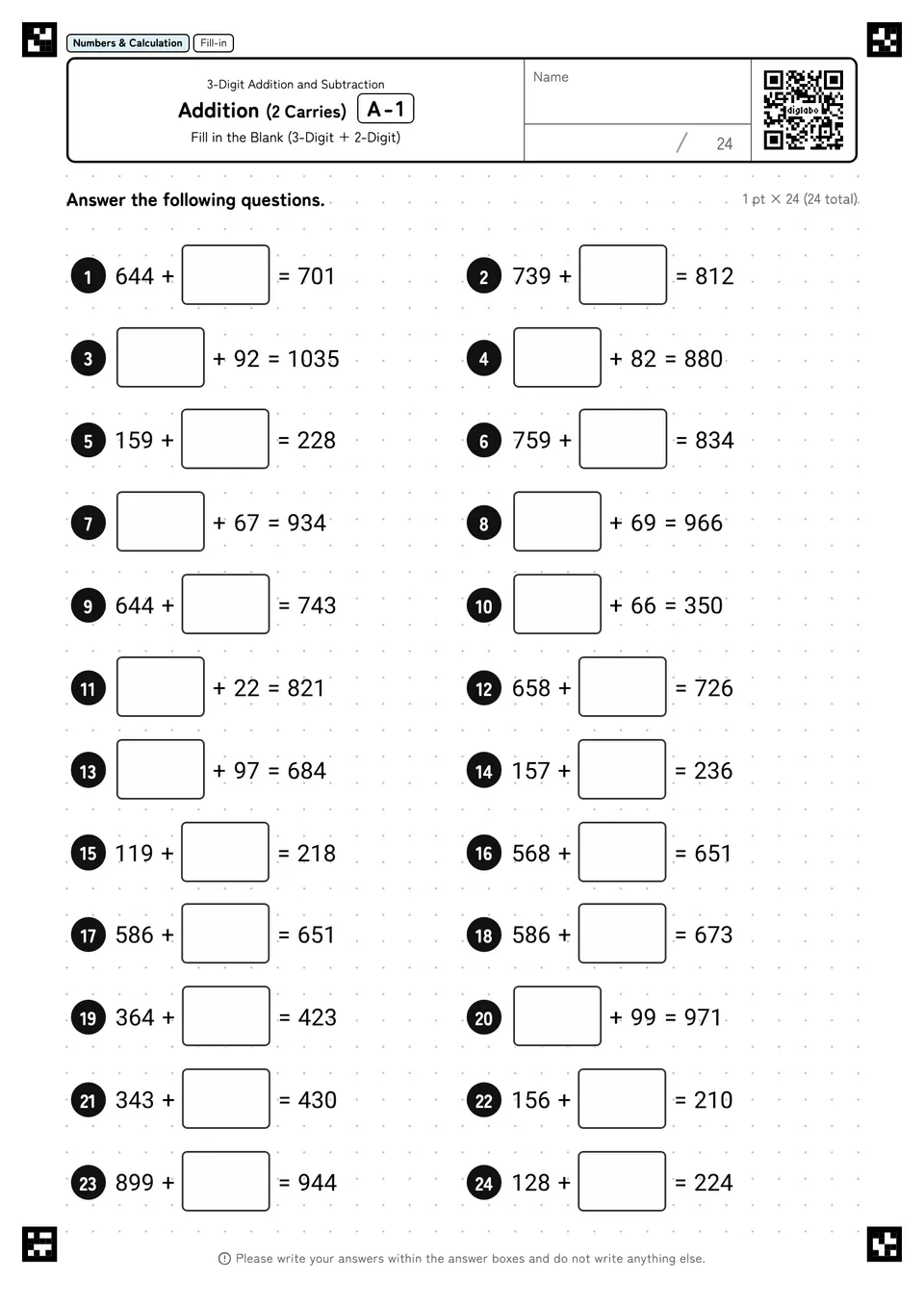 Addition (2 Carries)Addition (2 Carries) Fill in the Blank (3-Digit + 2-Digit)
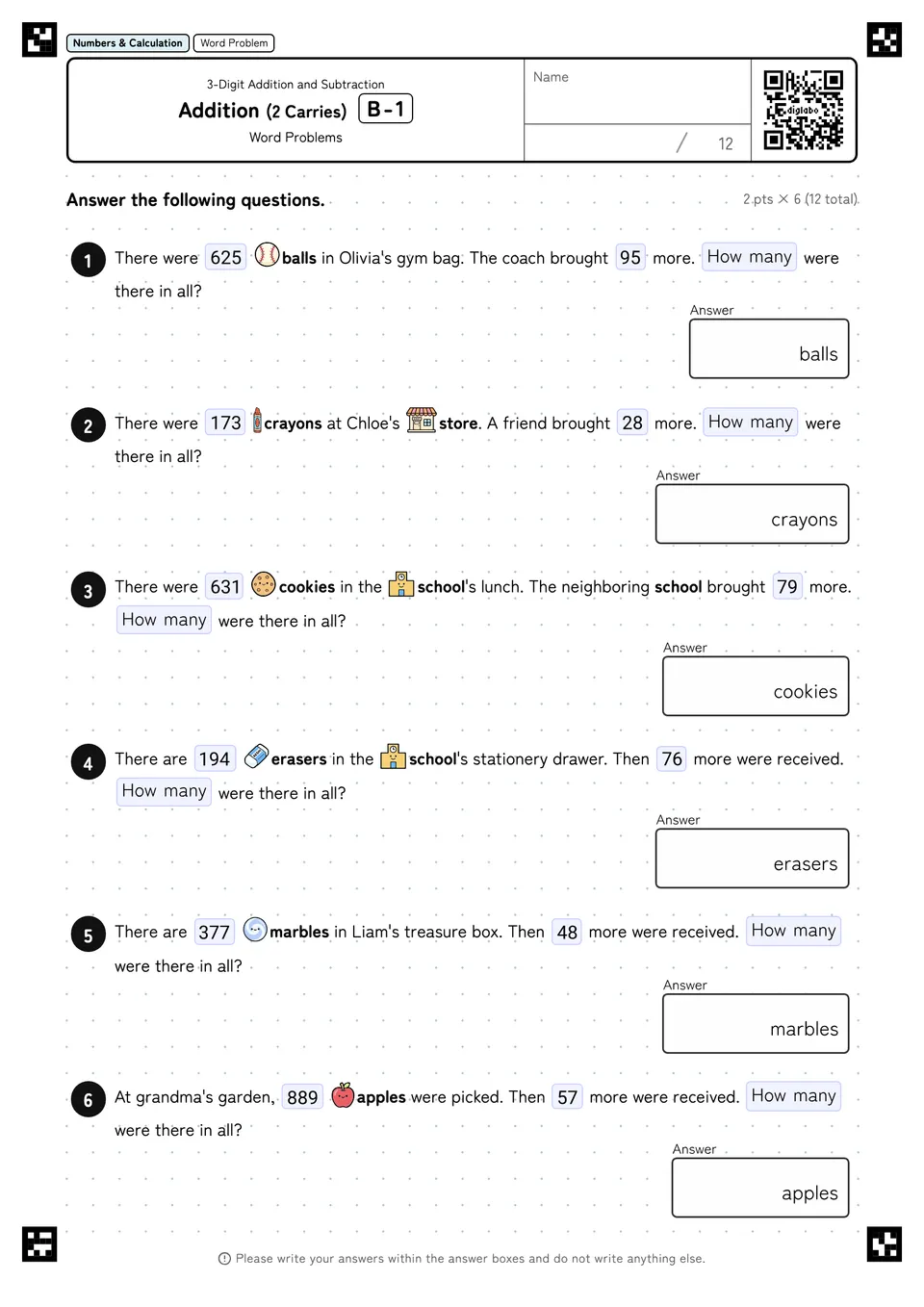 Addition (2 Carries)Addition (2 Carries) Word Problems
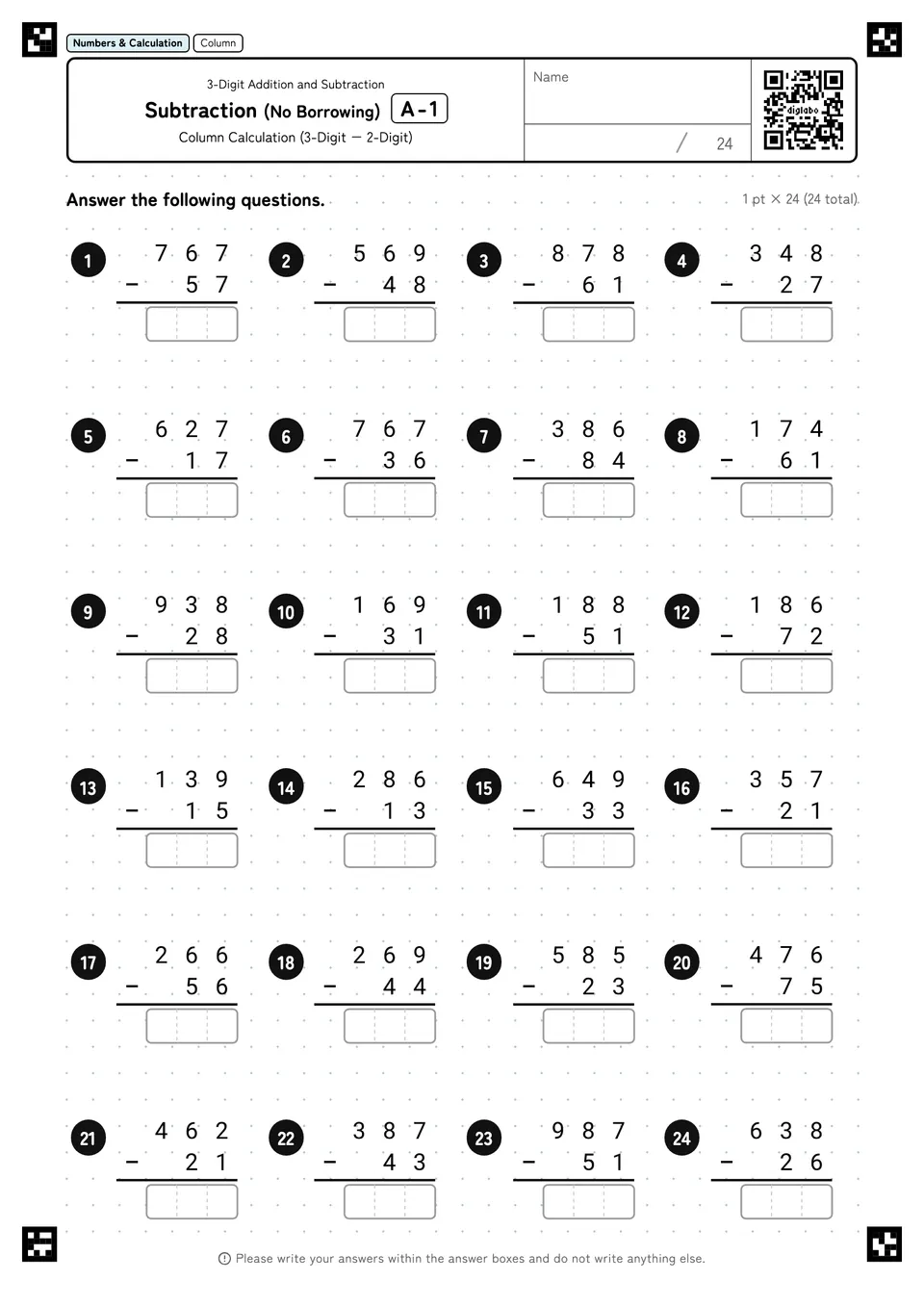 Subtraction (No Borrowing)Subtraction (No Borrowing) Column Calculation (3-Digit − 2-Digit)
 Subtraction (No Borrowing)Subtraction (No Borrowing) Calculation (3-Digit − 2-Digit)
 Subtraction (No Borrowing)Subtraction (No Borrowing) Fill in the Blank (3-Digit − 2-Digit)
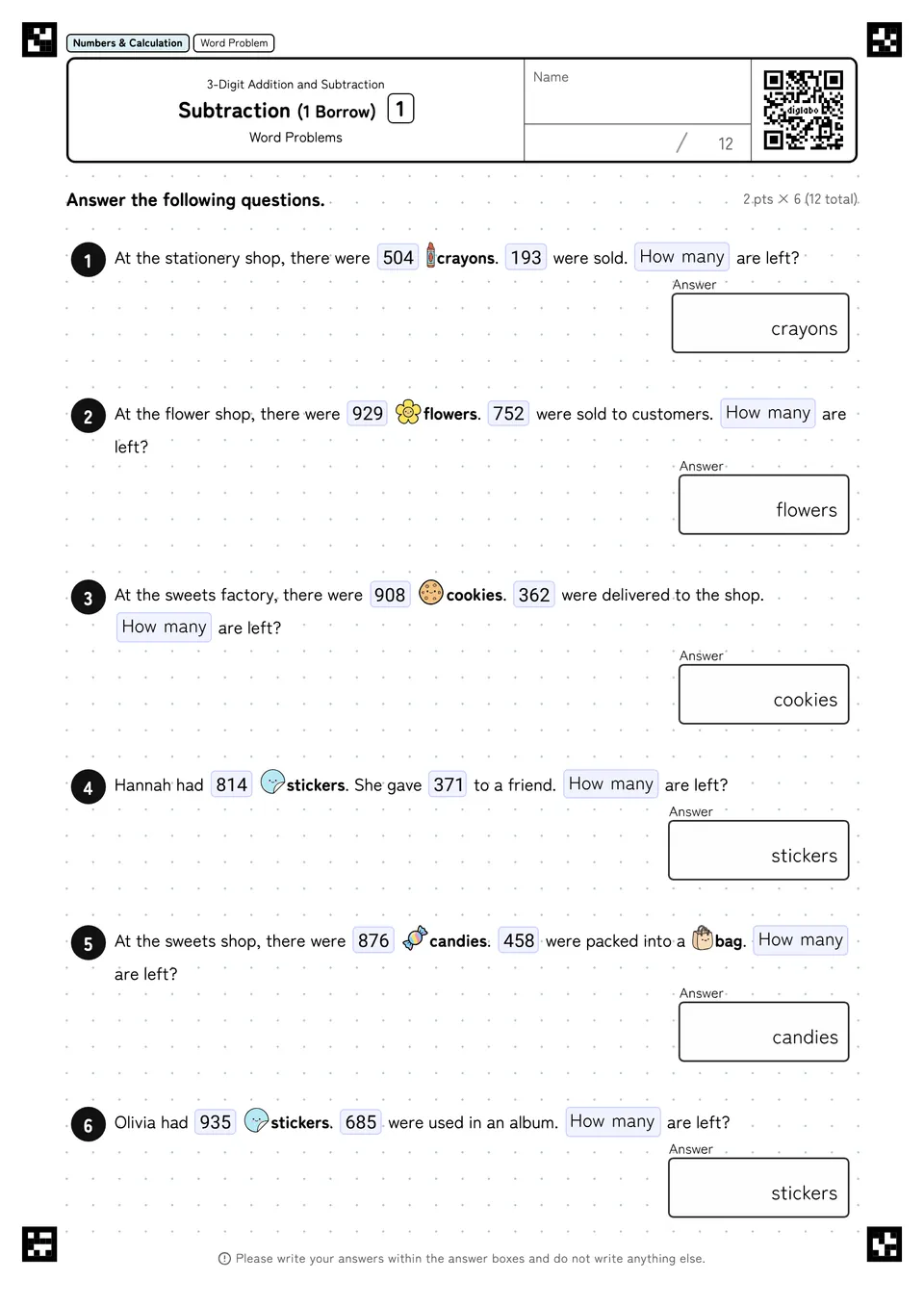 Subtraction (1 Borrow)Subtraction (1 Borrow) Word Problems
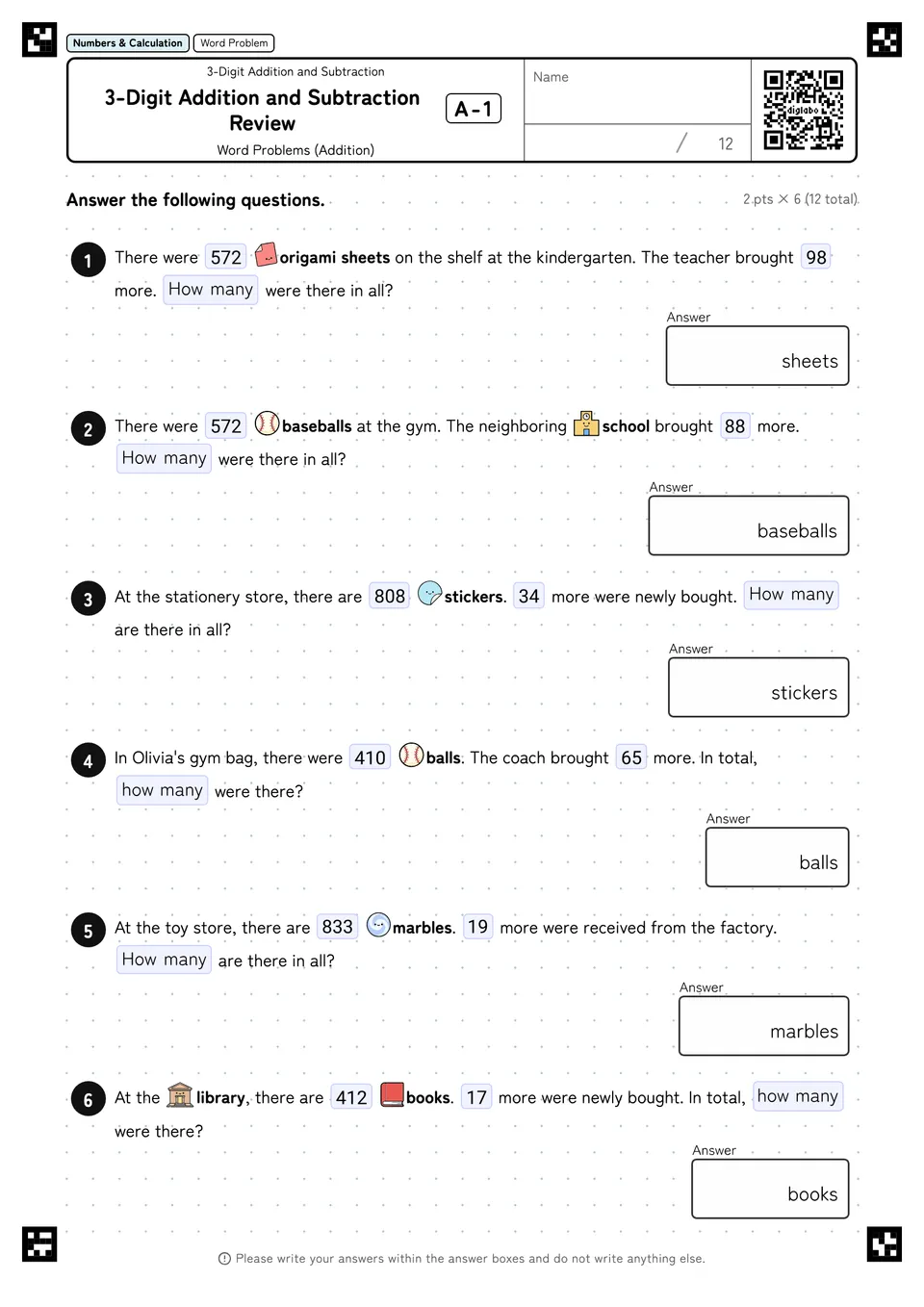 3-Digit Addition and Subtraction Review3-Digit Addition and Subtraction Review Word Problems (Addition)
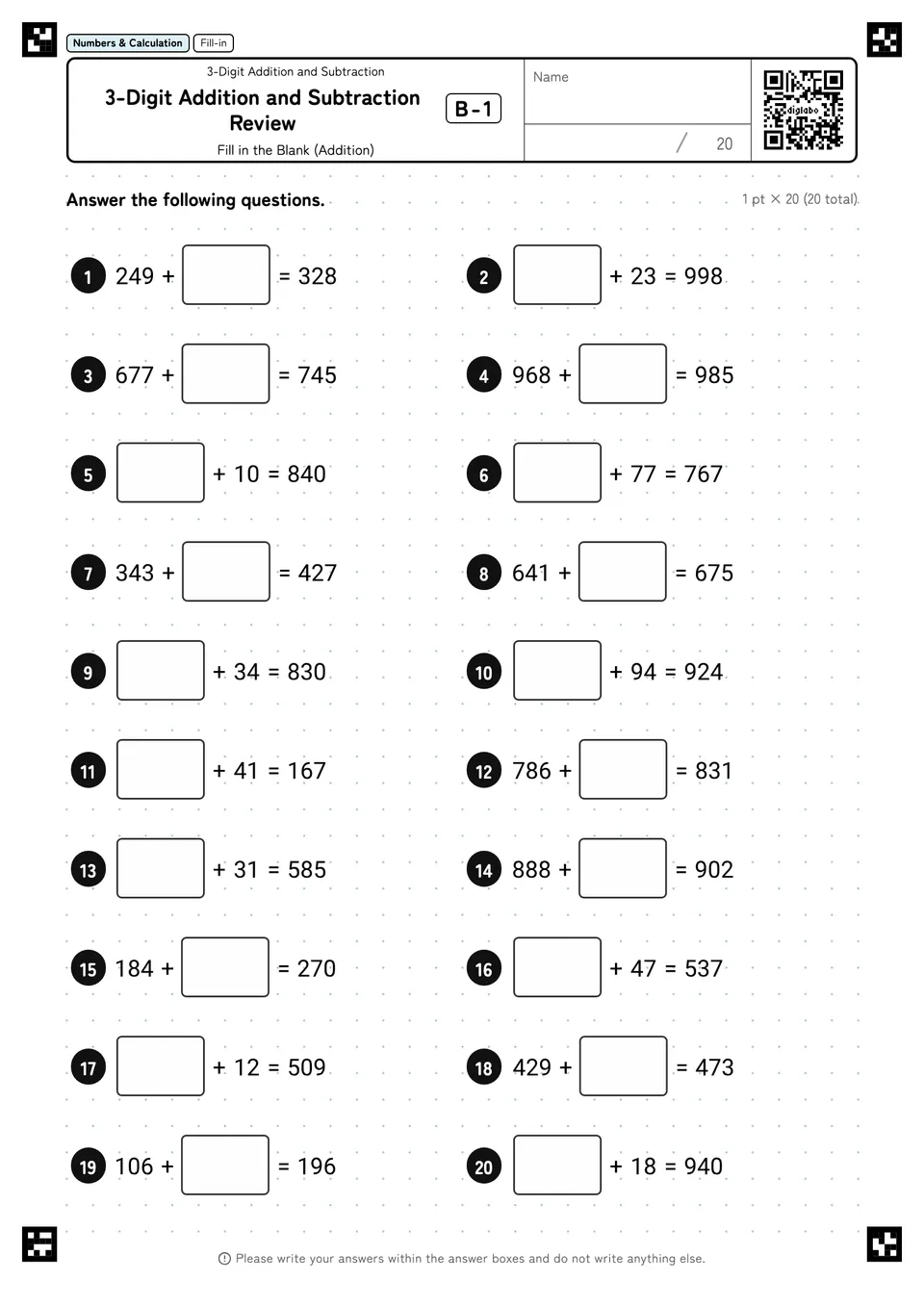 3-Digit Addition and Subtraction Review3-Digit Addition and Subtraction Review Fill in the Blank (Addition)
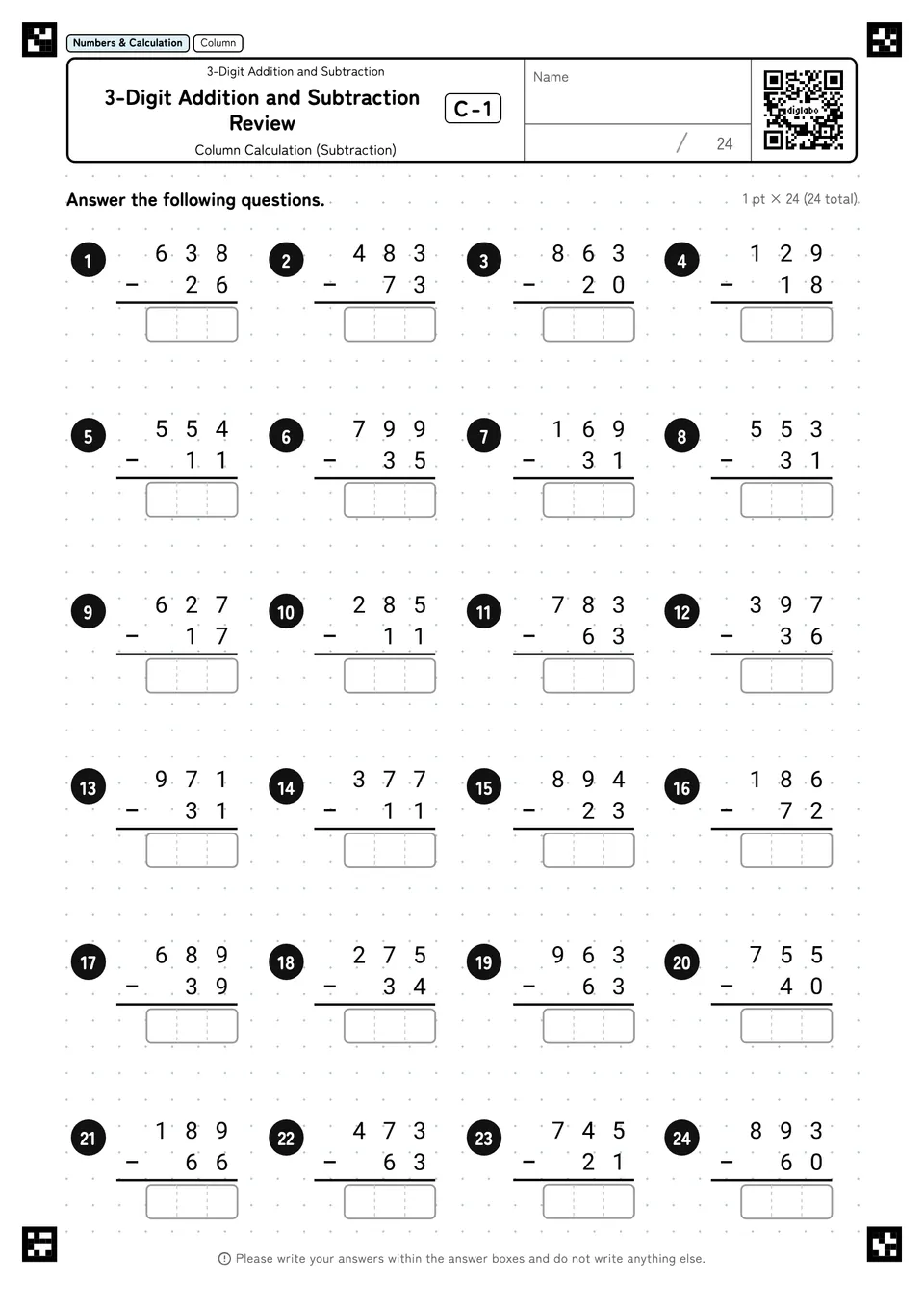 3-Digit Addition and Subtraction Review3-Digit Addition and Subtraction Review Column Calculation (Subtraction)
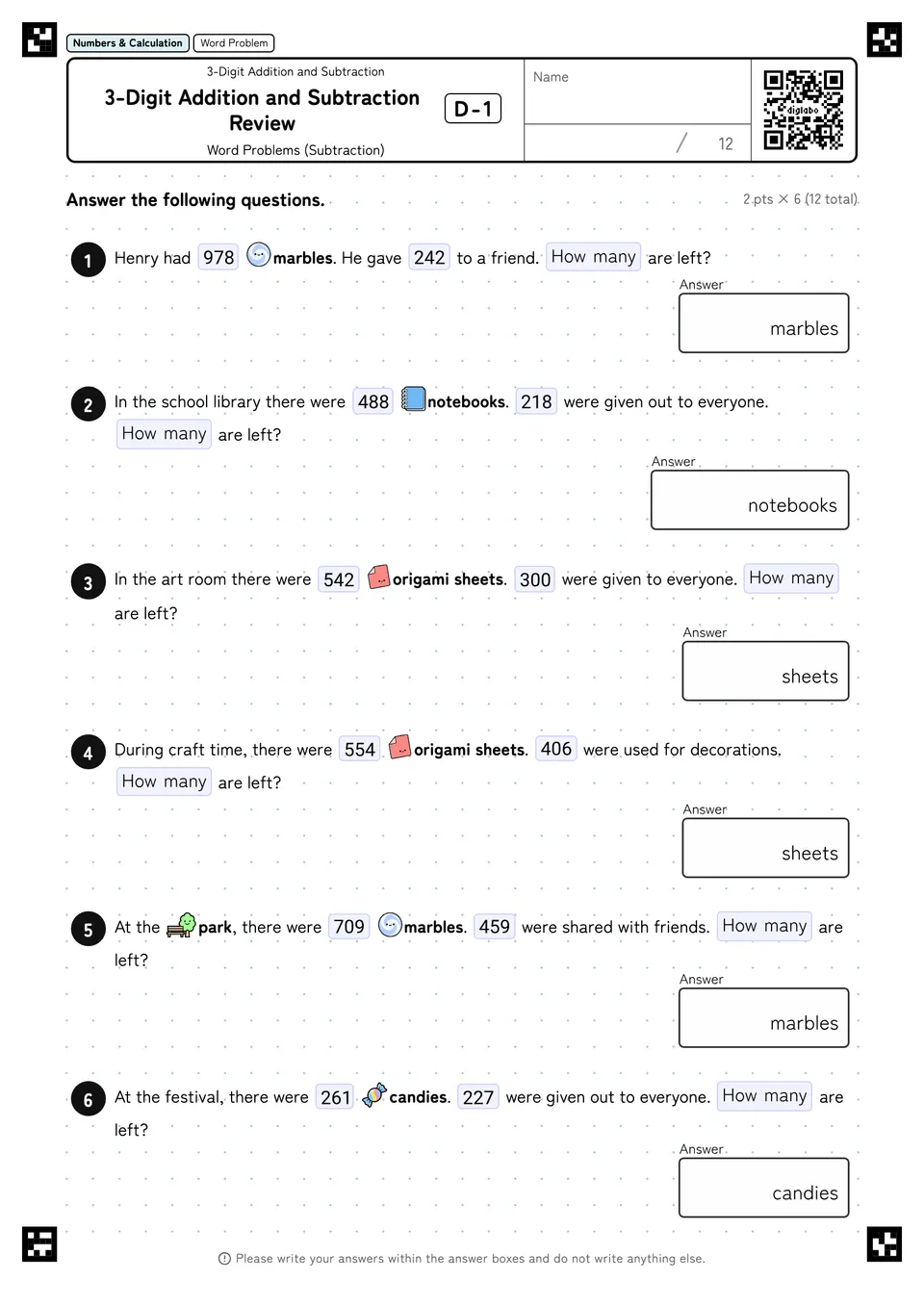 3-Digit Addition and Subtraction Review3-Digit Addition and Subtraction Review Word Problems (Subtraction)