
Math Drills · Grade 2 (Elementary School)
Capacity (L, dL, mL)
52 free maths worksheets for “Capacity (L, dL, mL)” in Grade 2 (Elementary School). Download the question and answer PDFs and print them, no sign-up needed.
WorksheetsWhat this unit covers
L, dL and mL are met by counting containers and reading a scale. With 1 L = 10 dL and 1 dL = 100 mL, children restate a quantity in another unit, then add and subtract within one unit and across units, including the cases that carry and borrow.
The standard error is misremembering 1 L as 100 mL and writing 3 L as 300 mL, so an answer with one zero missing identifies it. In Measuring Capacity (Reading the Scale), children count the lines without checking whether one mark stands for 1 dL or 2 dL, and write half the real value.
Comparing Capacity judged more and less by pouring water between containers; here, the amount of water is written as a number of L, dL or mL. This numerical way of grasping quantity continues into Decimal Units (Capacity and Length) in grade 3, where compound units are rewritten as decimals.
Learning steps
- Ways to Compare and UnitsMeasuring Capacity (Counting Containers)Measuring Capacity (Total on the Scale)Measuring Capacity (Reading the Scale)
- Units (L, dL, mL)L→dLdL→LL→mLmL→LdL→mLmL→dLdL→L, dLL, dL→mLmL→L, dL
- Addition (Same Units)EquationsWord Problems
- Addition (Different Units)EquationsWord Problems
- Addition (With Carrying)EquationsWord Problems
- Subtraction (Same Units)EquationsWord Problems
- Subtraction (Different Units)EquationsWord Problems
- Subtraction (With Borrowing)EquationsWord Problems
Worksheets
Ways to Compare and Units
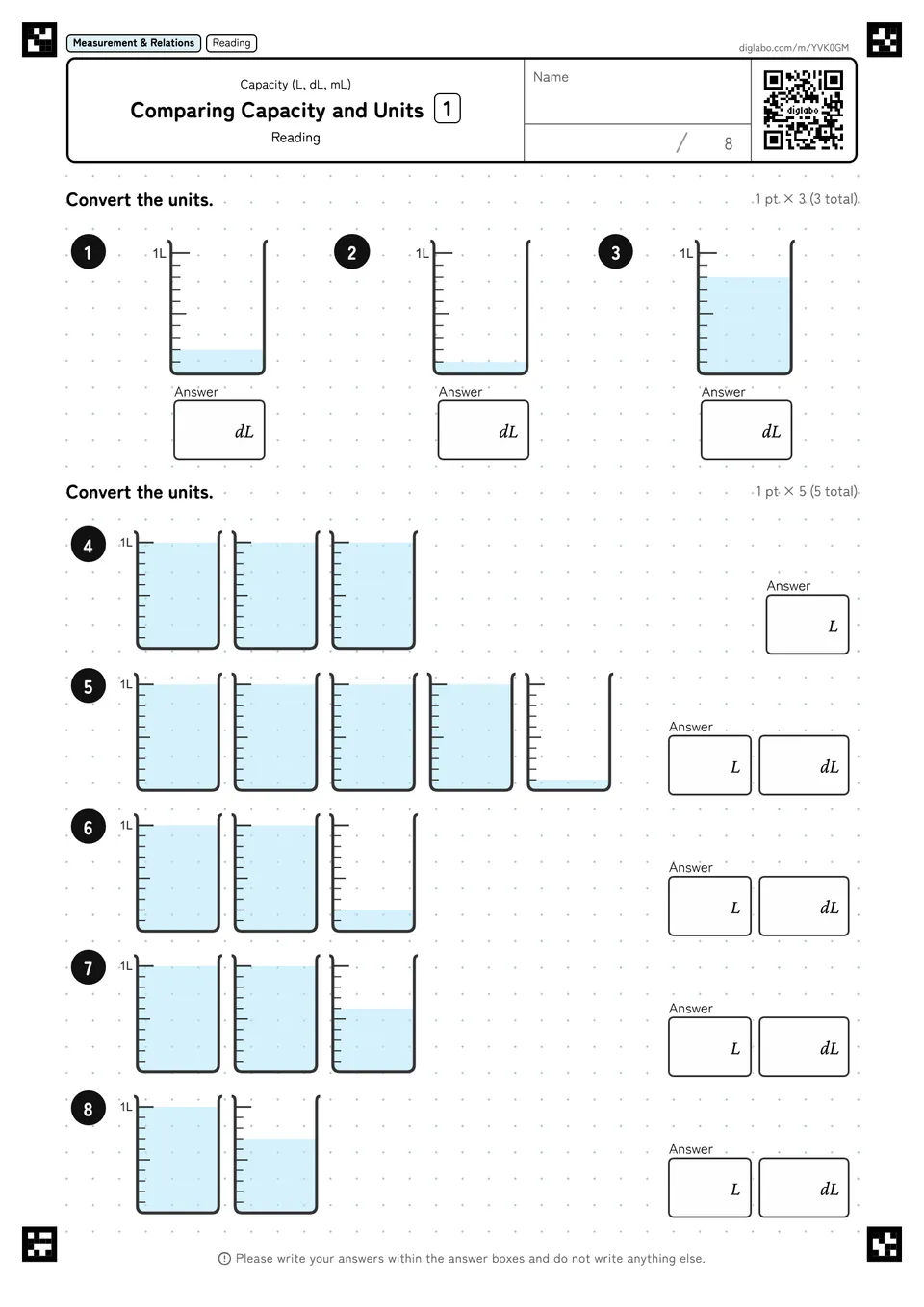
Units (L, dL, mL)
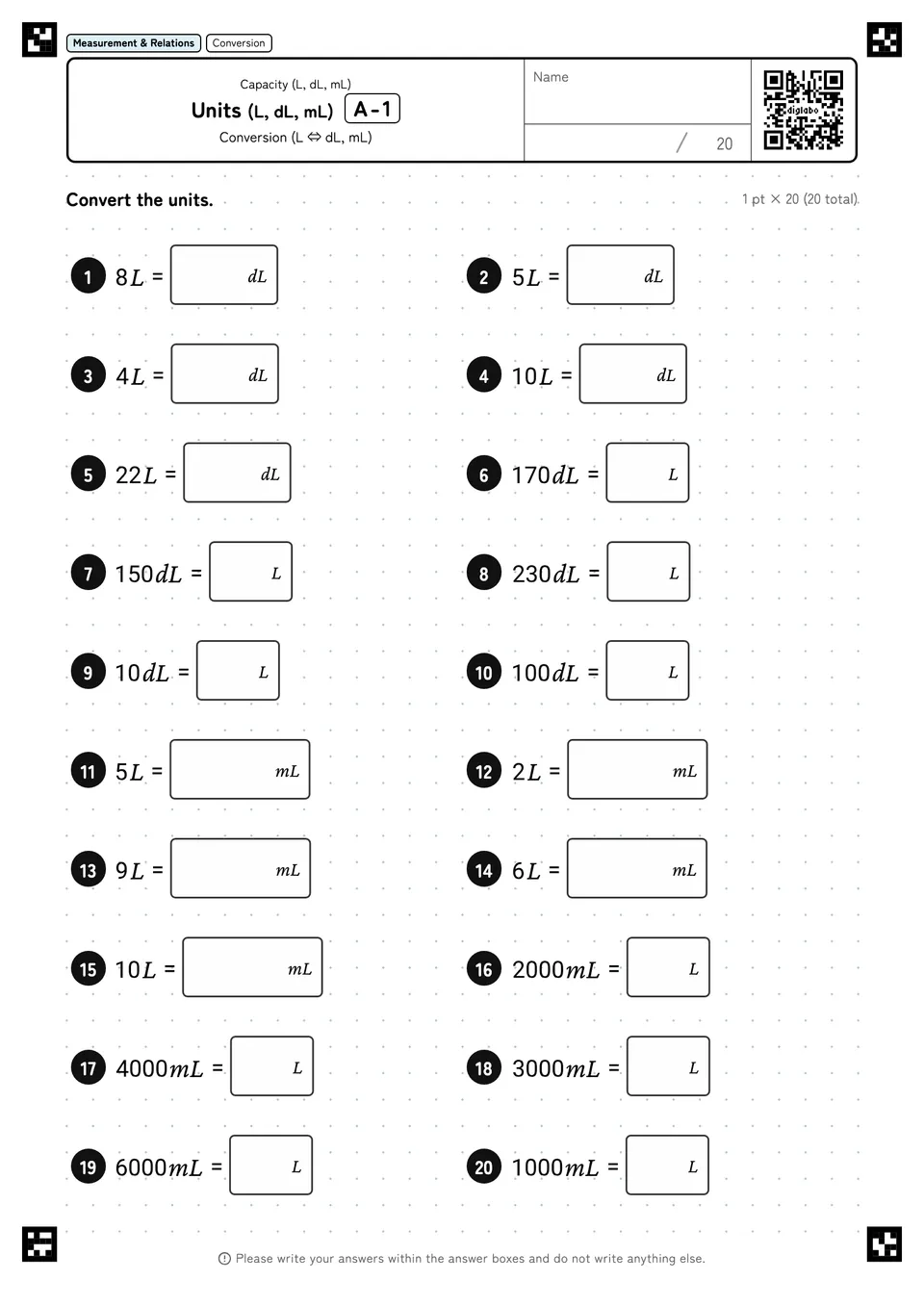
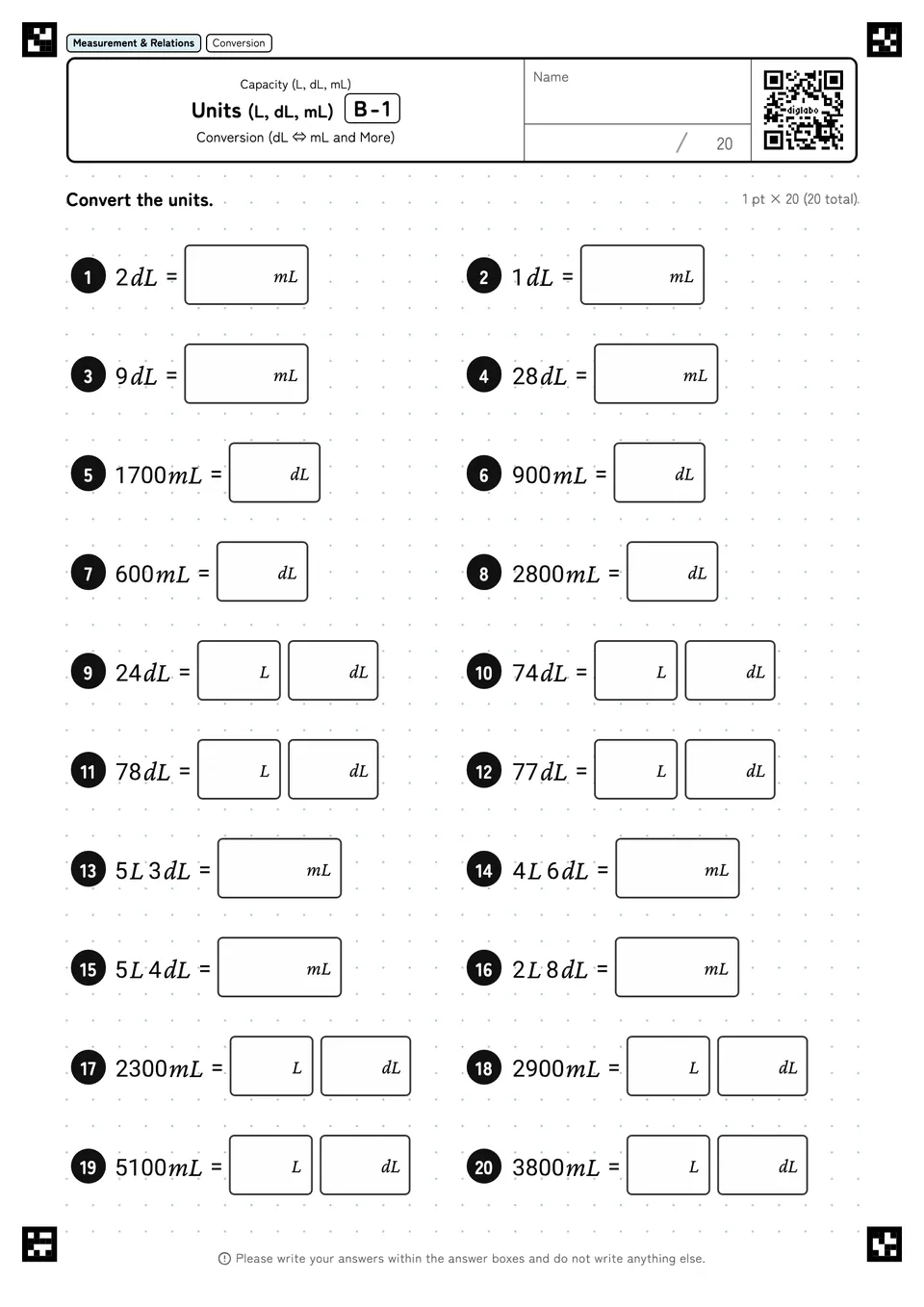
Addition (Same Units)
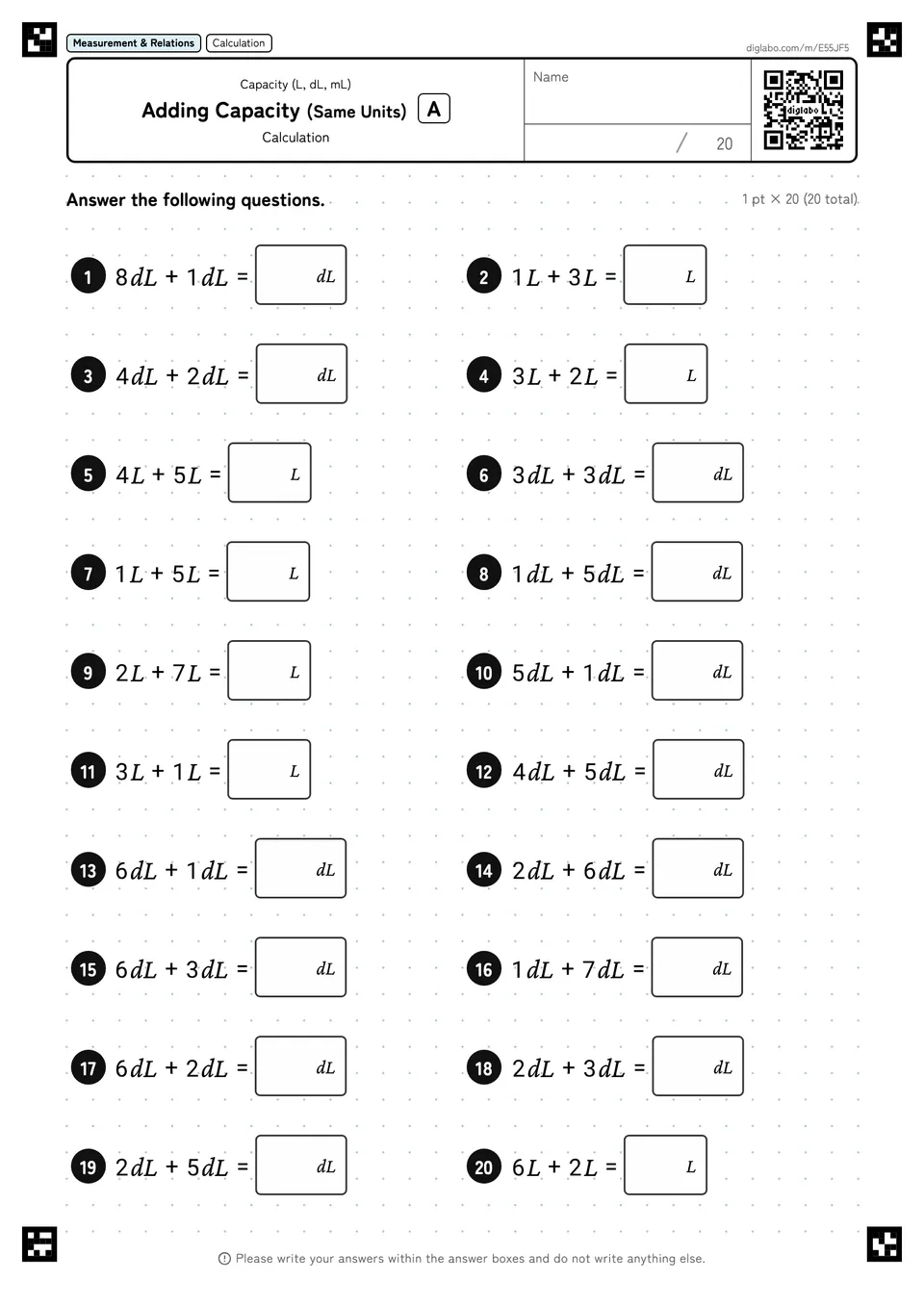
Calculation
- Equations20 questions
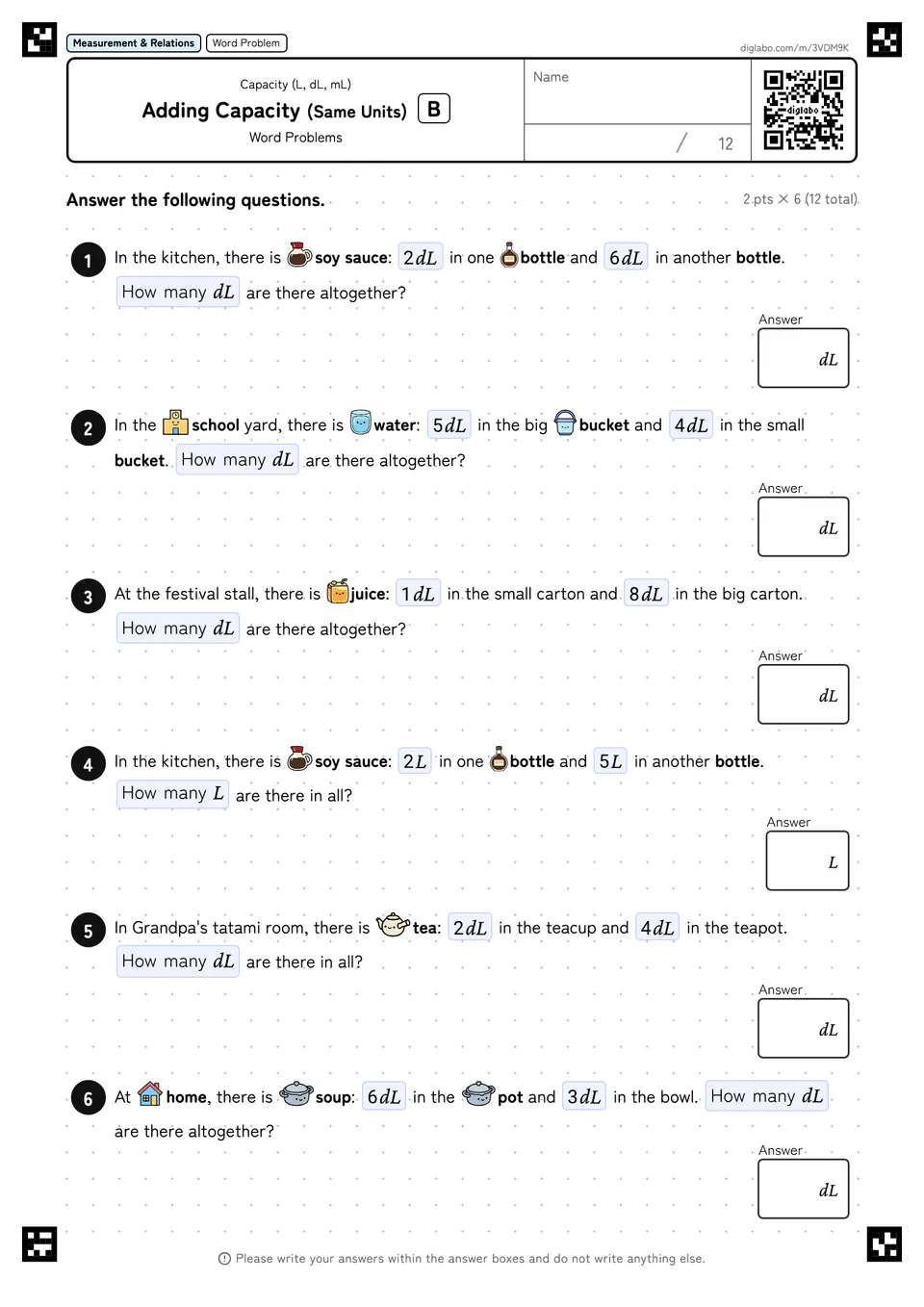
Word Problems
- Word Problems6 questions
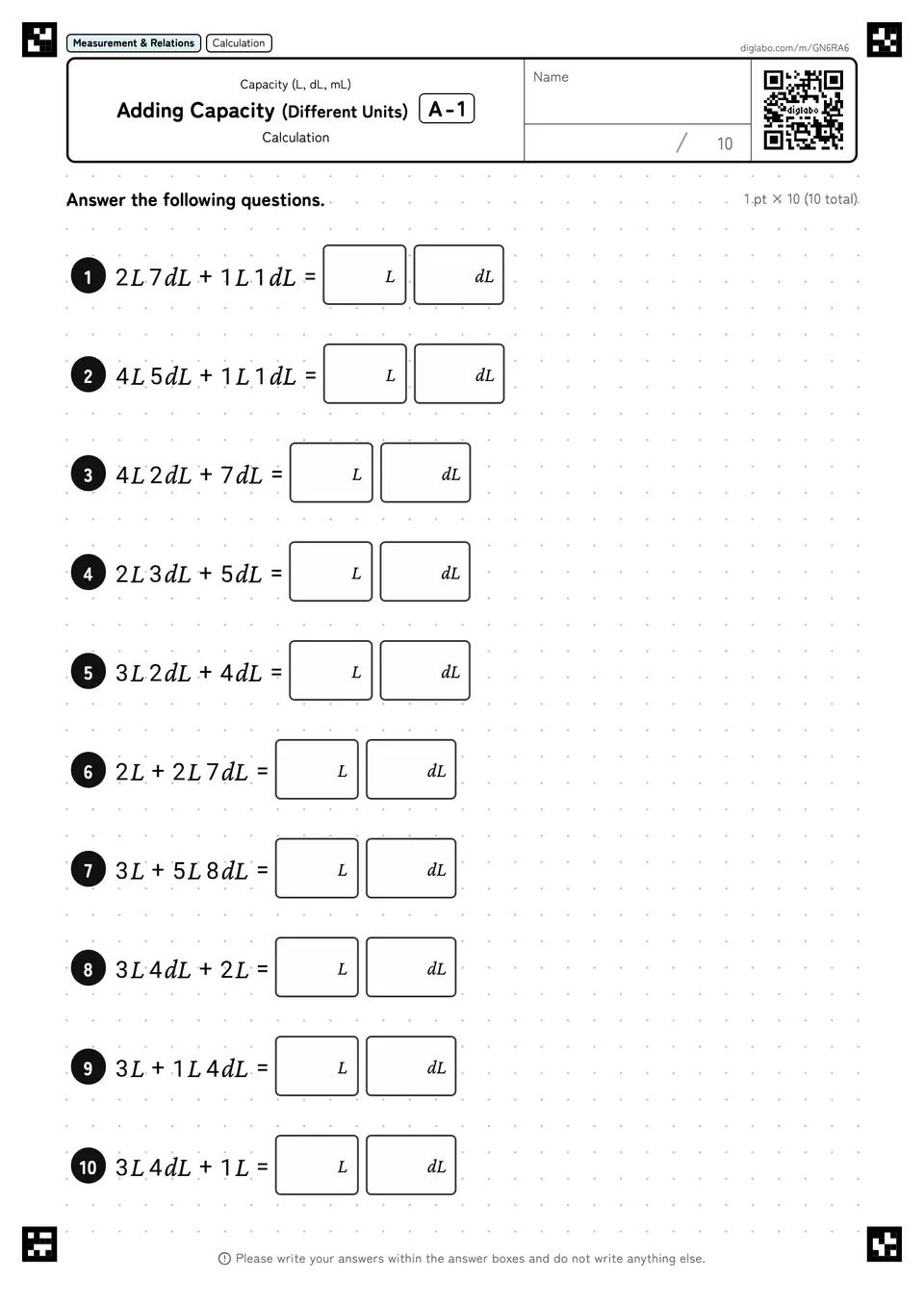
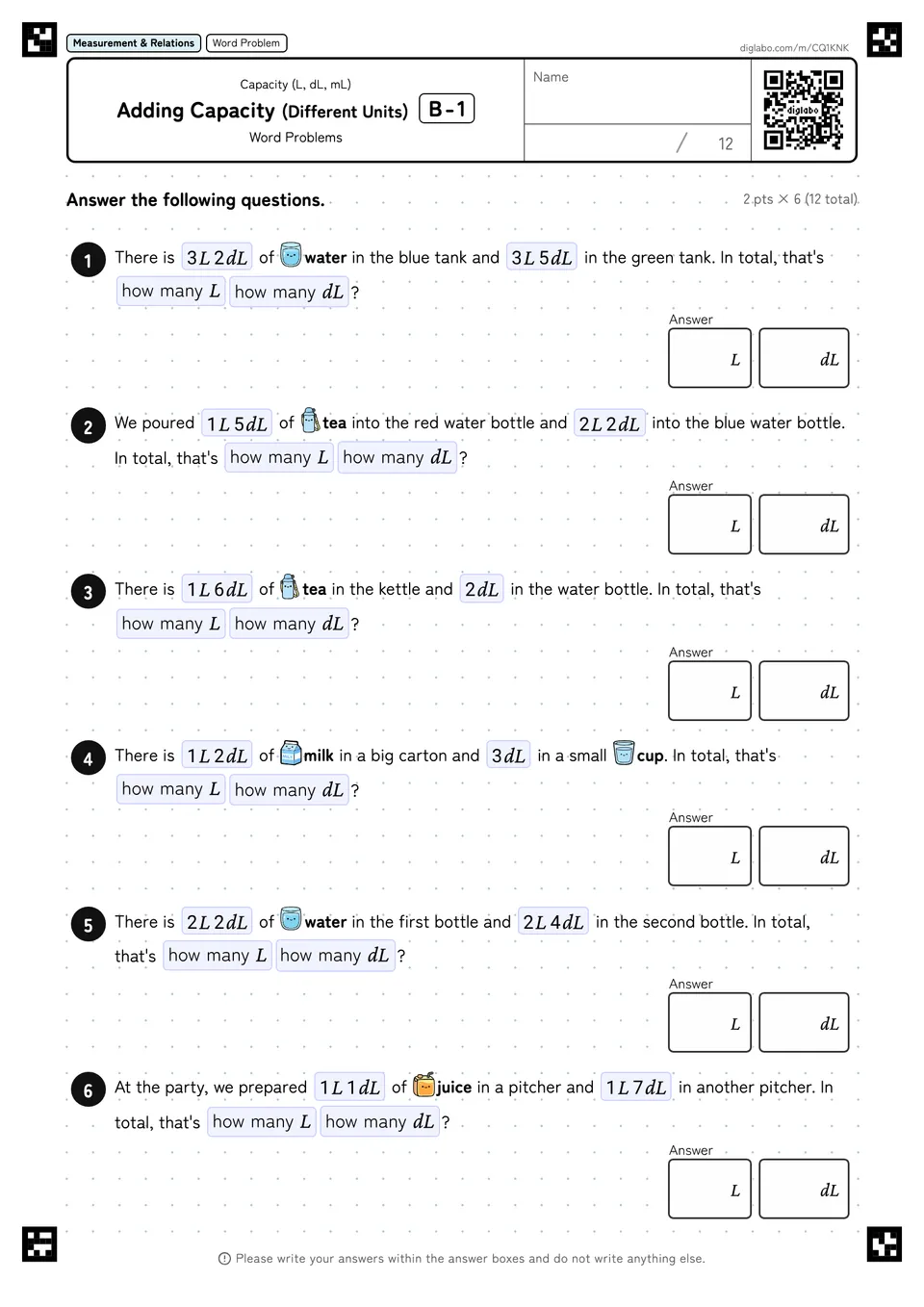
Addition (Different Units)
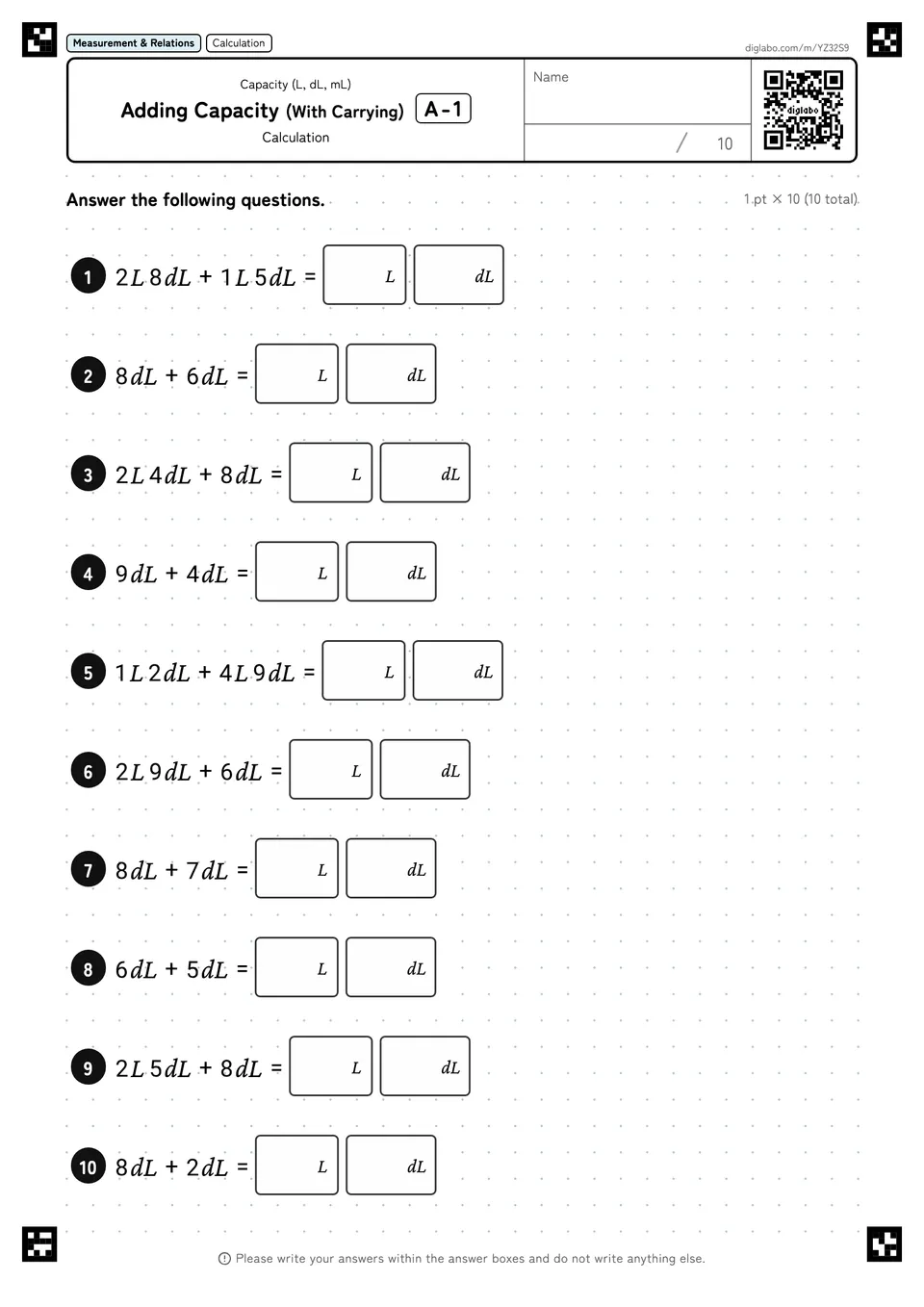
Addition (With Carrying)
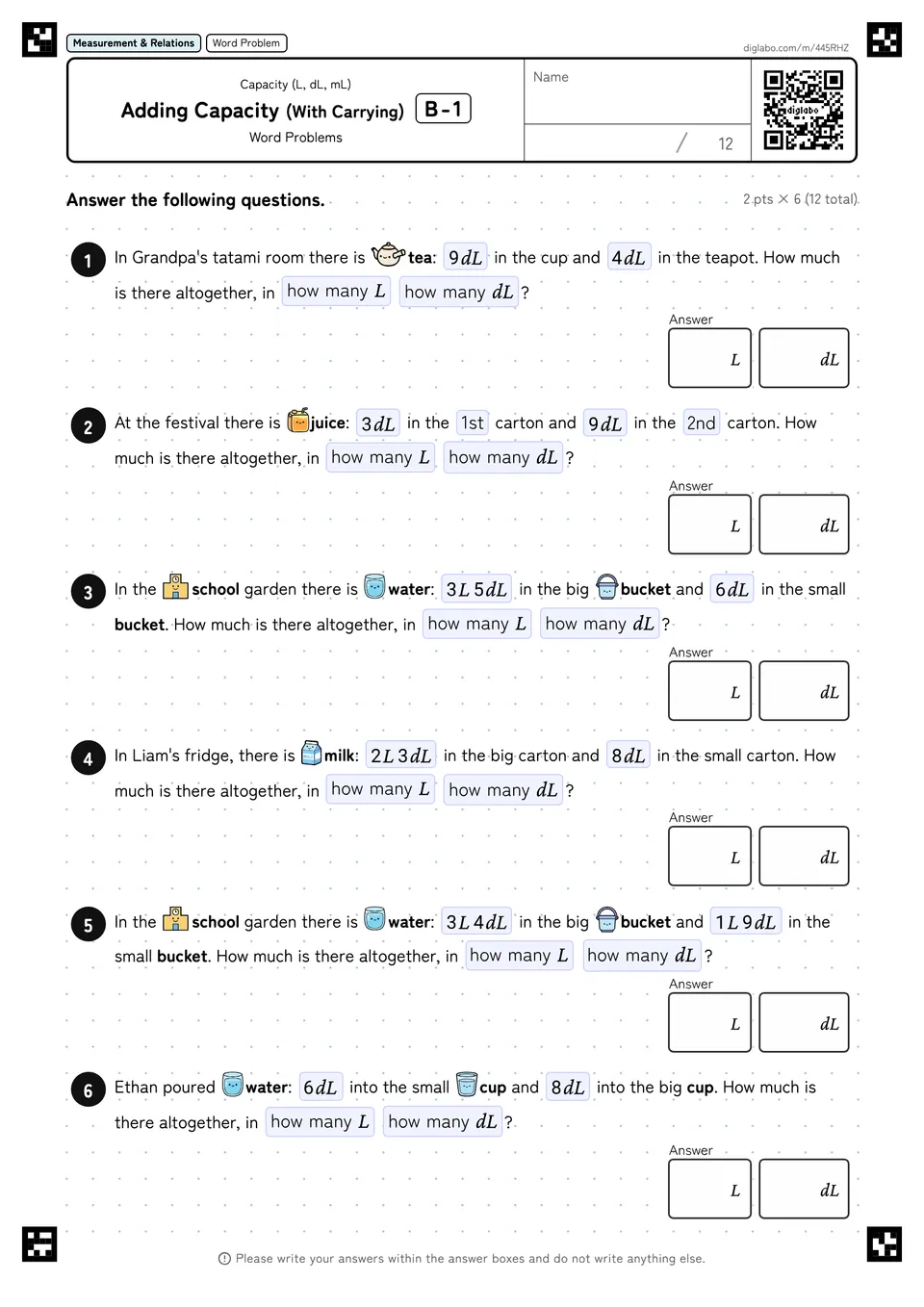
Subtraction (Same Units)
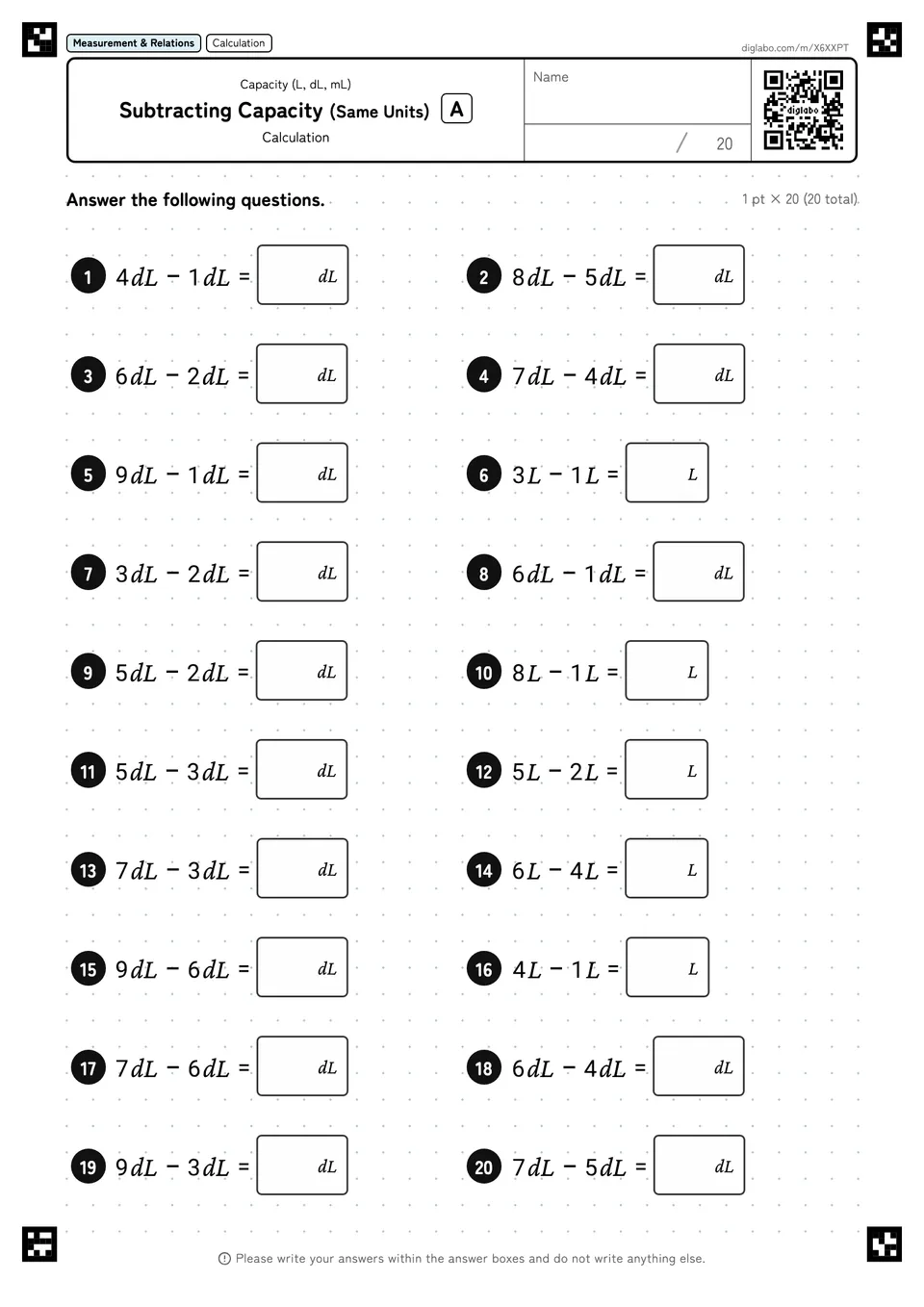
Calculation
- Equations20 questions
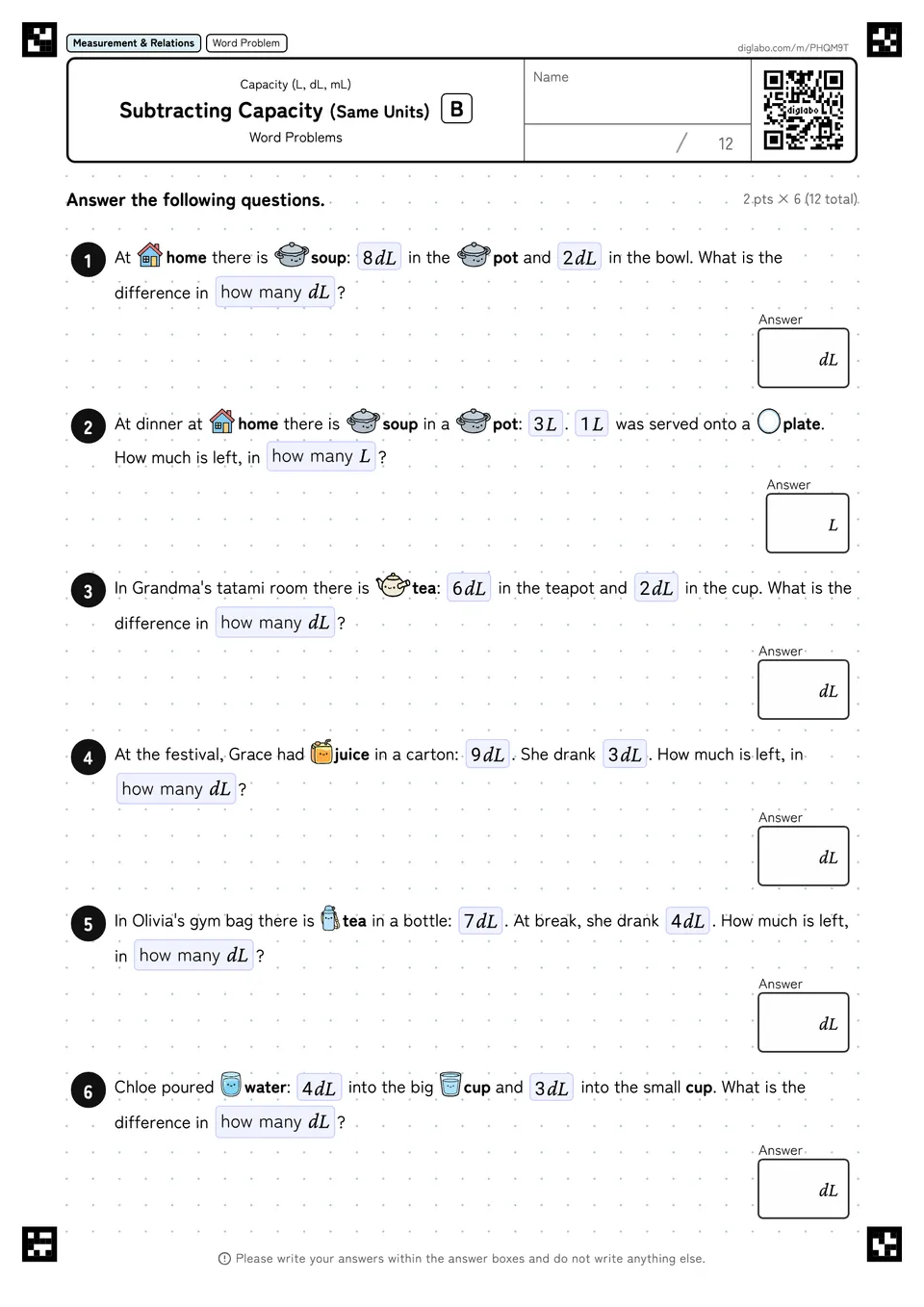
Word Problems
- Word Problems6 questions
Subtraction (Different Units)
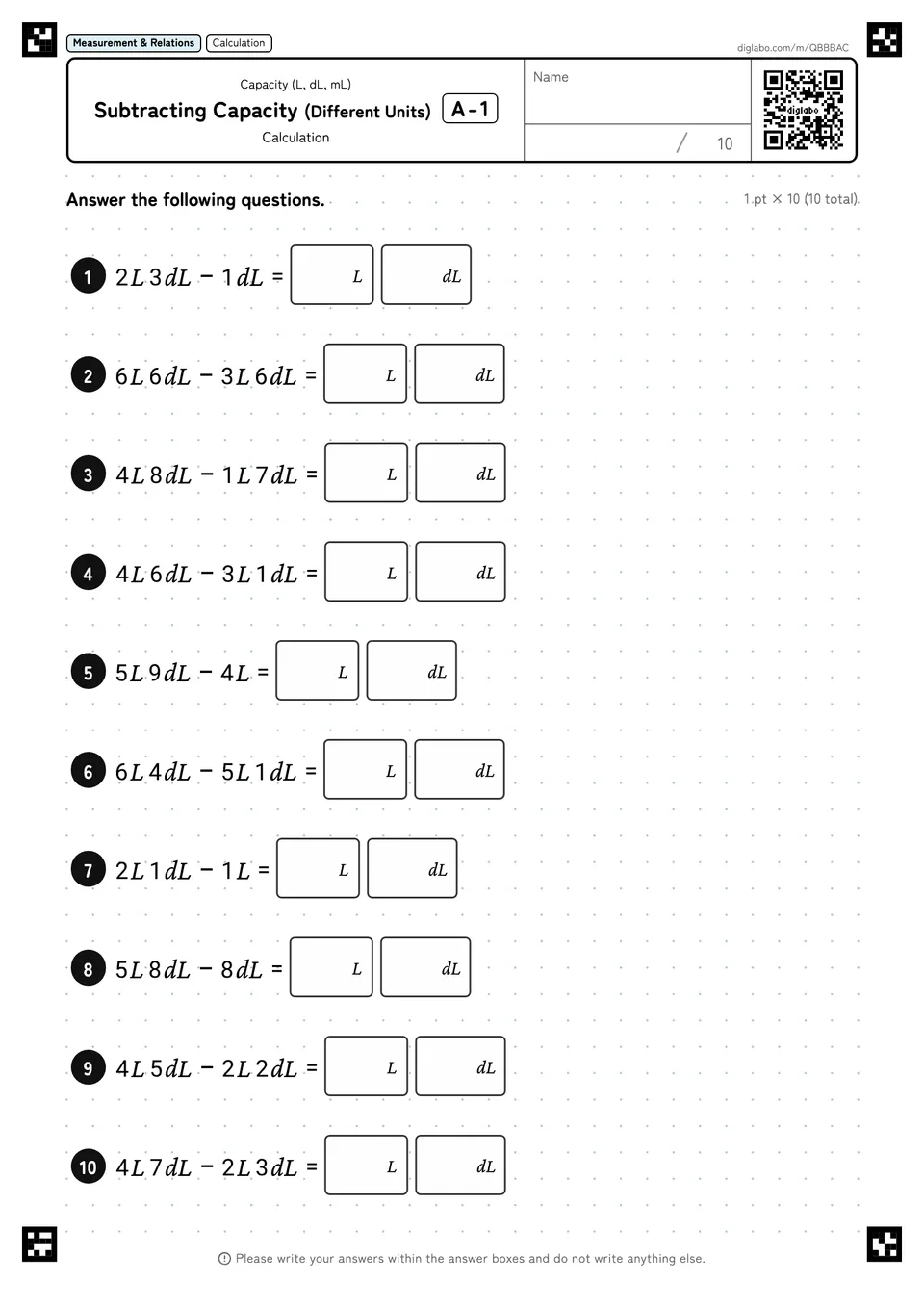
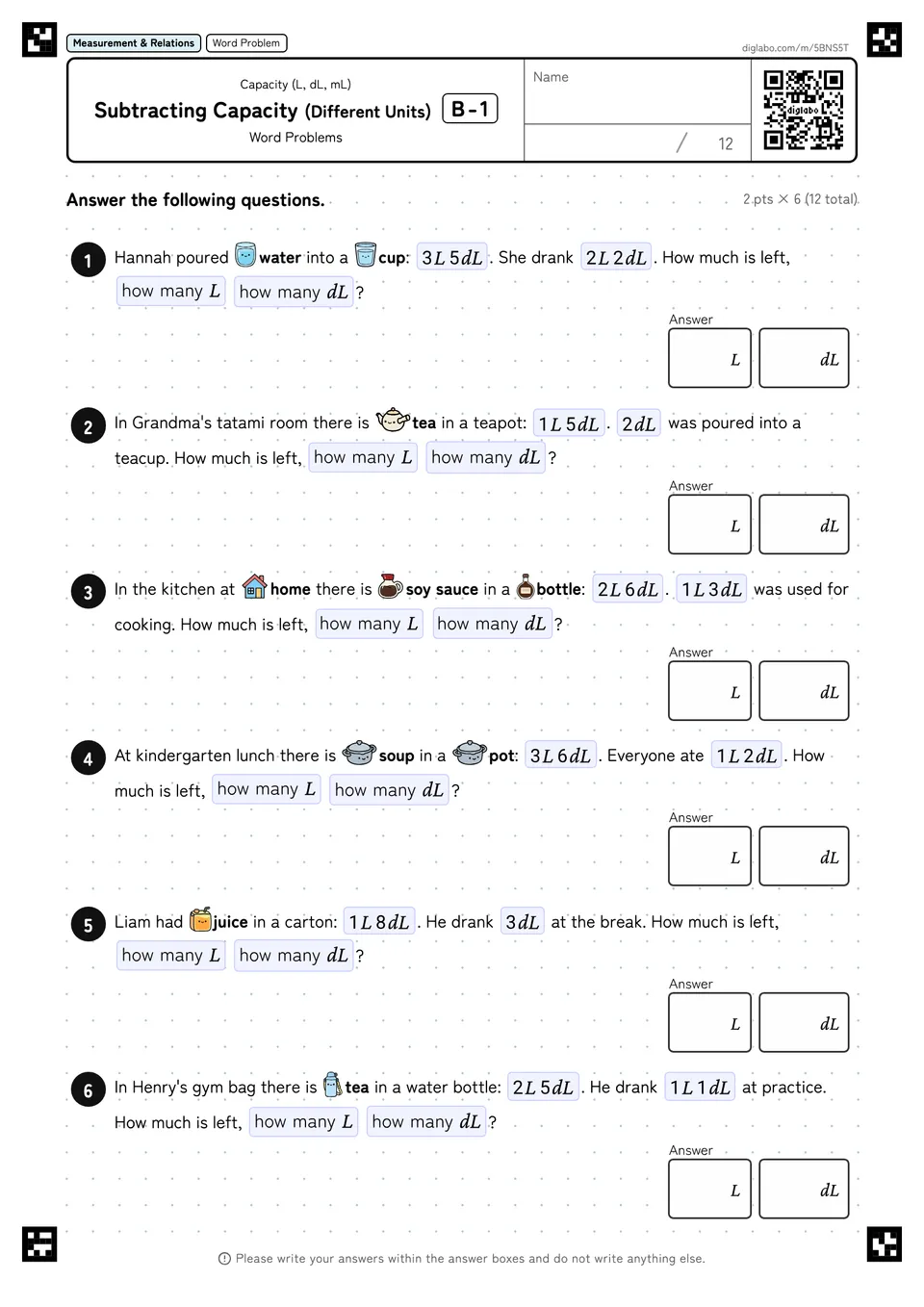
Subtraction (With Borrowing)
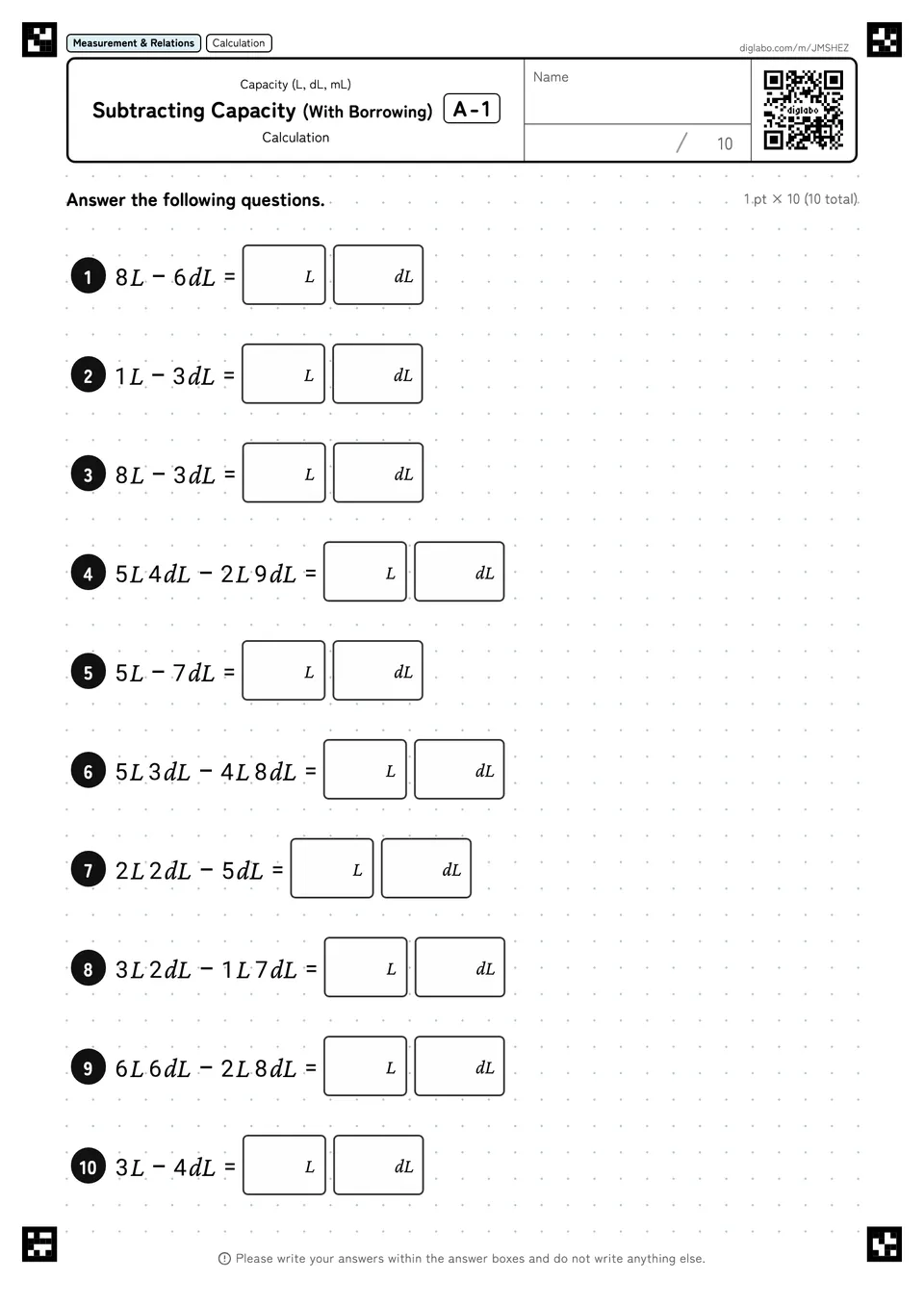
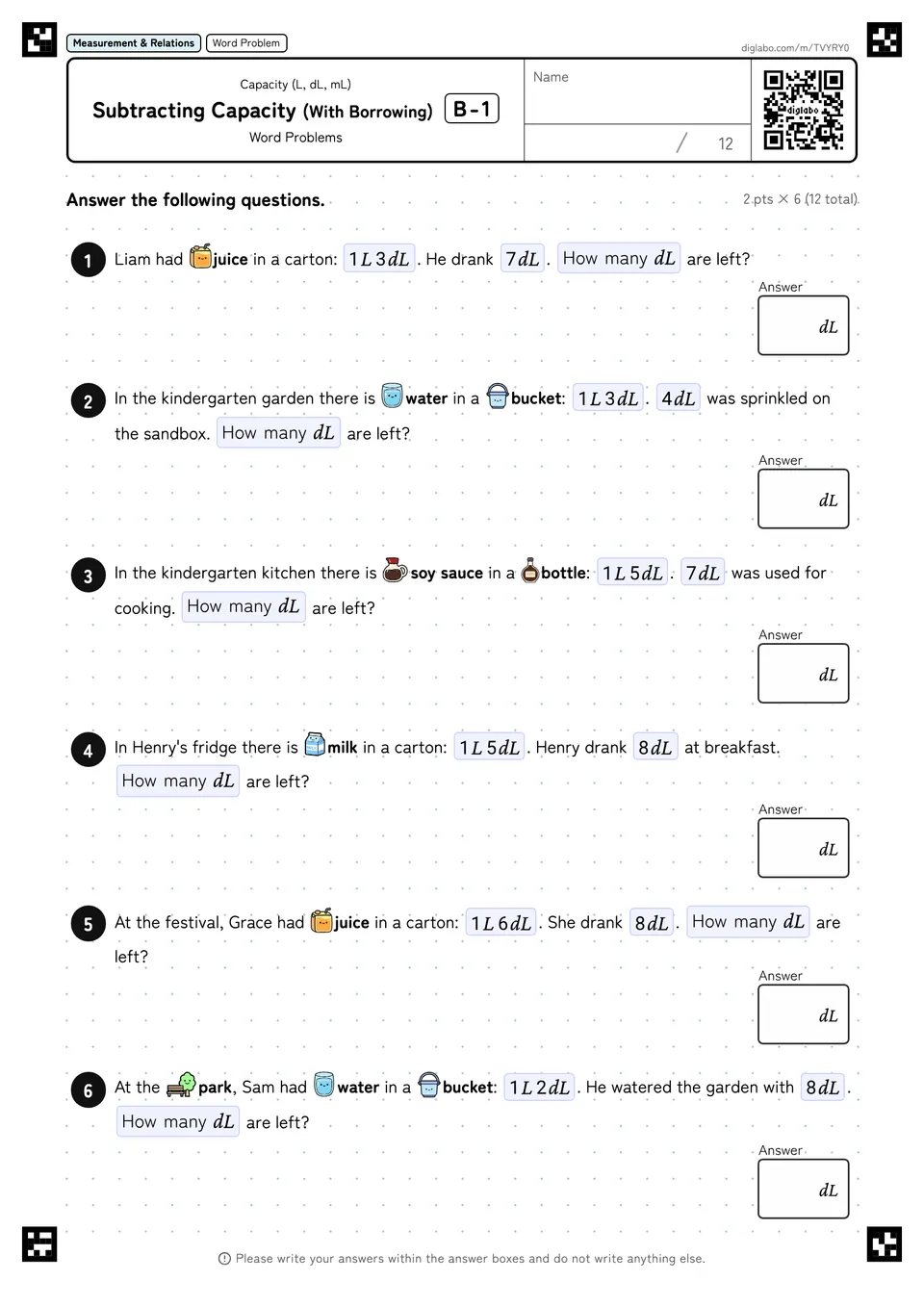
Summary Prints
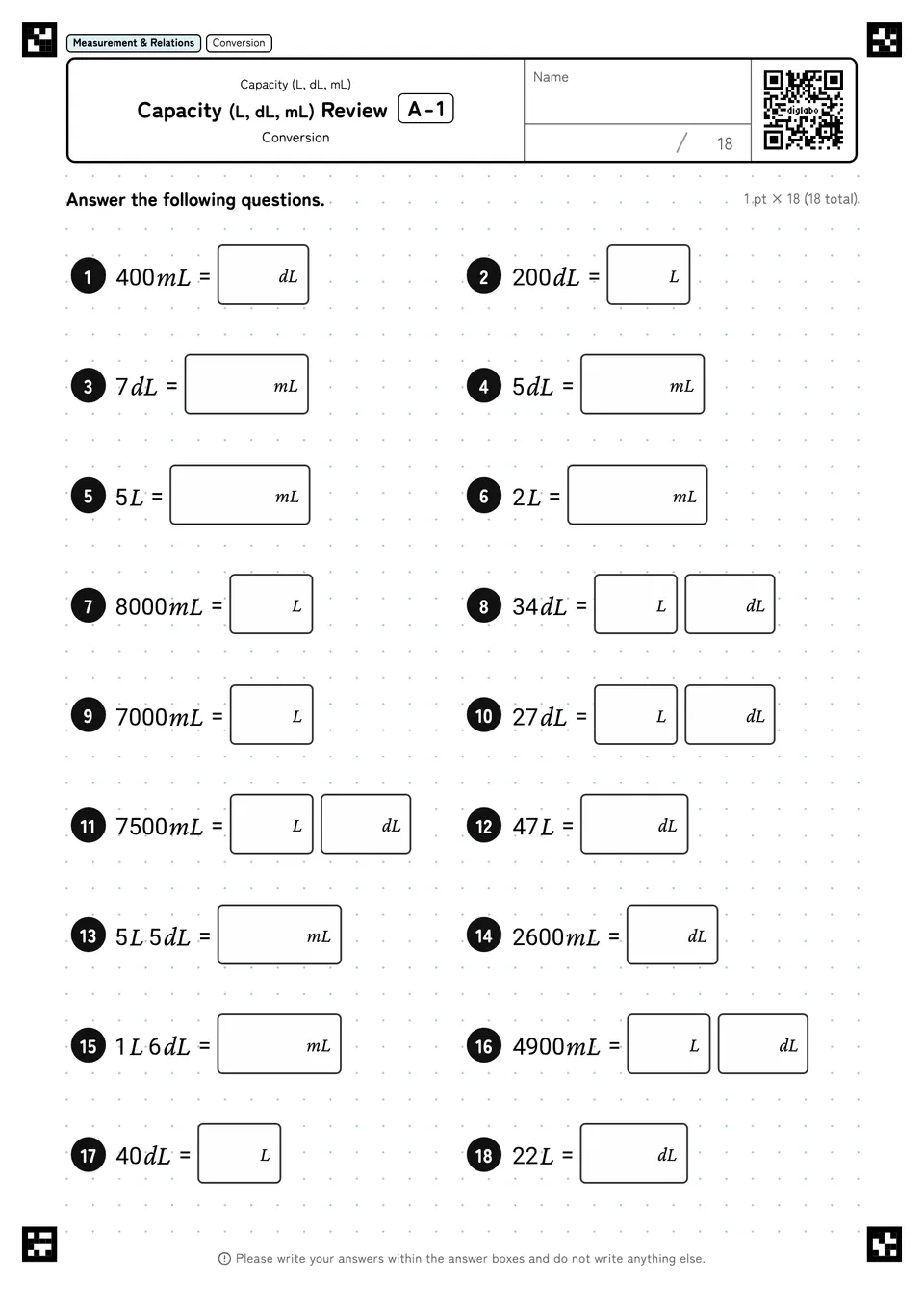 5
5Conversion
- Units (L, dL, mL) · L→dL2 questions
- Units (L, dL, mL) · dL→L2 questions
- Units (L, dL, mL) · L→mL2 questions
- Units (L, dL, mL) · mL→L2 questions
- Units (L, dL, mL) · dL→mL2 questions
- Units (L, dL, mL) · mL→dL2 questions
- Units (L, dL, mL) · dL→L, dL2 questions
- Units (L, dL, mL) · L, dL→mL2 questions
- Units (L, dL, mL) · mL→L, dL2 questions
 5
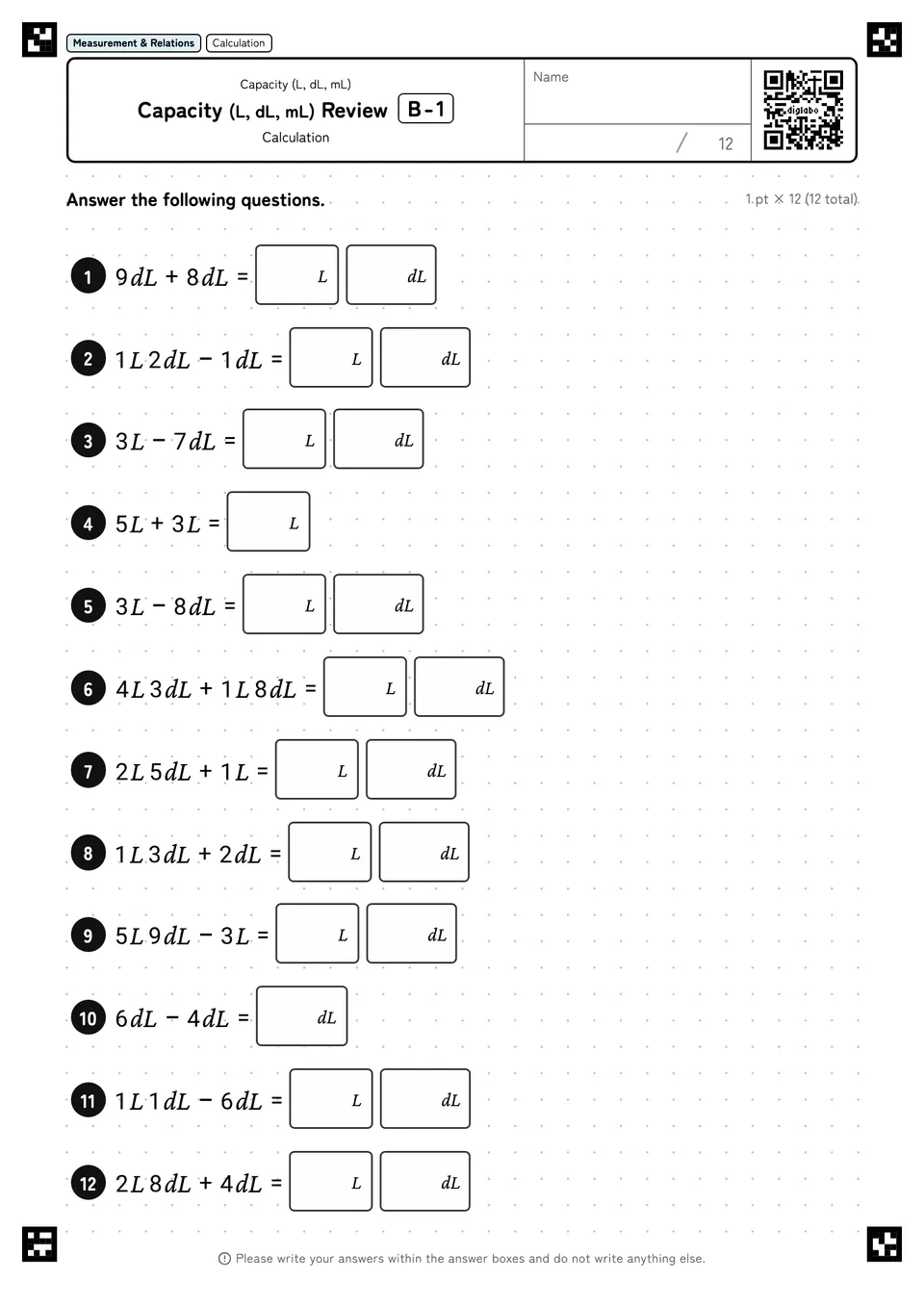
5Calculation
- Addition (Same Units) · Equations1 question
- Addition (Different Units) · Equations2 questions
- Addition (With Carrying) · Equations3 questions
- Subtraction (Same Units) · Equations1 question
- Subtraction (Different Units) · Equations2 questions
- Subtraction (With Borrowing) · Equations3 questions
 5
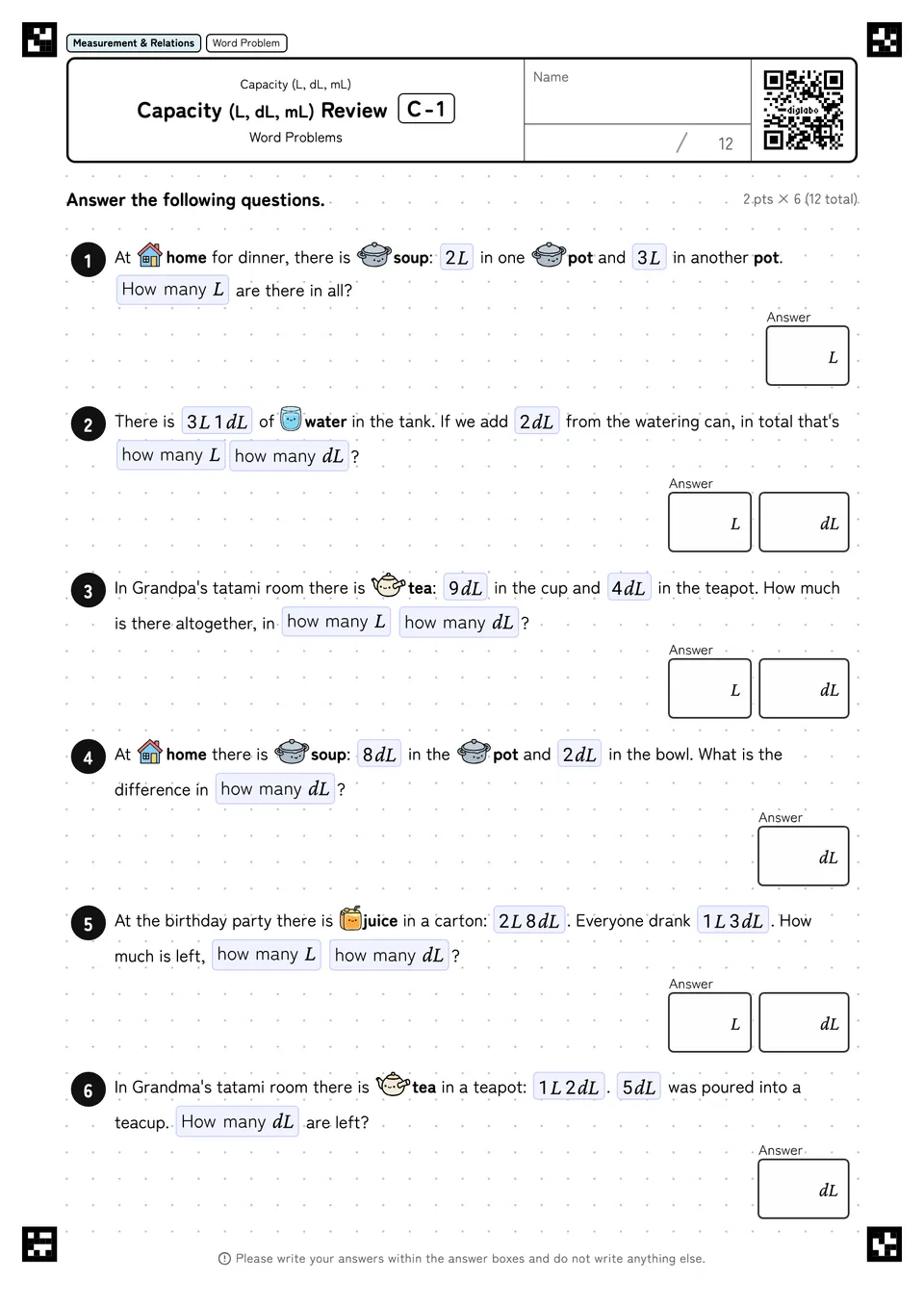
5Word Problems
- Addition (Same Units) · Word Problems1 question
- Addition (Different Units) · Word Problems1 question
- Addition (With Carrying) · Word Problems1 question
- Subtraction (Same Units) · Word Problems1 question
- Subtraction (Different Units) · Word Problems1 question
- Subtraction (With Borrowing) · Word Problems1 question
Related study guides
- Learning Units of Length and Capacity — Build a Feel for Quantity Before Conversion
They know 1 L = 10 dL but freeze on the problem. Unit trouble isn't a memory gap — it's the missing feel for what 1 dL or 1 cm actually is. Here's how to build it at home.
Frequently asked questions
- What do the “Capacity (L, dL, mL)” worksheets for Grade 2 (Elementary School) practice?
- They cover problems such as Measuring Capacity (Counting Containers), Measuring Capacity (Total on the Scale), Measuring Capacity (Reading the Scale), L→dL, dL→L, L→mL, mL→L, dL→mL.
- How many “Capacity (L, dL, mL)” worksheets are there for Grade 2 (Elementary School)?
- 52 worksheets are free to use. Every one is a printable PDF and comes with an answer key.